

Illustrative patient and clinician discussing assessment of a retained tooth root
Specialized Care

Retained Root Removal in Burlington

A hard sliver your tongue keeps finding where a tooth used to be might be bone, old filling material or a piece of root. From Burlington, you can have it examined and hear plainly what, if anything, needs to be done.

The spot your tongue won’t leave alone

Sharp, small, and hard to ignore.

It often starts with the tongue. Weeks or years after a tooth is gone, something hard and slightly rough seems to press through the gum. It could be a fragment of root, a small ridge of bone, or leftover restorative material. Other retained roots never announce themselves and turn up only on an X-ray.

Knowing it is a root still does not tell you what to do. The decision rests on symptoms, signs of infection or decay, where the piece is, and what reaching it would involve. A rough root edge sitting just under thin gum is not the same problem as a deep tip near a nerve, where surgery could do more harm than good.

If you are travelling in from Burlington, a quick phone description helps us suggest how soon to come. Tell us when the tooth was removed, by whom, and what was said afterward. Any notes or images are useful. At the visit we can explain what the hard spot is and whether an oral surgeon should be part of the plan.

Have the sharp spot checked
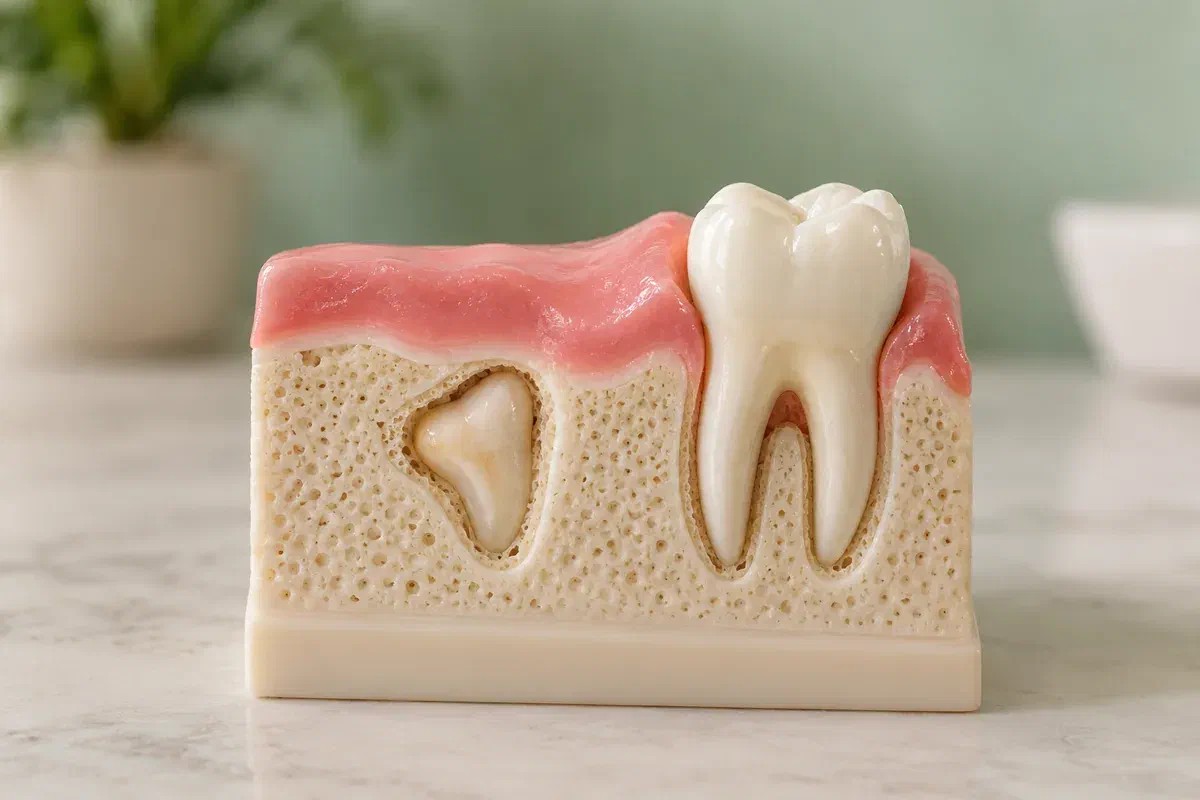
Illustrative cutaway teaching model showing a buried root fragment beside an intact tooth
When to bring it up

Is it the root, or something else? An exam sorts that out.

You do not have to identify the hard spot yourself. Describe how it feels, when it started and anything you were told after the extraction, and the clinician will take it from there.

Pain or swelling around the hard spot

If the area is sore, puffy or leaking, mention it, and say whether it has happened before. A temperature or swelling that keeps spreading should be raised as soon as you call. The exam decides where symptoms come from, because tenderness close to a fragment is not proof it is the culprit.

Rubbing, scraping or catching

Notice whether the edge scrapes your tongue or cheek, presses on an appliance, or makes the toothbrush awkward to use there. Resist the urge to nudge or pull it out. Root, bone and filling material can feel alike, and handling them at home can cause bleeding or injury.

An upcoming replacement for that gap

If a bridge, denture or implant is being planned, the hard spot may matter to that plan or it may not. Ask what the clinician needs to know to decide. A root showing up during planning is a prompt for assessment, not an automatic reason to operate.

Swelling that spreads quickly, difficulty swallowing or breathing, or bleeding that will not stop are medical emergencies: call 911 or go to emergency care. For an urgent dental concern without those warning signs, call the clinic about the earliest suitable assessment.

Why an examination helps

Find out what the edge is before deciding what to do with it.

Once the hard spot is identified, the consultation turns to a simple balance: is removal more likely to help than to harm? You should hear the specific problem treatment would address, the likely course if it is left, and the risks that belong to the procedure itself. A good recommendation is built on your findings, not on habit.

Removing a sharp fragment can make the area comfortable while leaving a wider question unanswered, such as whether the gap should be filled. Keep the two decisions distinct. Raise whether healing time or a later reassessment is expected, what restorative work might follow, and who will coordinate that once the immediate problem is settled.

Patient information: York and Scarborough Teaching Hospitals — retained fragments and surgical risks

Knowing exactly what you are feeling

An exam and, where useful, imaging can show whether the edge is root, bone or something else, and how it sits beside other structures. Ask to have the result explained simply. An extra image is worth taking only if it would change what you and the clinician decide.

A sensible choice of treatment setting

Where the fragment is, how easily it can be reached, your medical history and the procedure involved all shape who should treat it. You can ask directly why it suits this clinic or why a surgeon is recommended, and what information the referral would carry.

Guidance if the fragment is left alone

If watching is the advice, find out how and when it will be checked and which changes should bring you back sooner. Note the decision for future dental visits. A monitored fragment still deserves attention if swelling or soreness appears.

Your visit, in order

Listen, look, explain, then act only if it makes sense.

Tell the team if your earlier extraction was uncomfortable or left you nervous about more work. That context helps the clinician explain each stage clearly and arrange support during the appointment.

  1. Background: the extraction, the spot and your health

    Describe the extraction, when the hard area appeared, and anything unusual about healing. Your medication list and health conditions are reviewed, including bone-related treatment or earlier radiation to the jaws. Never stop a prescribed medicine on your own; changes must be directed by the clinician who manages it.

  2. A close examination of the area

    The clinician checks the gum, nearby teeth and any available records, then explains the likely cause. Imaging is used if it informs the decision. Ask whether the piece is easy to reach, whether nearby structures make removal more involved, and whether a specialist should assess it.

  3. A side-by-side look at the options

    Go over why treatment might help, what it should achieve, the alternatives and the meaningful risks. If removal is proposed, find out whether surgical access is expected and what pain control will be used. Confirm the agreed plan in advance and how an unexpected finding would be handled and shared.

  4. Treatment, if agreed, and written aftercare

    Removal depends on where the fragment sits and may mean reaching it through the gum. Afterward, ask what was done, whether stitches were placed, and whether a follow-up visit is needed. Leave with written instructions and know what happens next if the gap is to be restored.

Once the fragment is out

A smooth recovery depends on leaving the site alone.

Recovery depends on the access needed, the root’s location and anything else done during the visit. Follow the written advice from your treating team rather than a routine from a previous extraction.

No exploring with tongue, finger or tools

It is tempting to check the area, especially if it used to feel sharp. Try not to pick, pull at stitches or probe. Keep to the cleaning, eating and activity advice you were given, and if a new edge appears, tell the team instead of handling it.

Prescriptions taken as instructed

Clarify how to take anything prescribed and let the team know about a possible reaction or difficulty. Leftover antibiotics are not a substitute, and blood-thinning medicine is never altered without the prescriber’s direction. After sedation, its own rules for transport, supervision and activity apply regardless of how you feel.

Follow-up kept, worsening symptoms flagged

Check whether the site needs a planned review and when replacing the tooth can be discussed. Call about pain or swelling that is building, bleeding that continues, or changed sensation that is not easing. A future appointment does not mean waiting while things get worse.

What happens to the fragment

Out, observed, or seen by a specialist

The best approach depends on the fragment and your health. Weigh the likely benefit against the risks, and ask what finding would change the recommendation.

When symptoms, disease or the treatment plan justify it

Removal of a problem fragment

After assessment, the clinician may advise taking the piece out. Some removals are simple; others need surgical access. Ask what removal is meant to resolve, whether more treatment follows, and which complications are relevant to this particular fragment rather than to extractions in general.

When leaving the fragment is the safer balance

Watching it, with a written record

A piece may be left when removing it carries more risk than it is worth. That needs an individual judgement; a lack of pain alone does not decide it. Learn what is known, how it will be reviewed, and which changes mean you should come back.

When the root’s depth, location or your health adds complexity

A referral to an oral surgeon

A specialist can assess a deep fragment or one near important structures. Clarify what the referral needs to answer and whether your records will be forwarded. In the meantime, follow the interim advice and let us know about any change in symptoms or general health.

Questions about that hard spot

What people want to know when something feels sharp

Not having old records is no reason to hold off. Share what you remember about the extraction and the questions on your mind, and we can work through them together.

(905) 876-4488
Could the sharp thing in my gum be bone rather than root?
Yes. After an extraction, a small edge of bone can sometimes work through the gum and feel very similar to a fragment of tooth. Leftover filling material is another possibility. An examination, sometimes with an image, tells them apart and guides what, if anything, needs to be done.
Can a root work its way up through the gum by itself?
Sometimes a fragment becomes more noticeable as tissues change over time, but this varies and is not something to wait out or help along. If you can feel a new hard area, avoid touching it and arrange an assessment so the clinician can see what is happening.
Is it okay to wiggle out a loose tip with my fingers?
It is safer not to. You cannot see what the piece is attached to, and pulling at it can cause bleeding or injury. Leave it alone and book an assessment, mentioning whether it is painful, sharp or getting in the way of eating so the urgency can be judged.
Will removing a small sharp fragment need stitches?
It depends on the size of the fragment, where it sits and how it is reached. Some small pieces come out with little disturbance to the gum; others need more access and may be closed with stitches. The clinician will explain the approach before treatment and what aftercare it involves.
Do antibiotics get rid of a fragment that is causing soreness?
No. Antibiotics cannot remove a physical piece of root, and they are not needed for every retained fragment. The clinician first works out what is causing the soreness and whether local treatment is required. Avoid using leftover antibiotics, and keep the assessment even if symptoms ease.
Can I mention the sharp spot at my regular cleaning instead of making a separate trip from Burlington?
You can, if it is not painful, swollen or interfering with eating, and the cleaning is coming up soon. If it is sore, spreading, or bothering you day to day, call sooner rather than waiting. Either way, telling us ahead of time lets us plan enough time to look at it.
Retained-root concerns from Burlington

Tell us what you feel. We will find out what it is.

Get in touch about a hard spot, a possible retained root, or one you have already been told about. Share any symptoms, the history of the extraction and any replacement plans, so we can talk about the right assessment and what to bring.

Call if symptoms are urgent. Any recommendation on treatment or referral follows examination.

Visit Milton Dental Clinic
Unit 1, 342 Bronte St. S, Milton, ON L9T 5B7
Get directions Clinic hours
Monday–Thursday
11am–7pm
Friday–Sunday
By appointment only

Areas we serve

  • Milton
  • Oakville
  • Mississauga
  • Georgetown
  • Halton Hills
  • Acton
  • Campbellville
  • Brampton
  • Burlington
  • Puslinch
  • Rockwood
  • Erin
  • Caledon
  • Etobicoke
  • Old Milton
  • Bronte Meadows
  • Timberlea
  • Dorset Park
  • Dempsey
  • Clarke
  • Beaty
  • Coates
  • Harrison
  • Scott
  • Willmott
  • Ford
  • Bowes
  • Cobden
  • Walker
  • Mountain View
  • Milton Heights
  • Hawthorne Village
  • Valley View
  • Fallingbrook
  • Nassagaweya
  • Trafalgar
  • Esquesing
  • Nelson
  • Brookville
  • Moffat
  • Glen Williams
  • Norval
  • Limehouse
  • Stewarttown
  • Ashgrove
  • Hornby
  • Silver Creek
  • Speyside
  • Scotch Block
  • North Oakville
  • River Oaks
  • Glen Abbey
  • West Oak Trails
  • Palermo
  • Bronte Creek
  • College Park
  • Joshua Creek
  • Uptown Core
  • Preserve
  • Iroquois Ridge
  • Lisgar
  • Meadowvale
  • Meadowvale Village
  • Churchill Meadows
  • Erin Mills
  • Central Erin Mills
  • Streetsville
  • East Credit
  • Creditview
  • Heartland
  • Sheridan
  • Mount Pleasant
  • Credit Valley
  • Huttonville
  • Churchville
  • Springbrook
  • Northwest Brampton
  • Bram West
  • Fletcher's Meadow
  • Fletcher's Creek South
  • Alton Village
  • Orchard
  • Millcroft
  • Headon Forest
  • Tansley
  • Brant Hills
  • Tyandaga
  • Kilbride
  • Lowville
  • Aberfoyle
  • Morriston
  • Arkell
  • Hillsburgh
  • Freelton
  • Carlisle
  • Waterdown
  • Flamborough
  • Mountsberg

How can we help?

Milton Dental Clinic

Have a question about your smile? Choose the option that works best for you.

For urgent dental concerns, please call.
Messages are reviewed during clinic hours.