

Illustrative patient and clinician discussing assessment of a retained tooth root
Specialized Care

Retained Root Removal in Campbellville

If the last extraction was a hard experience, news of a leftover root can bring it all back. From Campbellville, you can talk it through first: what the fragment is, whether anything needs doing, and how a visit could be paced around your comfort.

After a difficult extraction

Talking it through comes before any treatment.

Some extractions go smoothly. Others are long, uncomfortable or end with the news that part of the root could not be retrieved. Later, a retained fragment might show up on an X-ray, start to ache, or come up when you plan a replacement tooth. For many people, the first feeling is dread about going through it all again.

A retained root does not automatically mean more surgery. The decision depends on symptoms, signs of infection or decay, where the fragment sits and what removing it would involve. A small, stable tip near a nerve might be safest left in place, while an exposed root that keeps flaring may be worth treating.

If you are coming from Campbellville, you may prefer a first visit that is only a conversation and an examination. Tell us what happened last time, what you were told about the fragment, and what worries you most. Bring any records. From there we can explain the findings, the options, and whether it makes sense to bring in an oral surgeon.

Start with a conversation
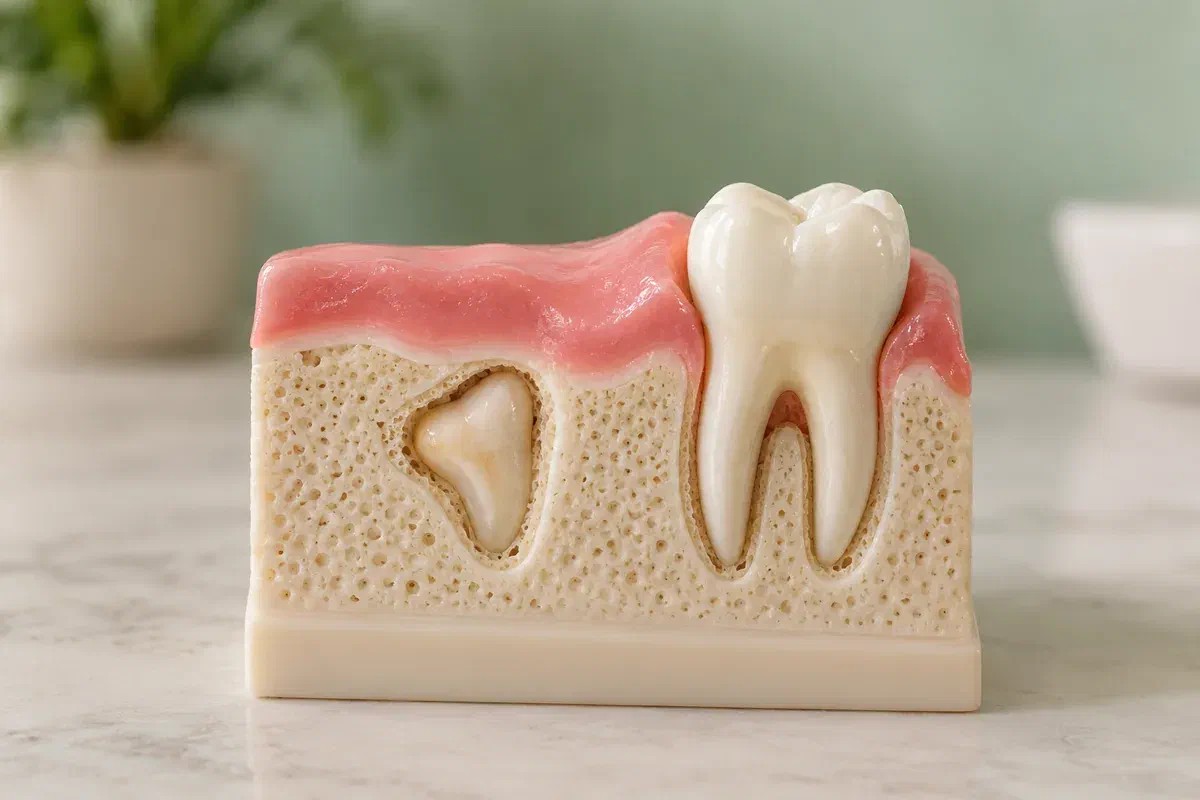
Illustrative cutaway teaching model showing a buried root fragment beside an intact tooth
What might bring you in

A symptom, a sharp edge, or a plan for the gap

You do not need to work out what the root is doing before you call. Describe what you have noticed and anything from the earlier extraction that still worries you, and the clinician will take that into account.

Discomfort or swelling near the old site

Tell us about pain, puffiness or a discharge, and whether it has returned after earlier care. Mention any fever or swelling that seems to be spreading. An examination is needed to find the cause, as soreness in the area may come from the fragment or from something else.

Something hard at the gumline

If you feel a sharp or rough point, please leave it alone rather than trying to remove it yourself. It may be root, bone or a filling material. Note when it appeared and whether it catches your tongue, presses on a denture, or makes brushing awkward.

Planning a bridge, denture or implant

Replacement planning often prompts a closer look at an old site. Ask whether the fragment affects that particular option and what information is still needed. Its presence is considered alongside the plan, not as an automatic reason to operate.

Difficulty breathing or swallowing, fast-moving swelling, or bleeding that is heavy and will not stop requires emergency medical care: call 911. For other urgent dental symptoms, phone the clinic so we can discuss how soon you should be seen.

What a calm assessment offers

Understanding first, decisions second

The consultation is a chance to understand both sides before committing to anything. You should hear what removal would aim to fix, what might happen if the fragment stays, and the risks that come with the procedure itself. Knowing the reasoning, rather than only the recommendation, often makes the next step feel more manageable.

It also separates the fragment from the wider plan for your mouth. Removing a root may settle a sore spot without completing the replacement of the missing tooth. Discuss healing, any reassessment and later restorative work, and ask who will coordinate each stage so nothing feels rushed. There is rarely a need to settle every question in a single appointment, and you are welcome to come back with more.

Patient information: York and Scarborough Teaching Hospitals — retained fragments and surgical risks

A plain explanation of what is there

Appropriate images can show where the fragment lies and what is near it. Ask the clinician to walk you through what they see, in everyday words, and whether further imaging would change anything. Each image should help answer a question about your care.

Honest advice about where treatment should happen

Access, anatomy, medical history and the procedure involved all shape who should treat the root. If you feel more comfortable with a particular approach, say so. Ask why care can happen here or why a referral to a specialist is advised, and what the referral would include.

Reassurance with a plan behind it

If leaving the fragment is the advice, find out how it will be reviewed and which symptoms should prompt a call. Keep a note of the decision for future visits. Monitoring is an active plan, not a reason to ignore a change.

A visit paced around you

No surprises: here is how the appointment works.

Let us know what made the earlier extraction difficult, whether it was pain, the length of the visit or something else. The clinician can explain each stage before it happens, check in as you go, and plan support that suits you.

  1. Begin with your story and health history

    Describe what happened during the earlier extraction and what you were told afterward. The clinician reviews medicines and medical conditions, including treatment that affects bone and any past radiation to the jaw. Keep taking prescribed medicines unless the clinician who prescribes them advises otherwise.

  2. A gentle look at the site

    With your agreement, the clinician examines the gum, neighbouring teeth and any records, explaining as they go. Imaging is suggested only if it helps the decision. Feel free to ask how easy the fragment is to reach, what lies near it, and whether a specialist would be helpful.

  3. Options laid out, no pressure

    You will hear why treatment might help, what it should achieve, the alternatives and the meaningful risks. If removal is proposed, ask whether surgery to reach the root is expected and what comfort measures are available. Nothing proceeds until you have agreed to the plan.

  4. Clear instructions at the end

    How the root is removed depends on where it sits; sometimes the gum is opened slightly to reach it. You will be told what was done, whether stitches were placed and whether a follow-up visit is needed. Written aftercare goes home with you, along with the next step for any replacement.

Healing at home

Simple steps, and a number to call if you are unsure

Recovery depends on the access required, where the root was and any other treatment that day. Follow the written instructions from the treating team; they replace whatever you were told last time.

Let the site rest

It is tempting to check whether everything is gone, but try not to probe the area, pull on stitches or use any tool there. Follow your guidance on cleaning, meals and activity. If a sharp spot appears, call and describe it rather than touching it.

Follow medicine and sedation instructions

Make sure the prescription instructions are clear to you, and mention any reaction you suspect or any trouble following them. Do not use leftover antibiotics, and do not change blood-thinning medicine without direction. If you had sedation, someone needs to take you home and follow the supervision guidance, however well you feel.

Call early if something seems wrong

Find out whether a check is planned and when replacement can be discussed. Get in touch about rising pain, increasing swelling, bleeding that continues or numbness that is not improving. A booked review is not a reason to wait if you are getting worse.

Choices for the fragment

More treatment is only one possibility.

The right path depends on the root, your health and how you feel about treatment. Ask how each option’s benefit compares with its risks.

When symptoms, disease or a planned replacement make it worthwhile

Removing the fragment

The clinician may recommend removal after looking at the site and alternatives. Sometimes it is simple; sometimes it needs surgical access. Ask what removal should achieve, whether more care is needed afterward, and which complications are relevant to your particular root.

When removal would carry more risk than it is worth

Leaving it with planned review

Some fragments are left because disturbing them would do more harm than good. That decision needs an individual assessment, not only the absence of pain. Learn what is known about the root, how it will be followed, and which changes should bring you back.

When depth, anatomy or medical history adds complexity

A specialist’s opinion

An oral surgeon can assess a deep fragment or one close to important structures and help decide whether removal is wise. Ask the clinician to put the purpose of the referral in writing, and check that your X-rays are being forwarded. Follow any interim advice until then.

Questions from Campbellville

What people ask when the last extraction was hard

Complete records are not needed to book. Share what you remember and what concerns you, and we will answer as clearly as we can.

(905) 876-4488
Can I have an assessment without agreeing to treatment?
Yes. An assessment is a chance to understand the situation and the options. Nothing is done without your consent, and you can take time to think about the recommendation or ask for a specialist opinion before deciding.
Is removing a retained root usually as hard as the original extraction?
Not necessarily. It depends on where the fragment sits, how it is reached and your individual anatomy. Some removals are brief and straightforward; others need more access. The clinician can explain what is likely in your case before you decide.
What can be done to help if I feel very anxious?
Tell the team when you book and at the start of the visit. The clinician can explain each step, agree on a signal to pause, and discuss comfort options, including whether sedation is appropriate. Some people prefer to bring a support person.
Did my previous dentist make a mistake by leaving part of the root?
Not necessarily. Roots can break during removal, and sometimes leaving a small piece is safer than continuing to search for it. The earlier records may explain the decision. Today the focus is on the fragment’s current condition and what, if anything, should be done.
Can I take my time deciding after the assessment?
Usually, yes, unless there are signs of infection or other symptoms that need prompt treatment. Ask the clinician how urgent the situation is and what to watch for while you decide. Call sooner if you notice new pain or swelling.
What if the clinician recommends leaving the fragment alone?
Then you should leave with a clear explanation of why, a note of where the fragment is, and a plan for review. Keep this information for future dental visits, and call if you notice new symptoms near the site.
Book from Campbellville

Come for a conversation first, if that helps.

Get in touch about a retained root you have been told about, or one you suspect. Let us know about your symptoms, the earlier extraction and any plans for a replacement, and we can arrange an assessment at a pace that suits you.

Call us about urgent symptoms. Advice on treatment or referral follows an examination.

Visit Milton Dental Clinic
Unit 1, 342 Bronte St. S, Milton, ON L9T 5B7
Get directions Clinic hours
Monday–Thursday
11am–7pm
Friday–Sunday
By appointment only

Areas we serve

  • Milton
  • Oakville
  • Mississauga
  • Georgetown
  • Halton Hills
  • Acton
  • Campbellville
  • Brampton
  • Burlington
  • Puslinch
  • Rockwood
  • Erin
  • Caledon
  • Etobicoke
  • Old Milton
  • Bronte Meadows
  • Timberlea
  • Dorset Park
  • Dempsey
  • Clarke
  • Beaty
  • Coates
  • Harrison
  • Scott
  • Willmott
  • Ford
  • Bowes
  • Cobden
  • Walker
  • Mountain View
  • Milton Heights
  • Hawthorne Village
  • Valley View
  • Fallingbrook
  • Nassagaweya
  • Trafalgar
  • Esquesing
  • Nelson
  • Brookville
  • Moffat
  • Glen Williams
  • Norval
  • Limehouse
  • Stewarttown
  • Ashgrove
  • Hornby
  • Silver Creek
  • Speyside
  • Scotch Block
  • North Oakville
  • River Oaks
  • Glen Abbey
  • West Oak Trails
  • Palermo
  • Bronte Creek
  • College Park
  • Joshua Creek
  • Uptown Core
  • Preserve
  • Iroquois Ridge
  • Lisgar
  • Meadowvale
  • Meadowvale Village
  • Churchill Meadows
  • Erin Mills
  • Central Erin Mills
  • Streetsville
  • East Credit
  • Creditview
  • Heartland
  • Sheridan
  • Mount Pleasant
  • Credit Valley
  • Huttonville
  • Churchville
  • Springbrook
  • Northwest Brampton
  • Bram West
  • Fletcher's Meadow
  • Fletcher's Creek South
  • Alton Village
  • Orchard
  • Millcroft
  • Headon Forest
  • Tansley
  • Brant Hills
  • Tyandaga
  • Kilbride
  • Lowville
  • Aberfoyle
  • Morriston
  • Arkell
  • Hillsburgh
  • Freelton
  • Carlisle
  • Waterdown
  • Flamborough
  • Mountsberg

How can we help?

Milton Dental Clinic

Have a question about your smile? Choose the option that works best for you.

For urgent dental concerns, please call.
Messages are reviewed during clinic hours.