

Illustrative patient and clinician discussing assessment of a retained tooth root
Specialized Care

Retained Root Removal in Mississauga

Told after an extraction that a small piece of root stayed behind? It is a common worry and a fair question. We can review what happened, check the site now, and explain whether removal, observation or a surgeon’s view fits, for adults coming from Mississauga.

A second look after an extraction

Something stayed behind. Now what?

Hearing that part of a root remained after a tooth was pulled can be unsettling. In practice it happens for several reasons: roots are sometimes curved or brittle and fracture, and a clinician may decide that a tiny remaining tip is safer left than chased. Other fragments are simply what is left of a tooth that broke apart from decay.

None of that settles what should happen today. A fresh assessment considers whether there is pain, infection or decay, where the fragment sits, and what removing it would risk. A loose, exposed piece that keeps irritating the gum calls for a different plan than a deep sliver lying beside a nerve canal.

For people coming from Mississauga, it saves a trip to send or bring any paperwork from the extraction first. Let us know who did it, roughly when, and what explanation you received. Images are especially useful. We can then go over the assessment and talk openly about whether an oral surgeon should review the site.

Request a second look at the site
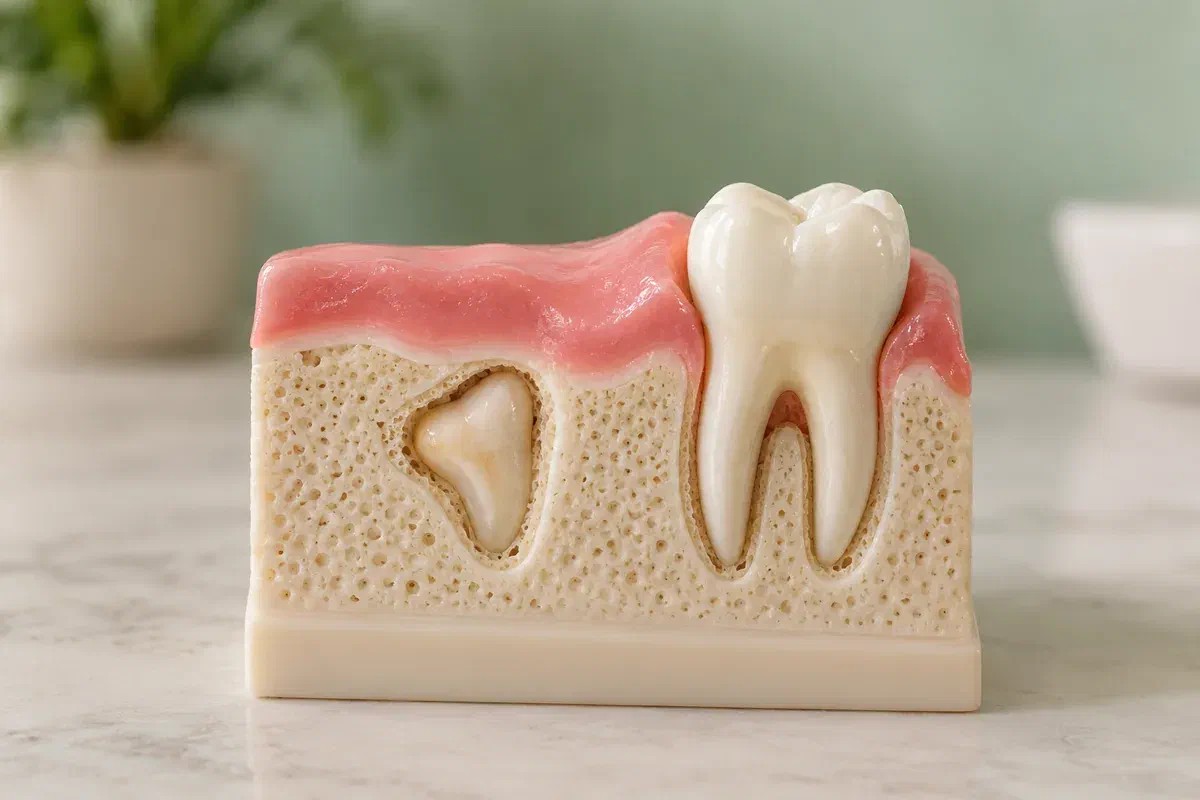
Illustrative cutaway teaching model showing a buried root fragment beside an intact tooth
What might prompt the visit

Worry, symptoms or a plan, any of these is reason enough.

Diagnosing the fragment is the clinician’s job, not yours. Tell us what you have noticed, what the previous office said, and what you hope to do with the space next.

Discomfort that has not settled

Lingering ache, swelling or a discharge near the site are worth describing, including whether they eased and returned. Mention a fever or swelling that is getting bigger when you call. An examination is needed to pin down the cause, since pain in the area could have another source.

A rough piece you can feel

If there is a hard edge at the gum, leave it be, without fingernails or tweezers. It may be root, bone or a material from earlier work. Tell the team when you first felt it and whether it bothers your tongue, an appliance or your brushing.

Deciding what goes in the gap

Plans for an implant, bridge or denture often lead to a closer review of where the fragment sits. Ask whether it matters for the option you are considering and what information is still missing. Being present is not, on its own, a reason to operate.

If breathing or swallowing becomes difficult, swelling spreads rapidly or bleeding is heavy and uncontrolled, call 911 or seek emergency medical care straight away. Urgent dental problems without these signs should be phoned through to the clinic so we can discuss timing.

What you gain from a fresh assessment

Facts about the fragment, not guesses about the past

A second assessment is about the root in front of the clinician today. You should come away knowing what removal would aim to fix, what would likely happen if the fragment stays, and the risks attached to the procedure. That advice should be specific to your site, because leftover pieces vary widely in how they behave.

It can also untangle the immediate question from the bigger one. Taking a fragment out may settle a sore spot but still leave a gap to be planned. Ask about healing, whether the area will be reassessed, what restorative work might follow, and who will be responsible for coordinating it.

Patient information: York and Scarborough Teaching Hospitals — retained fragments and surgical risks

A straightforward account of the fragment’s position

Appropriate images may show where the root lies and what is close to it. Ask the clinician to walk you through what they see and whether another image would make a difference. Imaging is useful when it answers a real question, not as routine reassurance.

An honest view on who should treat it

Ease of access, anatomy, health history and the procedure required all influence the right setting. Feel free to ask why treatment can happen in a general practice or why referral is advised. Referrals should state their purpose and include what is already known.

A concrete plan if the fragment stays

If leaving it is advised, find out when it should be rechecked and which symptoms mean calling earlier. Keep a written note of the decision. Observation is an active choice that still responds to swelling, pain or any other change.

How we approach a second opinion

Gather the story. Check the site. Agree on a path.

If you are making the trip from Mississauga and the first extraction was stressful, or left you uneasy about further treatment, tell us early. That helps the clinician explain things at your pace and plan support for the visit.

  1. Your account, your records and your health

    Explain when the tooth was removed and what you were told about the fragment. The clinician reviews medicines and medical conditions, including any bone-related therapy or past radiation to the jaw. Please continue prescribed medicines unless the clinician responsible for them advises a change.

  2. An examination with relevant imaging

    The gum, the surrounding teeth and any records are assessed before the likely picture is explained. New images are taken only if they inform the decision. You can ask how accessible the fragment is, whether nearby structures affect removal, and whether a specialist should look.

  3. An open discussion of the choices

    The reason for treatment, the expected benefit, the alternatives and the important risks are covered. If removal is suggested, find out whether a surgical approach is anticipated and how comfort will be managed. Confirm what is agreed before starting and how surprises during treatment would be explained.

  4. Treatment and instructions, when appropriate

    If the fragment is removed, the method depends on its location and can involve accessing it through the gum. Ask what was done, whether stitches were used, and whether a follow-up is planned. Keep the written aftercare and confirm what comes next for replacing the tooth.

Recovery after the fragment is removed

Follow this site’s instructions, and speak up about change.

Healing varies with the access required, the fragment’s location and any other treatment done. The written advice you receive now supersedes whatever you were told after the earlier extraction.

Give the site space to heal

Do not pick at it, tug at stitches, or try to check for leftover pieces with anything sharp. Follow the cleaning, food and activity guidance you were given. If you notice a new hard edge, let the team know instead of dealing with it at home.

Take only what was prescribed

Make sure the medicine instructions are clear, and report any suspected reaction or difficulty. Do not start leftover antibiotics or adjust a blood thinner without direction. If sedation was part of the visit, follow its transport, supervision and activity rules even if your mouth feels normal.

Report a worsening course promptly

Confirm whether a review is booked and when tooth replacement can be revisited. Call about pain or swelling that is increasing, bleeding that persists, or numbness that is not improving. Waiting for the scheduled check is not the right move if things are deteriorating.

Options for a fragment left behind

Three reasonable responses, each with a rationale

No single answer fits every root. Weigh the likely benefit of each option against its risks, and ask what new findings would change the recommendation.

When pain, infection or your restorative goals make a case for it

Taking out a fragment that needs it

The clinician may advise removal after considering the site and the alternatives. Sometimes it is uncomplicated; sometimes surgical access is needed. Ask what problem removal is meant to solve, what care may follow, and which complications are relevant to your fragment in particular.

When removal would cost more than it gains

Leaving it in place with documented follow-up

A small piece can be left when removing it carries greater risk than benefit. That requires an individual assessment and is not decided by the absence of pain alone. Find out what is known about it, how often it should be checked, and what should prompt another visit.

When depth, location or medical history adds complexity

Specialist review before deciding

An oral surgeon can assess a deeply placed fragment or one near important structures. Confirm what the referral is meant to answer and whether your records will be sent. Until then, follow the interim advice and report any change in symptoms or general health.

Second-opinion questions

Was it a mistake, and what happens next?

Paperwork from the original extraction helps, but you can book without it. Bring your recollection of what happened and any concerns, and the clinician will address them directly.

(905) 876-4488
Should I be worried that a root piece was left after my extraction?
Not necessarily. Roots can fracture, and leaving a small tip is sometimes the safer choice when retrieving it could injure nearby structures. Records may show why it was left. A current assessment looks at the fragment’s condition and position to decide whether anything needs to be done now.
Can I ask the dentist who did the extraction for my records?
Yes. You can request copies of your notes and images from the office that treated you. Bringing them helps the clinician understand what was found at the time and avoids repeating images unnecessarily. If they are not available, an examination still provides a sound starting point.
Is a second opinion appropriate if I already have a treatment plan?
It is reasonable to want to understand a recommendation, especially for surgery. A second assessment can confirm the plan, suggest an alternative, or explain why a referral makes sense. Bring the original proposal so the discussion can address the same questions directly.
Could the leftover piece explain a bad taste near the site?
Possibly, if there is infection or trapped food around it, but other causes are common too, such as gum problems or a neighbouring tooth. Mention the taste, any discharge and how long it has lasted. An examination is needed to identify where it is coming from.
How soon after an extraction can a retained fragment be reassessed?
That depends on your symptoms and what the extracting clinician advised. If there is increasing pain, swelling or drainage, call sooner. Otherwise, a review can be arranged at a time that lets the gum settle enough for a useful examination. Ask what timing makes sense for you.
Will a fragment near a nerve always be left alone?
Not always, but closeness to a nerve is one of the factors that can make leaving a fragment the safer option. The clinician weighs symptoms, infection, access and risk. In more complex cases an oral surgeon may be asked to assess the site before any decision is made.
From Mississauga, a clear next step

One assessment, an honest explanation.

Contact us about a fragment you have been told about or one you suspect. Share your symptoms, the details of the earlier extraction, and any plan for replacing the tooth, and we will discuss a suitable assessment and which records to gather.

Urgent symptoms should be phoned in. Recommendations for treatment or referral follow the exam.

Visit Milton Dental Clinic
Unit 1, 342 Bronte St. S, Milton, ON L9T 5B7
Get directions Clinic hours
Monday–Thursday
11am–7pm
Friday–Sunday
By appointment only

Areas we serve

  • Milton
  • Oakville
  • Mississauga
  • Georgetown
  • Halton Hills
  • Acton
  • Campbellville
  • Brampton
  • Burlington
  • Puslinch
  • Rockwood
  • Erin
  • Caledon
  • Etobicoke
  • Old Milton
  • Bronte Meadows
  • Timberlea
  • Dorset Park
  • Dempsey
  • Clarke
  • Beaty
  • Coates
  • Harrison
  • Scott
  • Willmott
  • Ford
  • Bowes
  • Cobden
  • Walker
  • Mountain View
  • Milton Heights
  • Hawthorne Village
  • Valley View
  • Fallingbrook
  • Nassagaweya
  • Trafalgar
  • Esquesing
  • Nelson
  • Brookville
  • Moffat
  • Glen Williams
  • Norval
  • Limehouse
  • Stewarttown
  • Ashgrove
  • Hornby
  • Silver Creek
  • Speyside
  • Scotch Block
  • North Oakville
  • River Oaks
  • Glen Abbey
  • West Oak Trails
  • Palermo
  • Bronte Creek
  • College Park
  • Joshua Creek
  • Uptown Core
  • Preserve
  • Iroquois Ridge
  • Lisgar
  • Meadowvale
  • Meadowvale Village
  • Churchill Meadows
  • Erin Mills
  • Central Erin Mills
  • Streetsville
  • East Credit
  • Creditview
  • Heartland
  • Sheridan
  • Mount Pleasant
  • Credit Valley
  • Huttonville
  • Churchville
  • Springbrook
  • Northwest Brampton
  • Bram West
  • Fletcher's Meadow
  • Fletcher's Creek South
  • Alton Village
  • Orchard
  • Millcroft
  • Headon Forest
  • Tansley
  • Brant Hills
  • Tyandaga
  • Kilbride
  • Lowville
  • Aberfoyle
  • Morriston
  • Arkell
  • Hillsburgh
  • Freelton
  • Carlisle
  • Waterdown
  • Flamborough
  • Mountsberg

How can we help?

Milton Dental Clinic

Have a question about your smile? Choose the option that works best for you.

For urgent dental concerns, please call.
Messages are reviewed during clinic hours.