

Illustrative patient and clinician discussing assessment of a retained tooth root
Specialized Care

Retained Root Removal in Old Milton

A tooth taken out decades ago can leave questions behind, especially once the old records are gone. For Old Milton households with long dental histories, we examine what remains, explain the options, and say plainly when a surgeon should look.

History that sits under the gum

What was left behind when that tooth came out years ago?

Plenty of people in Old Milton have had their teeth cared for by several dentists over the decades. A retained root can be a quiet trace of that history, either part of a tooth that crumbled long ago or a tip that stayed behind after an extraction. Some fragments cause pain or infection; many are simply found on an image.

The label alone does not decide anything. A clinician looks at symptoms, signs of disease, the fragment’s position and what removal would involve. An exposed, decayed root that keeps getting sore raises different questions than a small piece lying deep beside a nerve, where an operation could carry more risk than leaving it.

Lost records are common when a former dentist has retired or moved, and that is fine. Tell us what you recall about the tooth, roughly when it came out, and whether surgery was ever mentioned. If old images or letters turn up, bring them. From there we can talk about assessment and whether an oral surgery referral is sensible.

Ask about an old extraction site
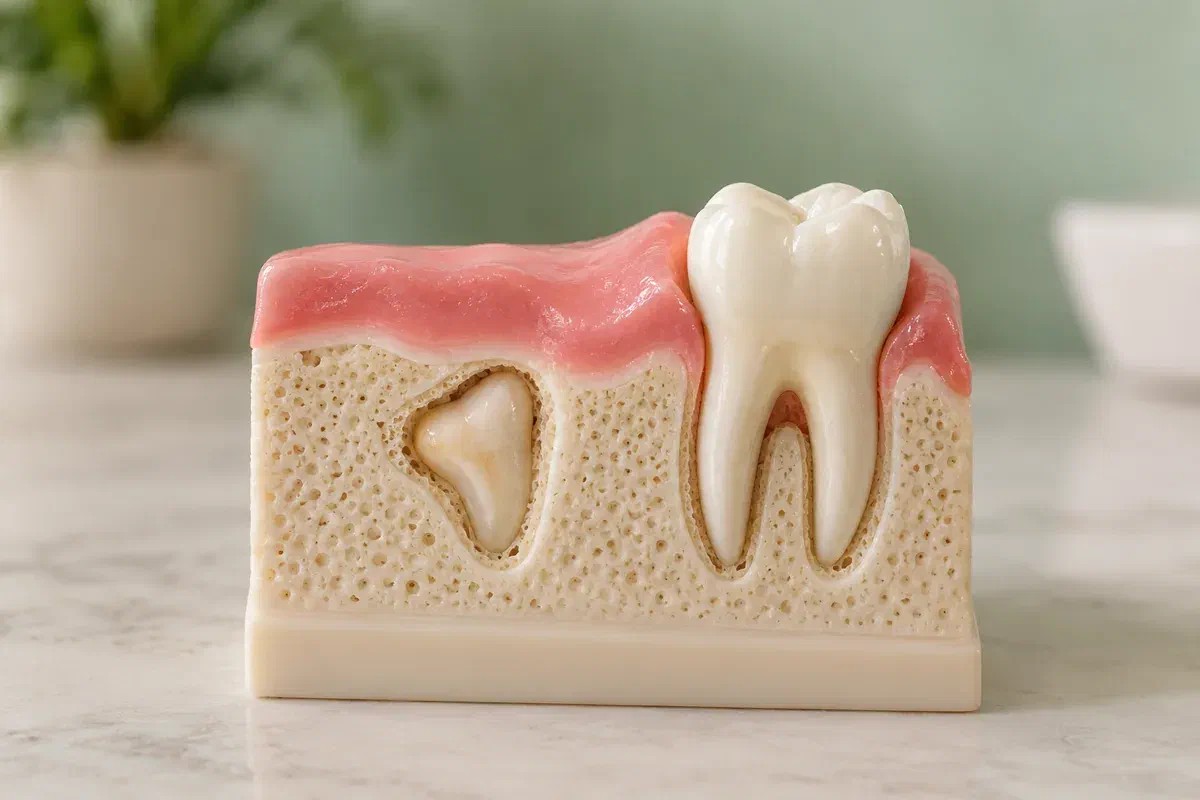
Illustrative cutaway teaching model showing a buried root fragment beside an intact tooth
Signs worth mentioning

Old site, new symptom? Put the two side by side.

You are not expected to know whether a fragment is infected. Describe the change you have noticed and whatever explanation you were once given, and the clinician will assess the area with that in mind.

Ache, swelling or drainage near an old gap

Tell us about any of these and whether they have returned after earlier treatment. Fever or swelling that is spreading should be mentioned on the phone. Only an examination can find the cause, because soreness in that part of the mouth does not mean the old root is behind it.

A hard edge that appeared out of nowhere

Something sharp at the gumline may be root, bone or a restorative material, and it can surface long after an extraction. Keep tweezers and fingernails away from it. Note when you first noticed it and whether it rubs your tongue, interferes with a partial denture, or makes cleaning awkward.

A gap you are finally ready to fill

Deciding on a denture, bridge or implant after years without a tooth often prompts a fresh look at the site. Ask how the root affects that specific option and what needs to be known first. Its presence is assessed together with the plan, not treated as an automatic reason for surgery.

Call 911 for difficulty breathing or swallowing, swelling that is spreading rapidly, or heavy bleeding you cannot control, as these need emergency medical care. If the problem is urgent but none of these signs are present, phone the clinic to ask about assessment availability.

What you can expect to learn

Two sides of the decision, both explained.

The point of a retained-root visit is to set leaving the fragment against removing it. You should understand what treatment would address, what could reasonably happen without it, and what risks the procedure itself brings. Your own findings drive the recommendation, because fragments do not all behave alike, including ones that have sat quietly for decades.

It also helps keep the surgical question apart from tooth replacement. Taking out a root may settle an infection or a sharp spot while the space still needs a plan of its own. Raise healing, any reassessment, further restorative work, and who will organise the next step once the first concern is dealt with.

Patient information: York and Scarborough Teaching Hospitals — retained fragments and surgical risks

Where the fragment sits, in plain terms

Well-chosen images can show the root and how it relates to nearby structures. Ask for the result in everyday language and whether more imaging would alter the advice. A second scan is not better by default; it should answer a question that matters for your care.

Why one setting suits better than another

Access, anatomy, health history and the type of procedure all affect who should treat the root. You are entitled to know why care can happen here or why a surgeon is suggested. A good referral explains its purpose and passes along what the assessment has already found.

Follow-up that has a shape

If removal is not advised yet, find out what review is sensible and which symptoms mean you should get in touch. Keep the decision on record for any future dentist. Monitoring is an active plan, and new swelling or change still deserves a call rather than patience.

Step by step

Piece together the past, then examine the present.

Some people carry a difficult memory from the original extraction. If that applies, or if more treatment makes you anxious, mention it early so the clinician can explain the plan at a pace that suits you.

  1. Start with the tooth’s story and your health

    Describe when the tooth broke or was removed and anything you were told then. Your medicines and conditions are reviewed, including any bone-related treatment or earlier radiation to the jaw. Please do not stop a prescribed medicine on your own; changes come only from the clinician who prescribes it.

  2. Look closely at the site

    The clinician examines the tissues, adjacent teeth and any records before explaining what is likely going on. Images are taken when they help the decision. You can ask whether the root is easy to reach, whether nearby anatomy matters, and whether a specialist view would help.

  3. Lay out the choices

    The reason for treatment, its expected benefit, the alternatives and the meaningful risks are discussed. If removal is advised, find out whether surgery to reach it is expected and what will be done for pain control. Agree on the plan beforehand, including how surprises would be handled and shared.

  4. Finish with clear instructions

    If the root is removed, the method depends on where it lies and may involve working through the gum. Check what was done and whether stitches or another visit are needed. Take home written aftercare, and confirm what comes next if a replacement tooth is still on the table.

In the days after removal

Care for this site, not the one from years ago.

Healing depends on how the root was reached, where it was and what else was done that day. Your new written instructions replace whatever routine you followed after a past extraction.

Leave the healing site in peace

Skip the mirror checks, tongue prodding and any tool to see whether something is still there. Follow the cleaning, diet and activity guidance as written. If a new sharp spot appears, tell the team about it rather than trying to deal with it yourself.

Medicines as prescribed, questions welcome

Make sure you understand any prescription and report a suspected reaction or trouble sticking to it. Old antibiotics from the cabinet are not a substitute, and blood thinners are not changed without direction. Sedation has its own rules about getting home, supervision and activity, whatever your mouth feels like.

Speak up early about a turn for the worse

Check whether a review visit is planned and when tooth replacement can be discussed again. Contact the provider about rising pain or swelling, bleeding that continues, or altered feeling that is not improving. A booked check-up later on is no reason to wait out a deterioration.

Three possible paths

What suits a fragment that has been there a long time?

Age alone does not settle it. Ask how the likely benefit of each approach compares with its risks and which findings would change the advice.

When symptoms, disease or your restorative plan call for it

Taking the root out

Removal may be advised after the site and the alternatives have been assessed. Sometimes it is straightforward; sometimes surgical access is needed. Find out what removal is meant to solve, whether further care follows, and which complications are relevant to this root rather than to extractions in general.

When the risks of removal outweigh what it would achieve

Leaving it, with notes and reviews

A fragment may be left when removing it would cause more problems than it solves. That call rests on an individual assessment, not simply on the absence of pain. Learn what is known about it, how often it should be reviewed, and which changes mean booking sooner.

When anatomy, medical history or access complicates things

Asking an oral surgeon to weigh in

A specialist can assess a deep root or one beside important structures. Clarify the question the referral is meant to answer and whether your records can travel with it. Meanwhile, follow the interim advice and let us know if symptoms or your general health change.

Questions we hear in Old Milton

Questions about a root with a long history

Gaps in the paperwork are normal after years and several dentists. Share what you can remember and which part of the decision you would like explained more clearly.

(905) 876-4488
My previous dentist retired. Can you still assess a root without their records?
Yes. Records help, but an examination and appropriate images can show the current situation. If you can request files from the former practice or its successor, they may add context about why the root remained. Either way, the decision is based on what is found now.
Can a root that has been quiet for twenty years suddenly cause trouble?
It can, though many long-standing fragments never do. Changes in the gum, decay or infection can bring symptoms on later. That is why a monitoring plan names the signs to watch for, such as swelling, pain or drainage, and why new symptoms deserve an assessment.
Was leaving a piece of root ever a deliberate choice?
Sometimes. Roots can break during extraction, and a clinician may have judged that leaving a small tip carried less risk than chasing it. Older records can explain what happened. Today’s assessment looks at the fragment’s condition and position rather than assuming the earlier treatment was at fault.
Does an old root rule out a partial denture?
Not automatically. The clinician considers whether the fragment is causing problems, whether it would sit comfortably under the denture, and whether it affects the fit. In some cases removal is advised first; in others the denture can be planned around it with monitoring.
Will a retained root show up on a regular dental X-ray?
Often, yes, although the type of image depends on where the root sits and what the clinician needs to know. Sometimes a wider or more detailed view helps. Ask what each image is meant to answer, since imaging should serve a clear purpose.
If old antibiotics settled a flare last time, can I take them again?
No. Leftover antibiotics may be the wrong medicine or dose, and they do not remove a root. Symptoms that ease and then return need an examination to find the cause and decide on local treatment or another approach. Please call rather than treating it yourself.
Retained-root visits near Old Milton

Your memory of the tooth is a good place to begin.

Reach out about a root you suspect or one already noted on a past X-ray. Let us know about symptoms, earlier surgery and any replacement you have in mind, and we will discuss which assessment and records make sense.

Urgent symptoms call for a phone call. Treatment or referral advice follows an examination.

Visit Milton Dental Clinic
Unit 1, 342 Bronte St. S, Milton, ON L9T 5B7
Get directions Clinic hours
Monday–Thursday
11am–7pm
Friday–Sunday
By appointment only

Areas we serve

  • Milton
  • Oakville
  • Mississauga
  • Georgetown
  • Halton Hills
  • Acton
  • Campbellville
  • Brampton
  • Burlington
  • Puslinch
  • Rockwood
  • Erin
  • Caledon
  • Etobicoke
  • Old Milton
  • Bronte Meadows
  • Timberlea
  • Dorset Park
  • Dempsey
  • Clarke
  • Beaty
  • Coates
  • Harrison
  • Scott
  • Willmott
  • Ford
  • Bowes
  • Cobden
  • Walker
  • Mountain View
  • Milton Heights
  • Hawthorne Village
  • Valley View
  • Fallingbrook
  • Nassagaweya
  • Trafalgar
  • Esquesing
  • Nelson
  • Brookville
  • Moffat
  • Glen Williams
  • Norval
  • Limehouse
  • Stewarttown
  • Ashgrove
  • Hornby
  • Silver Creek
  • Speyside
  • Scotch Block
  • North Oakville
  • River Oaks
  • Glen Abbey
  • West Oak Trails
  • Palermo
  • Bronte Creek
  • College Park
  • Joshua Creek
  • Uptown Core
  • Preserve
  • Iroquois Ridge
  • Lisgar
  • Meadowvale
  • Meadowvale Village
  • Churchill Meadows
  • Erin Mills
  • Central Erin Mills
  • Streetsville
  • East Credit
  • Creditview
  • Heartland
  • Sheridan
  • Mount Pleasant
  • Credit Valley
  • Huttonville
  • Churchville
  • Springbrook
  • Northwest Brampton
  • Bram West
  • Fletcher's Meadow
  • Fletcher's Creek South
  • Alton Village
  • Orchard
  • Millcroft
  • Headon Forest
  • Tansley
  • Brant Hills
  • Tyandaga
  • Kilbride
  • Lowville
  • Aberfoyle
  • Morriston
  • Arkell
  • Hillsburgh
  • Freelton
  • Carlisle
  • Waterdown
  • Flamborough
  • Mountsberg

How can we help?

Milton Dental Clinic

Have a question about your smile? Choose the option that works best for you.

For urgent dental concerns, please call.
Messages are reviewed during clinic hours.