
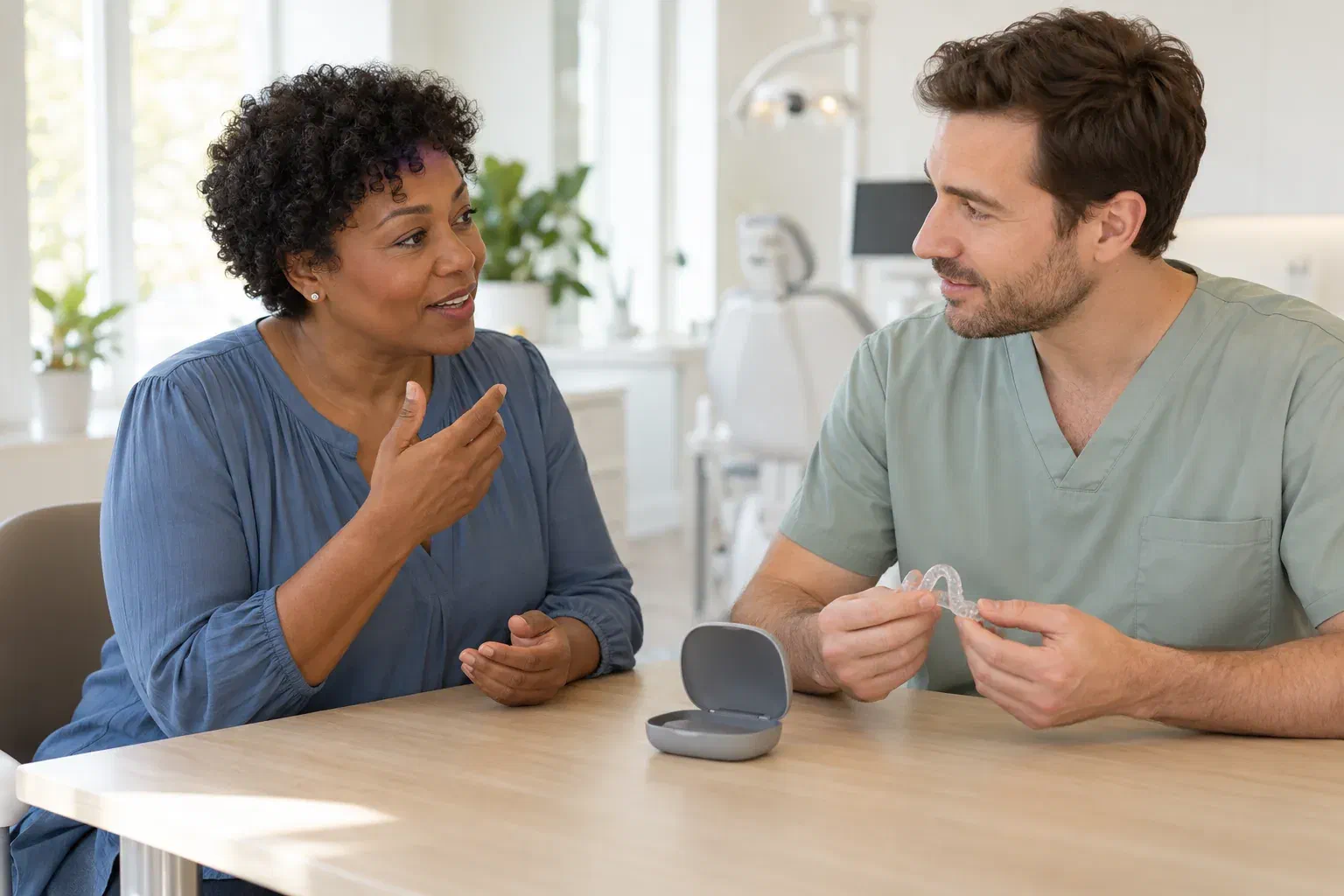
Illustrative discussion about sleep-appliance comfort and fit
Specialized Care

Sleep Appliance Adjustments in Oakville

The first weeks with a new sleep appliance often raise questions about pressure, jaw stiffness, and how far the settings should go. If you are coming from Oakville, a review can look at the device and your mouth together and set out the follow-up any change needs.

Early weeks with a sleep appliance, from Oakville

A new mouthpiece, and a list of small questions

Most people expect a period of getting used to an oral appliance. Still, it can be hard to tell normal settling-in from something that needs attention. Is that pressure on the front teeth part of the process? Is the stiff jaw at breakfast a reason to slow down? Those questions belong in a review, because the answer could involve the fit, a single contact point, or the prescribed position of your lower jaw.

Many new wearers assume that moving the jaw forward faster will bring results sooner. It does not work that way. Extra advancement is not automatically better, and a tighter grip on the teeth is not a measure of effectiveness. Your treatment position has to balance the benefit your sleep physician is looking for with what your mouth can tolerate. Even a device that feels fine has not, by that alone, shown that sleep apnea is controlled.

When you come in, bring the appliance in its case and the paperwork you received at fitting, including any schedule for adjustments. Tell us which office or provider supplied it and what you have noticed so far. We can then talk about an assessment and whether the provider who started your treatment should be involved before anything is altered.

Talk to us about your new appliance
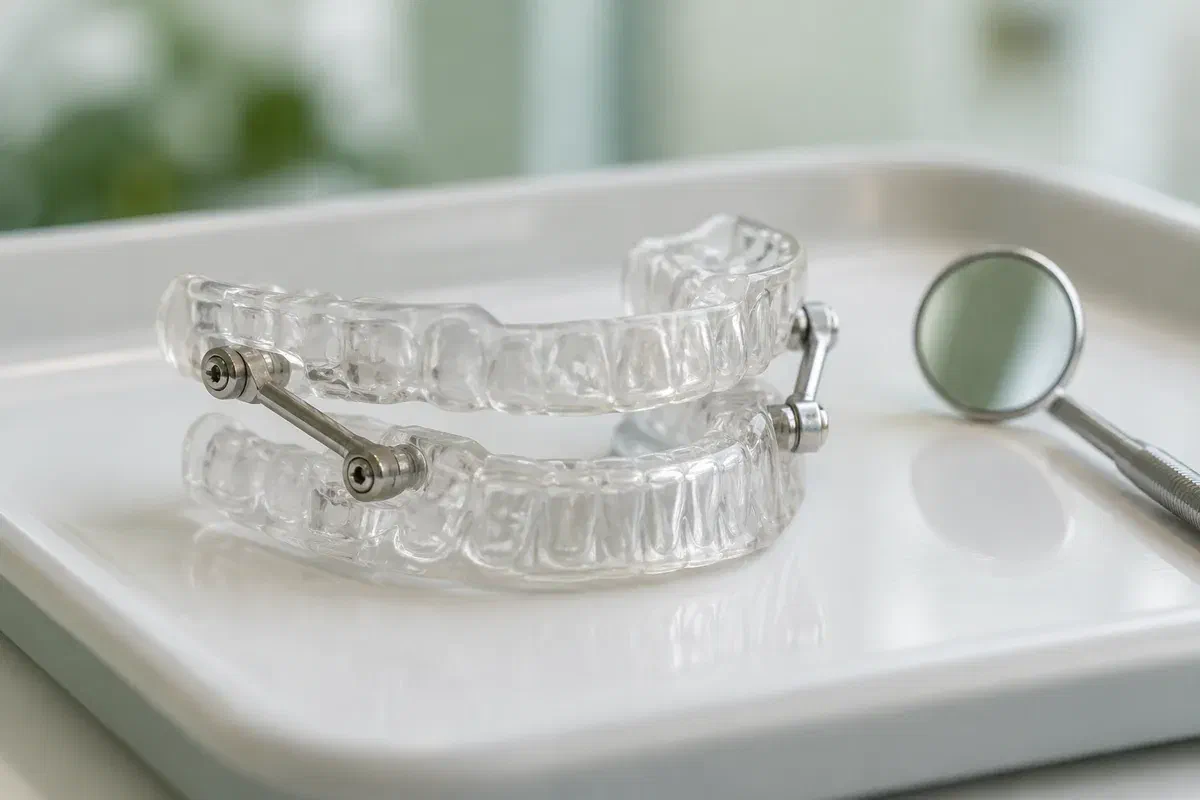
Illustrative connected oral sleep appliance beside a dental mirror
Questions new wearers often bring

Is it settling in, or is something off?

Describe when each symptom shows up and whether anything has changed with your teeth or the device. You do not need to wear it until it hurts or press it into place to prove a point before the appointment.

Pressure or soreness along the gums or teeth

Say exactly where you feel it and whether it eases soon after removal. Recent dental work matters here too. The clinician considers both the contact and the tooth or gum involved, since altering the appliance is only one of the possible responses.

Morning jaw stiffness or a bite that feels unfamiliar

Tell us whether it happens during the night, on waking, or hours later, and whether your teeth find their normal resting contact again. Pain that keeps going, a jaw that locks, or a bite that does not settle back needs assessment. Advancing further to get past discomfort is not part of a safe plan, and soreness is not proof of progress.

Not sure whether you are following the schedule correctly

New wearers sometimes lose count of turns or clicks. Bring any log you kept and describe your sleep symptoms honestly. If you are unsure of the current setting, it is better to say so than estimate. The dental and medical sides of your care may each need to check something, including how effectiveness will be evaluated later.

If the appliance breaks, has a loose piece, causes significant pain, or will not seat safely, stop using it and contact the provider who manages it. Ask your sleep physician what to do for treatment while it is out of use.

What you gain from a review

Each change should have a purpose you can check.

In the early weeks especially, it is tempting to fiddle. A review replaces guesswork with a specific finding: fit, a pressure area, jaw position, damage, or a dental issue that needs separate care. With a clear reason, any adjustment can be judged properly at the next visit.

It is also a good time to make sure the instructions make sense. If the schedule you were given felt confusing, point to the part that lost you. Ask to see the mechanism demonstrated and to take home a written record of any approved change, so you are not relying on memory late at night.

Patient information: AADSM — identifying an appropriate therapeutic appliance position

A check against your starting setup

The clinician can compare available records and settings with where things are now. If your appliance came from another provider, ask what details would help. Knowing the starting point makes it easier to separate a new issue from one that has been there since fitting.

A targeted answer to the discomfort

Tender gums, a loose fit, and jaw stiffness are different problems. Ask how the exam supports the approach being suggested. If a tooth or the jaw itself is involved, more dental assessment may be needed alongside or before any appliance change.

A follow-up date with a purpose

Find out what to watch for, what should prompt a call, and when the result will be reviewed. The plan should cover comfort and your continued sleep treatment. A change that feels better in the chair still needs checking after real nights of use.

The adjustment visit, step by step

Listen, look, decide, document

Bring all parts of the appliance and the instructions you are working from. If you have already made a change or attempted a fix, explain exactly what you did so the device can be understood as it is.

  1. Go over your symptoms and the plan from fitting

    You explain what you are feeling, how often you wear the device, and when the issue started. The clinician reviews dental treatment since fitting, updates from your sleep physician, and the supplier’s guidance. Ask whether more information is needed from the original provider.

  2. Assess the device, teeth, gums, and jaw

    The appliance is examined, and the parts of your mouth related to the concern are checked. Ask whether any wear or damage affects the choices. A mechanism that moves smoothly does not on its own show that the device is sound or ready for more adjustment.

  3. Explain and, when suitable, make the change

    If adjusting is appropriate, you hear what it is meant to achieve and what to do afterwards. Some appliances need the original provider or a lab for certain changes. Ask whether the therapeutic setting changed or whether only a fit or contact issue was addressed.

  4. Put the plan in writing and arrange the next check

    Take home clear instructions on wear, any scheduled progression, and what to do if symptoms return. Confirm the next dental review and whether your sleep physician should be told. Assessing treatment effectiveness is separate from making sure the appliance is comfortable.

Once you are home again

Resist the urge to add your own tweaks.

Your instructions are written for your device and situation. If something is unclear, ask before turning the mechanism, changing parts, or going beyond the setting you were given.

Log the approved setting and the date

Write down the change or instruction and when it happened. Add brief notes on symptoms that stand out, without testing the device repeatedly. That simple log helps the team understand your response instead of piecing together a blurry history of positions.

Call if pain persists or your bite seems different

Let the provider know if discomfort continues, chewing changes, or the appliance cannot be worn as directed. Do not force it or advance through pain. If you need to pause wear, ask for an interim plan that includes your sleep physician.

Stay with your dental and medical follow-up

Sleeping more quietly is useful information, but it does not settle whether treatment is working. Dental visits track effects on your teeth and jaw, and your physician decides how sleep benefit is measured. Tell both about any significant change.

What the review might recommend

Three directions a fit or setting concern can take

Ask which option matches the findings and what still needs checking afterwards. The aim is appropriate care inside your prescribed plan, not repositioning the device until it feels different.

When the device and tissues support a local fix

A focused comfort or fit change

A qualified provider may be able to ease a pressure point or correct a specific fit issue. Ask what will be modified and whether it touches the therapeutic position. Expect a recheck afterwards and clear guidance on reporting ongoing irritation or something new.

When progression is part of the plan

A planned step in jaw advancement

Many appliances move forward gradually under professional direction, with a pace and endpoint chosen for you. Ask how your response will be measured and when to stop and call. Speeding up the schedule yourself is not a substitute for reviewing symptoms or effectiveness.

When adjusting will not address it

Repair, replacement, or a different treatment option

Damage, dental changes, or trouble tolerating the appliance may call for another approach. Ask whether the manufacturer, another qualified dental provider, or your sleep physician should be involved. If you stop wearing it, find out how your sleep condition will be managed meanwhile.

Patient information: AADSM — professional management of oral-appliance side effects

Oakville questions, answered

What new appliance wearers ask most

Bring the device and your current instructions. The right step depends on the design, the exam findings, and the medical plan the appliance supports.

(905) 876-4488
How long does it usually take to get used to a sleep appliance?
It varies from person to person. Some mild tenderness or excess saliva early on is commonly described, but pain that builds, a bite that does not settle, or a device you cannot keep in deserves a call to the provider rather than waiting it out.
Can I speed up my advancement schedule to feel better sooner?
No. The pace and endpoint are set for you, and moving faster can add problems without adding benefit. Follow the prescribed schedule and ask the treating provider how progress will be evaluated before changing anything yourself.
I drool more with the appliance in. Should I mention it?
Yes. Changes in saliva are often reported when people start wearing an oral appliance, and many find it eases with time. Mention it at your review along with any other new sensations so the clinician has the full picture.
Is relieving a sore spot the same as adjusting my treatment position?
No. A contact modification eases pressure, while a position change moves your jaw. Ask which is proposed and whether the therapeutic setting is affected. Neither should be attempted at home, however minor it looks.
Should I stop advancing if my jaw feels sore in the morning?
Pause further advancement and contact the provider about the soreness. Significant pain or an unsafe fit may mean stopping wear until you are reviewed. Ask your sleep physician about interim treatment if the appliance cannot be used.
Will the dentist know whether my appliance is treating my sleep apnea?
A dental review checks the device and your mouth. Your physician decides how sleep apnea control is measured, which may include further testing. Ask whether an adjustment should be reported to your sleep provider.
Plan a visit from Oakville

Questions about a new appliance are worth asking early.

Reach out to Milton Dental Clinic about an appliance that feels uncomfortable or uncertain. Share the device type, who supplied it, and what you have noticed, and we can discuss an assessment, the records to bring, and any coordination needed.

Adjustments should stay within your agreed dental and medical treatment plan.

Visit Milton Dental Clinic
Unit 1, 342 Bronte St. S, Milton, ON L9T 5B7
Get directions Clinic hours
Monday–Thursday
11am–7pm
Friday–Sunday
By appointment only

Areas we serve

  • Milton
  • Oakville
  • Mississauga
  • Georgetown
  • Halton Hills
  • Acton
  • Campbellville
  • Brampton
  • Burlington
  • Puslinch
  • Rockwood
  • Erin
  • Caledon
  • Etobicoke
  • Old Milton
  • Bronte Meadows
  • Timberlea
  • Dorset Park
  • Dempsey
  • Clarke
  • Beaty
  • Coates
  • Harrison
  • Scott
  • Willmott
  • Ford
  • Bowes
  • Cobden
  • Walker
  • Mountain View
  • Milton Heights
  • Hawthorne Village
  • Valley View
  • Fallingbrook
  • Nassagaweya
  • Trafalgar
  • Esquesing
  • Nelson
  • Brookville
  • Moffat
  • Glen Williams
  • Norval
  • Limehouse
  • Stewarttown
  • Ashgrove
  • Hornby
  • Silver Creek
  • Speyside
  • Scotch Block
  • North Oakville
  • River Oaks
  • Glen Abbey
  • West Oak Trails
  • Palermo
  • Bronte Creek
  • College Park
  • Joshua Creek
  • Uptown Core
  • Preserve
  • Iroquois Ridge
  • Lisgar
  • Meadowvale
  • Meadowvale Village
  • Churchill Meadows
  • Erin Mills
  • Central Erin Mills
  • Streetsville
  • East Credit
  • Creditview
  • Heartland
  • Sheridan
  • Mount Pleasant
  • Credit Valley
  • Huttonville
  • Churchville
  • Springbrook
  • Northwest Brampton
  • Bram West
  • Fletcher's Meadow
  • Fletcher's Creek South
  • Alton Village
  • Orchard
  • Millcroft
  • Headon Forest
  • Tansley
  • Brant Hills
  • Tyandaga
  • Kilbride
  • Lowville
  • Aberfoyle
  • Morriston
  • Arkell
  • Hillsburgh
  • Freelton
  • Carlisle
  • Waterdown
  • Flamborough
  • Mountsberg

How can we help?

Milton Dental Clinic

Have a question about your smile? Choose the option that works best for you.

For urgent dental concerns, please call.
Messages are reviewed during clinic hours.