

Illustrative conversation about ongoing sleep-appliance care
Specialized Care

Sleep Appliance Follow-Up in Mississauga

A sleep clinic in one place, a dentist in another, and an appliance in between: it's easy for follow-up to drift. From Mississauga, book a review that checks your mouth and device and makes clear who handles each next step.

Coordinated follow-up for Mississauga

Three offices, one treatment plan

Oral appliance therapy often involves more than one professional. A physician diagnoses and monitors the sleep condition, a dentist fits the device, and another office may handle your regular checkups. Follow-up pulls those strands together. It examines your mouth and the appliance, notes what has changed and makes sure the dental findings reach the people reviewing your sleep.

Come with your everyday experience rather than a summary prepared for the occasion. If the device gets left behind on busy weeks, or your gums feel tender where it presses, say so. Those are exactly the details that make advice fit your life, and they are welcome however roughly you put them.

When you call from Mississauga, give us the names of the office that made your appliance and the provider in charge of your sleep care. We can explain which records help and how information might be shared. Our role is the oral and appliance assessment; deciding how well treatment works rests with the medical sleep team.

Ask how we coordinate appliance follow-up
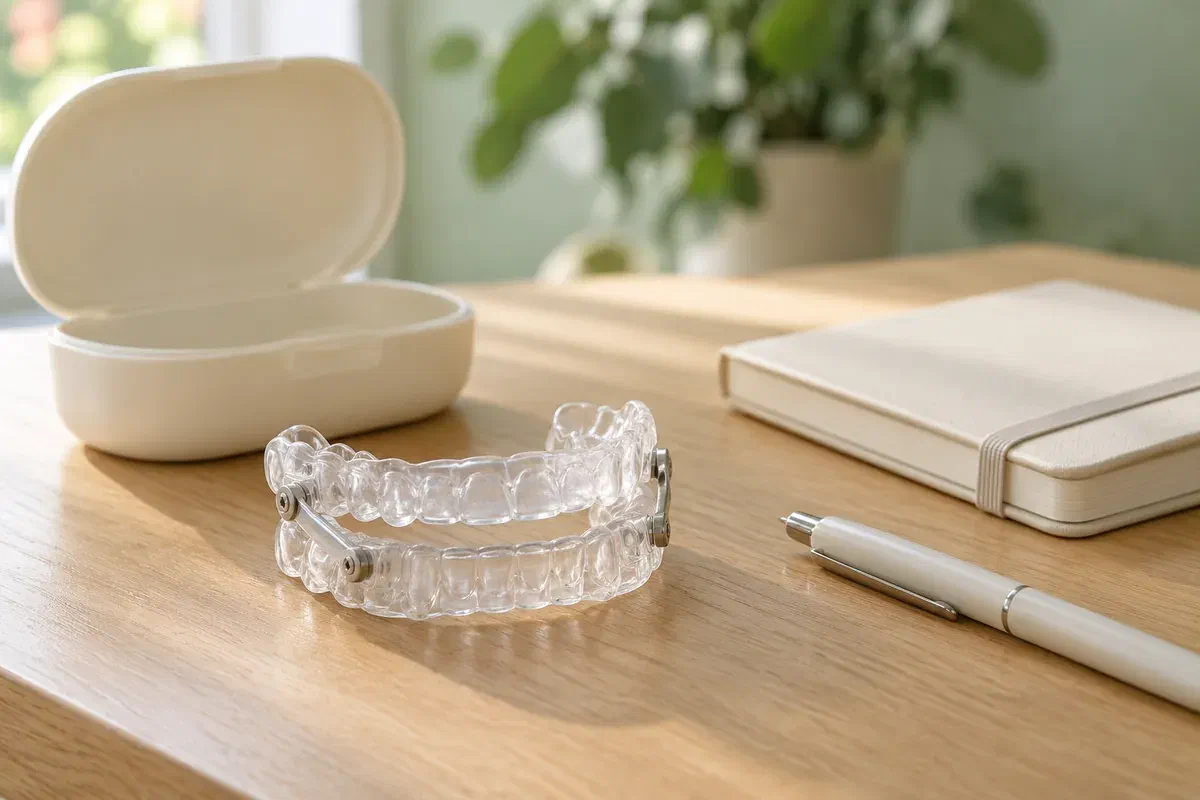
Illustrative oral sleep appliance beside its protective case and a closed journal
Changes worth passing along

If one office notices something, the others should hear about it.

List the changes you have seen since the fitting or your most recent review. Timing, frequency and the effect on wear matter more than a diagnosis, so mention them even if the cause is a mystery.

Busy weeks are cutting into wear

Explain what gets in the way: forgetting it when you stay elsewhere, rushing through the cleaning, discomfort, or a dry mouth. Give a rough number of nights it is actually used. With that, the clinician can talk about realistic adjustments to the routine rather than assuming the original instructions still work.

Teeth or jaw feel different

Report any shift in the way your teeth come together, a tooth that feels pressured, jaw discomfort, or dental work done at another office. Say when it began and whether it persists through the day. Even an appliance that slides in easily may need checking against your current teeth.

Sleep symptoms have changed

Let your sleep-care provider know, as well as the dental team, about returning snoring, pauses a partner has noticed or growing daytime tiredness. A stronger setting is not assumed to be the remedy. These changes can mean a medical reassessment is due, even if the appliance looks fine.

Don't sit on a serious problem until the next scheduled visit. Contact the treating provider promptly for significant pain, a fit that seems unsafe, or a cracked or loose part, and ask how your sleep treatment should continue until it is resolved.

What coordination achieves

Findings that travel between offices are findings that get used.

A review is most useful when it can be compared with something. Present observations can be weighed against earlier records, your report of how often the device is worn and dental treatment done elsewhere. That fuller picture is more informative than an appliance viewed alone, or the assumption that quiet months mean the plan is still right.

Just as importantly, follow-up makes ownership clear. You can ask which concerns the dental team can deal with, which need the office that made the device and which belong with your sleep physician. That clarity protects you when each provider sees only part of the picture.

Patient information: AADSM — ongoing dental review and coordinated oral-appliance care

A joint look at mouth and device

The clinician can examine teeth, gums, bite, jaw function and the appliance itself. Ask what has changed and what needs a response. A follow-up visit doesn't automatically mean an adjustment; its job is to pick out relevant findings and agree a plan.

A routine built around your real schedule

Share whichever part of wear or care is hardest to fit into your week. Bring the case and instructions if handling is confusing. The discussion may lead to some extra coaching, a fit check or a different approach rather than a repeat of what you were first told.

Dental notes that reach your sleep physician

Find out whether your sleep provider has the latest updates and whether testing or a review is still pending. Sleeping better is a good sign to report, but it doesn't answer every question about apnea control. Ask how the findings from each office will shape your ongoing plan.

Stages of a coordinated review

Listen, examine, connect, confirm.

The visit opens with your account of use and closes with a clear sense of who does what next. If you can, bring treatment records, appliance instructions and any recent letters or reports from your sleep-care provider.

  1. Listen to how treatment has gone

    Tell us how you have used the appliance since your last visit, including gaps and any changes another provider requested. Share health updates, new medications and recent dental work. If the current setting or your last instruction is unclear to you, it is fine to say you don't know.

  2. Examine your mouth and the device

    The clinician reviews the relevant oral findings and checks the appliance for condition and fit. Notes from other offices can help explain a change in bite or tissues. Ask what was seen, whether you should keep wearing the device as is, and whether further assessment should come first.

  3. Connect findings to the right provider

    Sort the concerns into dental ones and those your sleep physician should hear about. Find out where things stand with any effectiveness testing. A device can be easy to wear without fully controlling symptoms, so the plan should look at tolerability and response separately.

  4. Confirm who follows up, and when

    Leave knowing the agreed actions, whom to call and when you are next due. Clarify which changes should prompt earlier contact and whether any instructions on wear or settings have changed. Where another office needs an update, agree how it gets there and who checks for a response.

Keeping things on track

One short list can keep several providers aligned.

Next steps might be continuing as before, a further assessment, or a change a professional has directed. Follow the specific advice for your device and keep your dental and medical teams informed if the routine gets harder.

Track issues that affect your wear

When discomfort, a fit problem or a sleep concern comes up, note the date and whether it changed your routine. Short entries on your phone are enough. Take them to your review and get in touch sooner if the problem can't wait.

Tell every dentist who treats you

If you see another office for fillings or crowns on teeth the appliance holds, mention the device and bring it along. Ask whether the work might change its fit and whether the maker needs to be consulted. Don't force it over new work or modify it yourself.

Keep both review dates booked

Ask when dental and medical follow-ups are due and how to arrange any outstanding test. If scheduling, cost or travel is making it hard to attend, say so. Raising it openly is better than letting a concern vanish between offices.

Patient information: NHLBI — living with sleep apnea and keeping treatment under review

What happens after the review

Some plans stay the same. Some need another office involved.

Ask what each proposed action is meant to address. An appliance that seems to fit shouldn't lead automatically to a stronger setting, a replacement or the end of follow-up.

When current dental findings support continued use

Stay the course with monitoring

If no change is needed, confirm your wear and care routine and the date of your next review. Ask which signs should bring you in earlier. Medical follow-up continues alongside, because a reassuring dental exam does not confirm that sleep apnea is under control.

When comfort, fit or oral health needs attention

Resolve a specific dental or fit issue

The answer may be more examination, a professional adjustment, dental treatment or a return to the provider who made the device. Ask whether to keep wearing it while that is organised, and understand the reason before deciding the appliance has simply worn out.

When symptoms, response or circumstances have changed

Bring the sleep team back in

Your physician may reassess effectiveness or discuss alternatives when the current approach falls short. Share dental findings and any difficulty with wear. Until then, don't substitute an unprescribed mouthpiece, stop treatment or make a large setting change without advice.

Coordination questions

Who does what in appliance follow-up?

With several providers involved, it helps to know where each question belongs. These answers cover roles, records and what to do between visits.

(905) 876-4488
Who should I call first if my appliance feels wrong?
For pain, a damaged part or a fit problem, contact the dental provider treating your appliance. For returning sleep symptoms or daytime sleepiness, contact your medical sleep provider. If you aren’t sure, call either and explain; they can point you in the right direction.
Will you send my dental findings to my sleep physician?
Ask us at your review. We can discuss what information should be shared, how it will be sent and who will follow up on any reply, so nothing is left to chance.
Does a cleaning at another dental office cover my appliance check?
Not necessarily. A routine cleaning may not include an appliance assessment or communication with your sleep team. Tell any office you visit that you use an oral sleep appliance and ask what review you need.
What should I bring to keep everyone on the same page?
Bring the appliance and case, any instructions, recent letters from your sleep provider and details of dental work done elsewhere. Even partial information helps the clinician understand changes since your last review.
Is my sleep doctor still involved once the appliance is fitted?
Yes. Medical follow-up remains part of treatment, and your sleep provider decides whether and when effectiveness testing is needed. A dental review complements that medical role rather than replacing it.
What if my appointments are hard to fit into a Mississauga work week?
Mention your constraints when you call. Our hours are Monday to Thursday from 11am to 7pm, and Friday to Sunday by appointment only. Bringing records and the device to one planned visit keeps follow-up efficient.
Set up a review from Mississauga

One visit to check the device and line up the next steps.

Call Milton Dental Clinic to arrange a suitable sleep-appliance review. Let us know which office made your device, who manages your sleep care, and whether you have a fit concern, trouble wearing it, or a medical review that is overdue.

Dental review and medical assessment of how well treatment works each have their place.

Visit Milton Dental Clinic
Unit 1, 342 Bronte St. S, Milton, ON L9T 5B7
Get directions Clinic hours
Monday–Thursday
11am–7pm
Friday–Sunday
By appointment only

Areas we serve

  • Milton
  • Oakville
  • Mississauga
  • Georgetown
  • Halton Hills
  • Acton
  • Campbellville
  • Brampton
  • Burlington
  • Puslinch
  • Rockwood
  • Erin
  • Caledon
  • Etobicoke
  • Old Milton
  • Bronte Meadows
  • Timberlea
  • Dorset Park
  • Dempsey
  • Clarke
  • Beaty
  • Coates
  • Harrison
  • Scott
  • Willmott
  • Ford
  • Bowes
  • Cobden
  • Walker
  • Mountain View
  • Milton Heights
  • Hawthorne Village
  • Valley View
  • Fallingbrook
  • Nassagaweya
  • Trafalgar
  • Esquesing
  • Nelson
  • Brookville
  • Moffat
  • Glen Williams
  • Norval
  • Limehouse
  • Stewarttown
  • Ashgrove
  • Hornby
  • Silver Creek
  • Speyside
  • Scotch Block
  • North Oakville
  • River Oaks
  • Glen Abbey
  • West Oak Trails
  • Palermo
  • Bronte Creek
  • College Park
  • Joshua Creek
  • Uptown Core
  • Preserve
  • Iroquois Ridge
  • Lisgar
  • Meadowvale
  • Meadowvale Village
  • Churchill Meadows
  • Erin Mills
  • Central Erin Mills
  • Streetsville
  • East Credit
  • Creditview
  • Heartland
  • Sheridan
  • Mount Pleasant
  • Credit Valley
  • Huttonville
  • Churchville
  • Springbrook
  • Northwest Brampton
  • Bram West
  • Fletcher's Meadow
  • Fletcher's Creek South
  • Alton Village
  • Orchard
  • Millcroft
  • Headon Forest
  • Tansley
  • Brant Hills
  • Tyandaga
  • Kilbride
  • Lowville
  • Aberfoyle
  • Morriston
  • Arkell
  • Hillsburgh
  • Freelton
  • Carlisle
  • Waterdown
  • Flamborough
  • Mountsberg

How can we help?

Milton Dental Clinic

Have a question about your smile? Choose the option that works best for you.

For urgent dental concerns, please call.
Messages are reviewed during clinic hours.