

Illustrative discussion about having an oral sleep appliance assessed
Specialized Care

Sleep Appliance Repair in Brampton

A summer afternoon in a parked car, a cycle in the dishwasher, a rinse under very hot water: heat is one of the quieter ways an oral sleep appliance gets damaged. From Brampton, arrange a proper look at the warping, the fit and what it means for your sleep care.

Heat damage and warped trays, for Brampton households

When heat gets to your appliance

Many sleep appliances are made from materials that hold their shape well at mouth temperature but can soften or twist when they get much hotter. The change may be dramatic, with a tray that clearly bends, or so slight that you only notice a new tightness or gap. In either case the device may no longer hold the jaw position your treatment depends on, and that has to be judged before it goes back into use.

Try to reconstruct what happened. Was the case left in a car, on a radiator or in a sunny window? Was the appliance cleaned with very hot water or put through the dishwasher? Bring those details, the appliance itself in its case, and any instructions or supplier contact information you have kept.

Coming down from Brampton, ring us before you set out. We’ll ask how the warping showed up, explain how an assessment can be booked, and let you know whether the lab or office that made the device should be involved. Distortion is not always reversible, and some designs can’t be repaired at all, so no quick fix, particular part or warranty outcome can be assumed until the appliance has been examined.

Arrange an assessment for a warped appliance
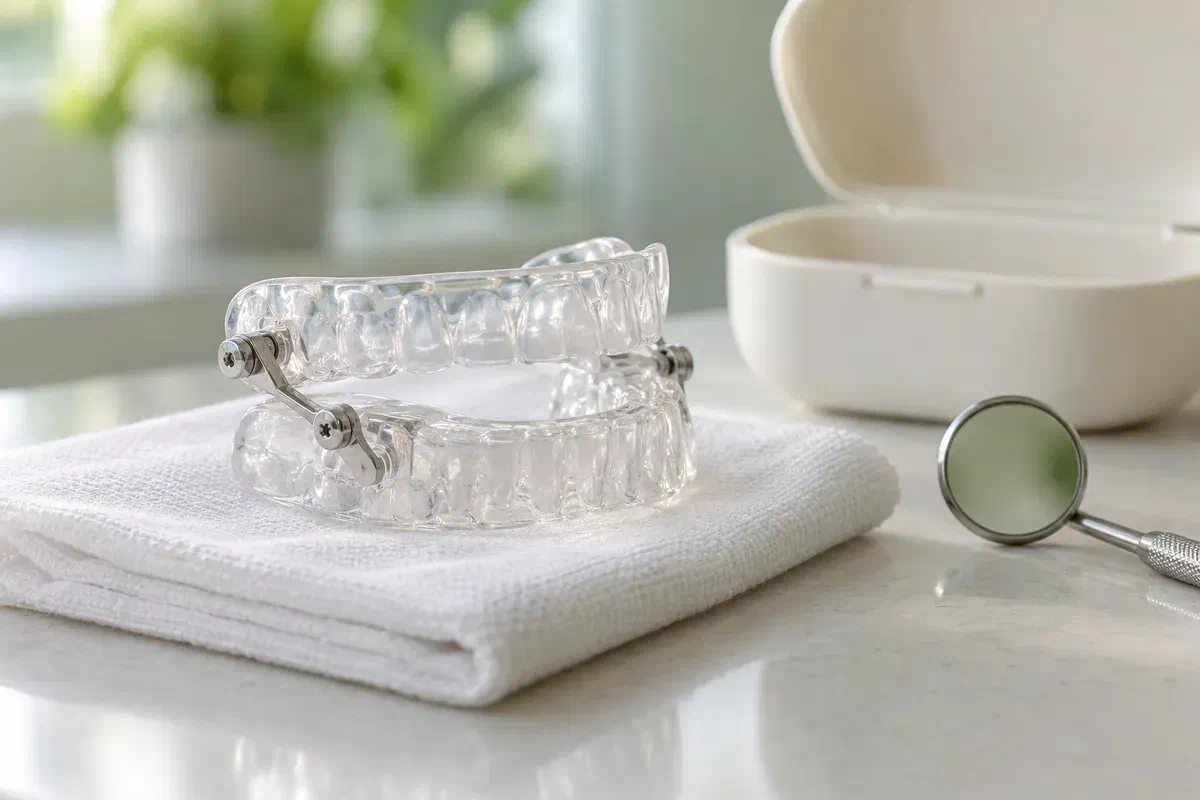
Illustrative intact sleep appliance beside a mirror and protective case before inspection
What heat and other damage can look like

A bend you can see, or a fit you can feel

If the appliance won’t seat, has rough or sharp areas, or has loose parts, take it out of use and contact the provider who treats you. Giving it another night may hide the underlying change and carries avoidable risk.

Cracks or brittle spots after heat or a fall

Heat can leave material weaker, and a later knock may then crack it. Keep any broken pieces with the appliance and don’t glue them. Tell us what happened first. A small crack still needs inspection, because where it sits and how the tray is built count for more than its size.

Connectors that have loosened or shifted

Warping can pull at the parts that link the trays. Don’t fit a hardware-store screw, an elastic or an unverified spare. Describe what has moved or gone missing. If a piece may have been swallowed or inhaled, seek medical advice first.

A tray that is twisted, tight or gaping

Let us know about the heat exposure, any recent dental work and any tooth that feels sore. Please don’t soften it again to bend it back, or push it on harder. The clinician needs to tell whether the device has distorted, your mouth has changed, or both.

Call 911 for choking or difficulty breathing. If a component is missing and may have been swallowed or inhaled, get prompt medical advice and say what is missing. Keep the remaining appliance so the part can be identified.

Why warping needs more than a quick reshape

Close enough isn’t the goal. The prescribed position is.

Even a tray that slips back on after reheating may hold your jaw slightly off from where it was set, or put pressure in new places. A professional review considers the design, the material and how it reacted to heat, the affected area and the present state of your teeth and gums. Ask what any suggested work could restore and how that will be confirmed.

Your nights matter in the meantime. Speak with your sleep physician about the interruption to treatment and what they advise. A sports mouthguard, an older appliance or a product bought online shouldn’t be assumed to substitute for what was prescribed.

Knowing the material and the maker

The original provider, manufacturer or lab can often tell how a material behaves and what repairs it tolerates. Bring the paperwork you have. If you don’t know the brand, that is something to find out, not a gap to fill with a lookalike part.

Understanding how the damage happened

Describe the heat exposure and anything else relevant, such as earlier sore spots, past breakages or recent dental treatment. Knowing the cause helps decide whether repair is sensible, and whether your mouth or treatment plan also needs review.

Weighing repair honestly before you commit

Ask about the work proposed, how long you would be without the device, the likely cost, and whether a lab must examine it. A good estimate tells you plainly what is certain now and what depends on closer inspection or another provider’s view.

Our approach to a heat-damaged appliance

From the first description to a confirmed fit

Bring the device, any loose parts and the records you have. You won’t be asked to squeeze a warped tray in to show us the problem. The appointment sorts what we can judge in the chair from what needs the supplier’s input.

  1. Walk us through the heat exposure

    Tell us how and when the damage happened, whether anything is loose or missing, and whether you can still wear the appliance. Share who made it and how your sleep care is managed. Mention any previous repairs, dental work and attempts to reshape it.

  2. Compare the device with your teeth and bite

    The clinician examines the appliance against your current teeth, gums and bite to see whether the distortion is local or has affected the overall fit. Records or guidance from the original supplier may be needed before a repair is proposed.

  3. Agree a route forward

    Discuss whether the findings support repair, a replacement assessment or referral, and whether lab work is needed. Ask about the sequence, costs where available and who your contact is. Coordinate with your sleep physician if you can’t wear the appliance during this time.

  4. Review the result before nightly wear

    A repaired or corrected appliance needs a clinical check of its fit and function before you go back to sleeping in it. Ask whether the prescribed position has been verified and whether your care instructions have changed. More follow-up may be needed, because a returned device doesn’t prove treatment is working as it was.

Protecting the appliance until it’s seen

Cool, cased and left alone

A clear account of how the appliance was exposed to heat helps more than any home attempt to correct it. Keep it ready for assessment and follow your provider’s guidance on wearing it.

Store it cool and secure

Use a hard case kept at room temperature, away from windows, heaters and the car. Keep any pieces where children and pets can’t get them. Don’t flex or trim it or keep trying it on. If a part has gone missing, say so directly.

Resist reheating or gluing

Another round of hot water or a household adhesive can change the material further and make assessment harder. If a reshape has already been tried, describe what you did, including water temperature if you know it, so the clinician can account for it.

Talk to your sleep physician about the gap

Let the medical sleep provider know your prescribed device is unavailable or unsafe to wear, and ask what interim approach suits you. Don’t change PAP settings on your own, stop other prescribed treatment, or assume a spare appliance is right just because it fits.

Patient information: NHLBI — keeping sleep-apnea treatment and provider follow-up connected

Possible next steps after distortion

Repairable, replaceable or a question for the maker

Ask what each choice should achieve and what is still uncertain. A quick, inexpensive correction may not suit you if the device can’t recover an accurate fit, or if whatever caused the damage is likely to happen again.

When the material and design can tolerate it

Repairing or correcting the current appliance

Some damage may be repairable when suitable materials, components and expertise are available and the rest of the appliance is sound. Ask whether lab work is needed and what clinical check comes after. A repair won’t make the device last indefinitely or replace future reviews.

When distortion or other damage is too extensive

Assessing for a replacement

Significant warping, widespread damage, unavailable parts or changes in your teeth may point toward a replacement assessment. Ask why repair is unlikely to work and which records need updating. A new device should reflect your current treatment plan, not simply reproduce an old fit or setting.

When material details or a treatment review are needed

Consulting the supplier or your sleep team

The supplier may know how the material responds to heat and what can be done. Your physician may want to review treatment while you are without the appliance. Agree on who is contacting whom and how you’ll hear the outcome.

Patient information: AADSM — device management and continued coordinated care

Heat damage questions

What to know about warping and repair

Each appliance and material reacts a little differently. Bring the device and an account of what happened instead of relying on photos or a method meant for a different product.

(905) 876-4488
Can I clean my sleep appliance in the dishwasher?
Follow the cleaning instructions that came with your device or ask your provider. Many appliances shouldn’t be exposed to high heat, and a dishwasher cycle may distort them. If yours has already been through one and feels different, stop wearing it and arrange an assessment.
My appliance was left in a hot car. Do I need to have it looked at?
If it looks or feels any different, yes. Heat can change the shape or weaken the material even when the change is subtle. Stop wearing it, avoid reheating it to correct the shape, and contact your provider to describe what happened.
Would softening a warped appliance in boiling water put it back into shape?
Please don’t. More heat can distort the material further in ways that are hard to predict, and may make repair less likely. Have the device assessed so the clinician can explain whether any correction is possible or a replacement review makes more sense.
How should I store my sleep appliance to avoid heat damage?
Keep it in its case at room temperature, away from direct sun, heaters, hot water and parked cars. Follow your provider’s cleaning and storage instructions, and ask if you are unsure what temperatures your device can handle.
Does a warped appliance always have to be replaced?
Not always, but it is possible. It depends on the material, the extent of distortion and the design. The assessment helps clarify whether repair, a replacement review or input from the supplier is the right next step.
What should I do before coming in from Brampton with a heat-damaged appliance?
Call ahead and describe how the damage happened. We can explain how assessment is arranged and whether to bring supplier details. Carry the appliance in its case and keep it out of the sun in the car on the way.
Brampton sleep-appliance assessments

Warped, tight or not sitting right? Call before you wear it again.

Contact Milton Dental Clinic with your appliance type, how it was exposed to heat or damaged, and whether you’ve stopped using it. We can explain how assessment works and whether we’ll need information from the original provider first.

How much of the distortion can be dealt with, and the time and fees involved, become clear only after the appliance is examined and any lab has weighed in.

Visit Milton Dental Clinic
Unit 1, 342 Bronte St. S, Milton, ON L9T 5B7
Get directions Clinic hours
Monday–Thursday
11am–7pm
Friday–Sunday
By appointment only

Areas we serve

  • Milton
  • Oakville
  • Mississauga
  • Georgetown
  • Halton Hills
  • Acton
  • Campbellville
  • Brampton
  • Burlington
  • Puslinch
  • Rockwood
  • Erin
  • Caledon
  • Etobicoke
  • Old Milton
  • Bronte Meadows
  • Timberlea
  • Dorset Park
  • Dempsey
  • Clarke
  • Beaty
  • Coates
  • Harrison
  • Scott
  • Willmott
  • Ford
  • Bowes
  • Cobden
  • Walker
  • Mountain View
  • Milton Heights
  • Hawthorne Village
  • Valley View
  • Fallingbrook
  • Nassagaweya
  • Trafalgar
  • Esquesing
  • Nelson
  • Brookville
  • Moffat
  • Glen Williams
  • Norval
  • Limehouse
  • Stewarttown
  • Ashgrove
  • Hornby
  • Silver Creek
  • Speyside
  • Scotch Block
  • North Oakville
  • River Oaks
  • Glen Abbey
  • West Oak Trails
  • Palermo
  • Bronte Creek
  • College Park
  • Joshua Creek
  • Uptown Core
  • Preserve
  • Iroquois Ridge
  • Lisgar
  • Meadowvale
  • Meadowvale Village
  • Churchill Meadows
  • Erin Mills
  • Central Erin Mills
  • Streetsville
  • East Credit
  • Creditview
  • Heartland
  • Sheridan
  • Mount Pleasant
  • Credit Valley
  • Huttonville
  • Churchville
  • Springbrook
  • Northwest Brampton
  • Bram West
  • Fletcher's Meadow
  • Fletcher's Creek South
  • Alton Village
  • Orchard
  • Millcroft
  • Headon Forest
  • Tansley
  • Brant Hills
  • Tyandaga
  • Kilbride
  • Lowville
  • Aberfoyle
  • Morriston
  • Arkell
  • Hillsburgh
  • Freelton
  • Carlisle
  • Waterdown
  • Flamborough
  • Mountsberg

How can we help?

Milton Dental Clinic

Have a question about your smile? Choose the option that works best for you.

For urgent dental concerns, please call.
Messages are reviewed during clinic hours.