

Illustrative discussion about having an oral sleep appliance assessed
Specialized Care

Sleep Appliance Repair in Georgetown

Before you approve any work on a damaged sleep appliance, you deserve to know what is being proposed, what is still uncertain and what happens to your treatment in the meantime. From Georgetown, an assessment gives you those answers before decisions are made.

Making an informed repair decision from Georgetown

Understand the work before you say yes

It’s natural to want a broken appliance back in use as soon as possible, and to wonder what it will cost. Good decisions come after the assessment, though, not before. Damage can be confined to one part or reach further into the fit, and the type of device shapes what is possible. The real question is whether any proposed repair would leave you with an appliance that can be used appropriately within your treatment plan.

You can help the assessment go smoothly. Bring the appliance and all its pieces in a protective case, plus instructions, receipts and warranty papers if you have them. Note when the problem appeared and whether the fit had been changing. Mention recent dental work, a drop or contact with heat, since each can affect what is recommended.

Call from Georgetown before coming over. We can hear about the damage, explain how assessment is arranged, and tell you whether the original supplier or lab might need to be involved, which can affect timing. Not every appliance or every type of damage is repairable, and no same-day result, particular part or warranty decision can be assumed before examination.

Book an assessment and get the facts
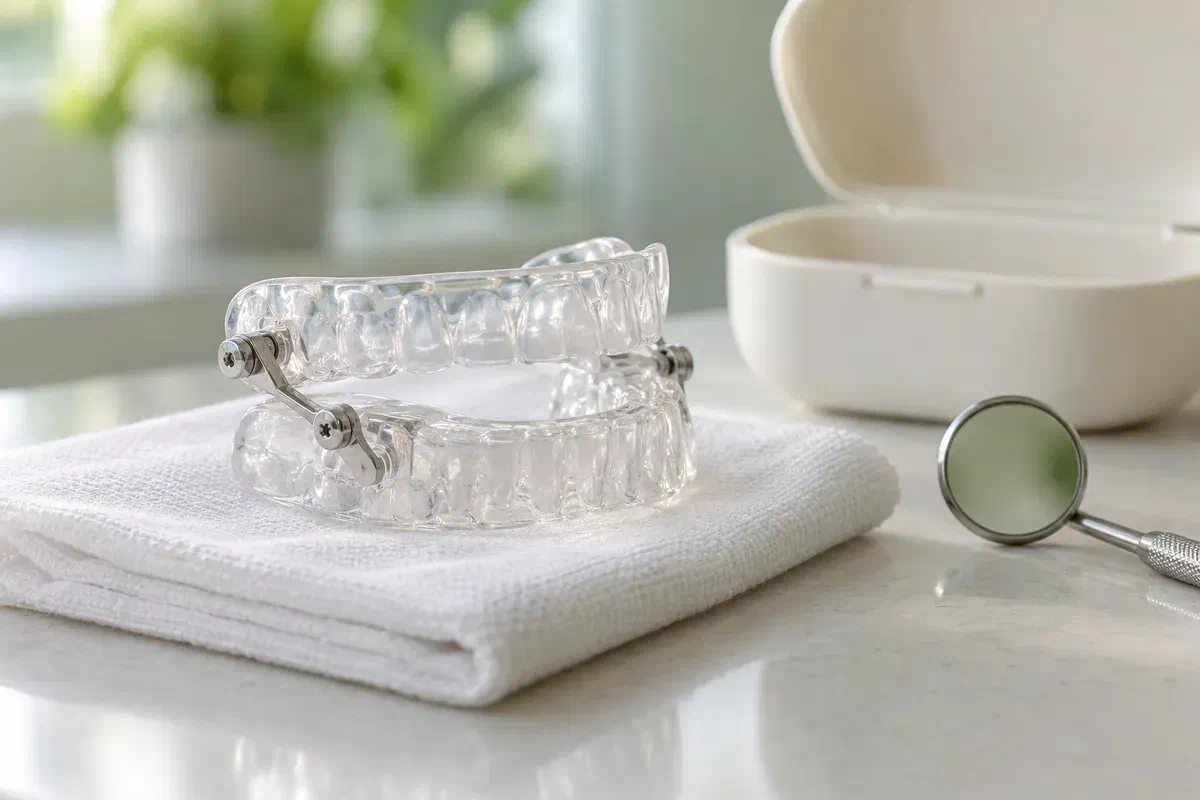
Illustrative intact sleep appliance beside a mirror and protective case before inspection
Signs the device should be examined

Hold off on wearing it until someone has looked

Take an appliance out of use if parts are loose, edges are sharp or the fit feels wrong, and get in touch with your treating provider. Trying another night won’t tell you much and could make the damage harder to assess.

A visible break or crack

Keep all fragments with the device and don’t glue them. Explain whether the damage came from an accident or appeared during normal wear, since that can matter for warranty questions as well as for repair. Location and construction matter more than how small the crack looks.

A connector that is loose, damaged or gone

Avoid household screws, elastics and parts bought online, which can also complicate any warranty claim. Tell us which component has changed and whether a piece is missing. If it may have been swallowed or inhaled, seek medical advice first.

A distorted tray or a fit that has shifted

Mention heat exposure, new fillings or crowns, sensitive teeth or trouble seating the appliance. Don’t force it on or reshape it with hot water. The clinician needs to tell whether the device or your mouth has changed, because the response and cost will differ.

Someone choking or struggling to breathe needs 911 straight away. When a piece is unaccounted for and might have gone down, speak to a doctor promptly and explain exactly what is missing. Hang on to the rest of the appliance; it shows what the lost part looked like.

Why the assessment comes before any estimate

You can only weigh the cost once you know the problem.

An appliance can look repaired without having its prescribed fit or position restored, and paying for that kind of fix helps nobody. The assessment considers the design, material, damaged area and your current oral health. Ask what the proposed work would correct and how it will be checked before you are told it is ready.

There is also the cost of going without treatment. Tell your sleep physician that the appliance is unavailable and ask about an interim plan. Don’t assume an older mouthpiece, a sports guard or an online product will do the same job while you wait.

Identifying the device and its warranty

The original provider, manufacturer or lab may have information that affects both repair options and coverage. Bring any documentation and say where the appliance came from. An unknown brand calls for gathering information, not choosing a similar-looking part.

Understanding what caused the problem

Tell us about earlier pressure points, repeated breakage or recent dental work. If the cause is still active, a repair may not hold, and it may be worth addressing your mouth or treatment plan as well rather than paying for the same fix twice.

A clear picture before you authorize anything

Ask about the proposed work, time away from the device, an estimated cost and whether lab assessment is required. A useful estimate separates what is known now from what depends on closer inspection or on another provider’s response.

Step by step

Assess, explain, decide, confirm

Bring all parts, records and any warranty information. You don’t need to demonstrate the problem by forcing the device into your mouth. The visit clarifies what can be assessed here and what needs input from the supplier or lab.

  1. Describe the damage and your treatment

    Explain how you noticed the problem, whether anything is missing and whether the appliance can still be worn. Share the original provider’s details, your sleep-care plan, recent dental work, earlier repairs and anything you’ve tried yourself.

  2. Examine the appliance and your mouth

    Your teeth, gums and bite are checked along with the appliance, because the cause can sit on either side. This tells the clinician whether one part has failed or the whole fit is affected. Sometimes the supplier’s records have to arrive before a fair estimate or repair recommendation is possible.

  3. Review the options and the estimate

    Discuss repair, replacement assessment or referral, and any lab steps. Ask for the expected order of events, available cost estimates and who will update you. If you can’t wear the appliance meanwhile, coordinate an interim plan with your sleep physician.

  4. Confirm the repaired device before reuse

    Before you wear it again, the appliance needs a clinical check of fit and function. Ask whether the prescribed position was verified and whether your instructions have changed. Follow-up may still be advised, because a repaired device doesn’t prove treatment is as effective as before.

Before your appointment

Protect the device and keep your physician informed.

A short, accurate description of the damage is more helpful than a home repair, and it avoids adding new damage you might later have to pay for. Keep the appliance ready for assessment and follow your provider’s advice.

Keep it and its pieces together

A protective case, stored away from children and pets, keeps everything safe. Avoid bending, trimming or repeated fitting attempts. If something is missing, say so rather than assuming it will be noticed.

Skip adhesives, heat and improvised parts

Superglue, a kettle of hot water or a spare screw can each alter the material or fit, muddy the assessment and possibly affect a warranty claim. Already tried something? That’s fine; just tell us the product and the method, so nothing is left to guesswork.

Ask your sleep physician about the interruption

Going without treatment has its own cost, so let the physician who manages your sleep care know the appliance is out of service. They can suggest how to handle the coming nights. Leave PAP settings and any other prescribed therapy as they are unless told otherwise, and don’t press a spare into service on the basis that it still fits.

Patient information: NHLBI — keeping sleep-apnea treatment and provider follow-up connected

Comparing the options

Value means a device that works, not just the lowest quote

For each choice, ask what it is meant to deliver and which questions are still open. Paying less now can turn out to be poor value if the device never fits properly again, or if whatever damaged it is still at work.

When the existing device is worth working on

Repairing your current appliance

If the right materials and parts can be sourced, someone with the skill to use them is available, and the rest of the appliance is in good order, repair is a reasonable option to weigh. Find out whether a lab handles the work and how the device will be checked afterwards. Budget for ongoing reviews too, since no repair lasts forever.

When repair is unlikely to meet your needs

Assessment for a replacement

Widespread cracking, warping, parts that are no longer made or real changes in your teeth can make a new appliance the more sensible spend. Ask the clinician to explain why repair would fall short and what records would be needed. Any new device should be built around your present treatment plan, not a copy of the old one.

When warranty details or a treatment review are needed

Coordinating with the supplier or sleep team

Warranty terms, compatible parts and design limits are often questions only the maker can answer. Your physician may also want to look at your therapy while the appliance is away. Settle who is phoning whom, and how the outcome will be passed on to you, before anyone starts work.

Patient information: AADSM — device management and continued coordinated care

Cost, coverage and timing questions

Practical questions before you approve a repair

Answers depend on your appliance, its damage and the terms that apply to you. Bring the device and its paperwork rather than relying on a photo or general information about another product.

(905) 876-4488
Can you tell me what a repair will cost before I bring the appliance in?
A reliable estimate usually depends on examining the device, because the damage, design and any lab involvement all affect the work needed. When you call, we can explain how assessment is arranged and what information helps us give you an estimate after review.
Is it cheaper to repair a sleep appliance than to replace it?
Sometimes, but not always, and the cheaper option isn’t always the better one. If a repair can’t restore an appropriate fit, it may not be good value. The assessment helps you compare realistic options before deciding.
Can a warranty or insurance claim be confirmed before the work starts?
Not by us. Coverage depends on the terms, the device and how it was damaged. Ask for the proposed work and an estimate where available, then contact the warranty provider or insurer directly. A clinical recommendation doesn’t establish payment eligibility.
How long will I be without my sleep appliance during repair?
It depends on the damage and whether a lab or the original supplier is involved. Ask about expected timing at the assessment, and speak with your sleep physician about an interim plan for the time the device is away.
Will trying to fix it myself affect what can be done?
It can. Glue, heat or substitute parts may change the material or fit and make professional repair harder. If you’ve already tried something, describe exactly what you used so it can be taken into account.
What should I bring when I come from Georgetown for an assessment?
Bring the appliance and all pieces in a case, any instructions, receipts or warranty papers, and supplier contact details. A note about when the problem started and recent dental work helps too. Calling ahead lets us confirm what else might be useful.
Repair assessments for Georgetown

Get clear answers before deciding on a repair.

Call Milton Dental Clinic with the appliance type, the problem you’ve noticed and whether you can still wear it. We can explain how assessment works and whether information from the original provider is needed before an estimate or decision.

Repairability, timing and cost depend on examining the device and the provider or lab pathway involved.

Visit Milton Dental Clinic
Unit 1, 342 Bronte St. S, Milton, ON L9T 5B7
Get directions Clinic hours
Monday–Thursday
11am–7pm
Friday–Sunday
By appointment only

Areas we serve

  • Milton
  • Oakville
  • Mississauga
  • Georgetown
  • Halton Hills
  • Acton
  • Campbellville
  • Brampton
  • Burlington
  • Puslinch
  • Rockwood
  • Erin
  • Caledon
  • Etobicoke
  • Old Milton
  • Bronte Meadows
  • Timberlea
  • Dorset Park
  • Dempsey
  • Clarke
  • Beaty
  • Coates
  • Harrison
  • Scott
  • Willmott
  • Ford
  • Bowes
  • Cobden
  • Walker
  • Mountain View
  • Milton Heights
  • Hawthorne Village
  • Valley View
  • Fallingbrook
  • Nassagaweya
  • Trafalgar
  • Esquesing
  • Nelson
  • Brookville
  • Moffat
  • Glen Williams
  • Norval
  • Limehouse
  • Stewarttown
  • Ashgrove
  • Hornby
  • Silver Creek
  • Speyside
  • Scotch Block
  • North Oakville
  • River Oaks
  • Glen Abbey
  • West Oak Trails
  • Palermo
  • Bronte Creek
  • College Park
  • Joshua Creek
  • Uptown Core
  • Preserve
  • Iroquois Ridge
  • Lisgar
  • Meadowvale
  • Meadowvale Village
  • Churchill Meadows
  • Erin Mills
  • Central Erin Mills
  • Streetsville
  • East Credit
  • Creditview
  • Heartland
  • Sheridan
  • Mount Pleasant
  • Credit Valley
  • Huttonville
  • Churchville
  • Springbrook
  • Northwest Brampton
  • Bram West
  • Fletcher's Meadow
  • Fletcher's Creek South
  • Alton Village
  • Orchard
  • Millcroft
  • Headon Forest
  • Tansley
  • Brant Hills
  • Tyandaga
  • Kilbride
  • Lowville
  • Aberfoyle
  • Morriston
  • Arkell
  • Hillsburgh
  • Freelton
  • Carlisle
  • Waterdown
  • Flamborough
  • Mountsberg

How can we help?

Milton Dental Clinic

Have a question about your smile? Choose the option that works best for you.

For urgent dental concerns, please call.
Messages are reviewed during clinic hours.