

Illustrative discussion about having an oral sleep appliance assessed
Specialized Care

Sleep Appliance Repair in Milton

Found a crack while rinsing your sleep appliance this morning? Set it aside and have it looked at before tonight. Our Milton team can review the device, its fit and the damage, and help you keep your sleep physician in the loop while a plan is worked out.

Sleep-appliance repair close to home in Milton

Noticed the damage at the sink? Pause there.

Most people spot a problem during the ordinary routine: brushing the trays in the morning, or snapping them into the case before work. A hairline split, a hinge that wobbles, or a tray that suddenly sits differently on the teeth all change how the device holds your jaw at night. Repair starts with working out exactly what has happened, and whether the result could still serve your treatment plan safely.

When you get in touch, have the appliance and every loose fragment ready in its case. Paperwork from the original supplier helps, as do the instructions you were given. Think back over the past few weeks too. Did the fit feel odd before the break? Have you had a new filling or crown, dropped the case, or left the device somewhere warm?

Because you are nearby, it is easy to assume you can simply walk in with it. Calling first is still worth the effort. We can talk through what you are seeing, how an assessment would be arranged, and whether the lab or provider who made it needs to be involved. Some designs and some kinds of damage cannot be repaired, and quick turnaround, a specific part or warranty help is never certain until the device has been examined.

Book an assessment for your appliance
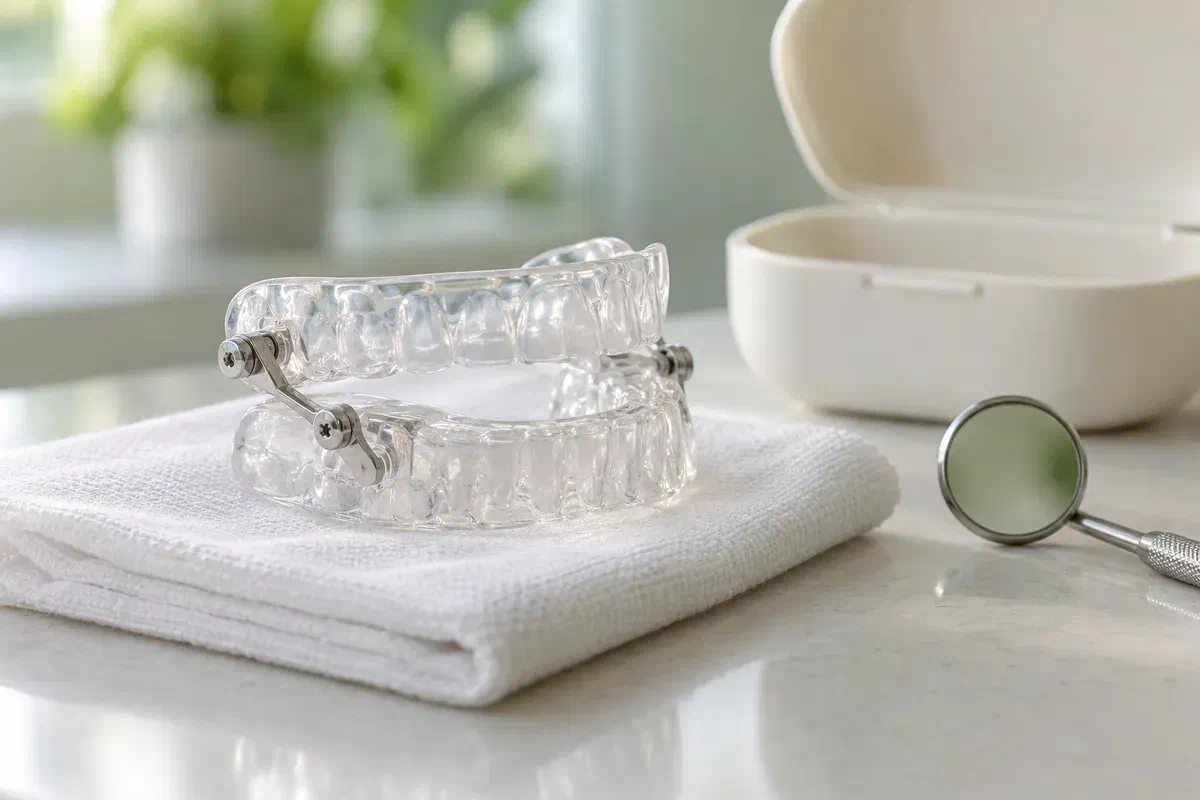
Illustrative intact sleep appliance beside a mirror and protective case before inspection
Signs that it should come out of rotation

Report it accurately. Don’t stress-test it.

If a piece has come loose, an edge feels sharp, or the tray no longer seats comfortably, stop wearing it and call your treating provider. One more night of making do can hide what went wrong and adds avoidable risk.

A split, chip or broken edge

Leave the fragments as they are and keep them with the device. Glue makes inspection harder. Let the team know whether the break followed a fall or showed up during normal nightly use. Even a crack that looks trivial deserves a proper look, because where it sits and how the appliance is built matter far more than its size.

A connector that has slipped, loosened or vanished

Resist the urge to use a spare screw, a rubber band or a part ordered online. Tell us which piece has moved or disappeared. If you cannot find a small component and there is any chance it was swallowed or breathed in, that is a medical question first, so seek appropriate advice before thinking about the appliance.

A tray that has warped or no longer seats

Mention any heat it may have met, recent dental work, or a sore tooth. Pushing it on harder, or softening it in hot water, can make matters worse. The clinician has to tell apart a device that has changed from a mouth that has changed, because each calls for a different next step.

Call 911 for choking or trouble breathing. If a part might have been swallowed or inhaled but you are breathing normally, get prompt medical advice and describe the missing piece. Keep the rest of the appliance so it can be identified.

What a proper assessment protects

Looking fixed and working correctly are different things.

A mended crack can hide the fact that the tray no longer holds your jaw where it was prescribed to sit. That is why the review looks at the design, the material, the damaged spot and the current state of your teeth and gums. Before agreeing to anything, ask what the proposed work would correct and how the appliance will be checked afterwards.

Just as important is what you do for sleep in the meantime. Let your sleep physician know that your prescribed device is out of action and ask what they recommend for the gap. An old night guard, a hockey mouthguard or a mouthpiece bought online is not a stand-in for the treatment you were prescribed.

Knowing which device you have and who can work on it

The provider, manufacturer or lab that made your appliance may hold details that shape the repair options. Bring any records and say where it came from. If you don’t know the brand, that is a reason to track down information, not to fit a part that simply looks similar.

Finding out what caused the damage

Tell us about earlier sore spots, past breakages or recent dental treatment. The cause can decide whether repair makes sense at all. It is also worth asking whether your teeth or treatment plan need attention, so a problem that keeps coming back is not handled as a one-off.

Seeing the limits clearly before you say yes

Ask what the work involves, how long you may be without the device, the estimated cost, and whether a lab must assess it. A good estimate separates what is already known from what depends on closer inspection or on a reply from another provider.

From first call to wearing it again

Four stages, each with a check built in

Bring every part and any records you have. There is no need to show us the problem by pushing a damaged tray into your mouth. The visit is about learning what can be assessed here and what needs input from elsewhere.

  1. Share what happened and how you were treated

    Describe when you noticed the issue, whether anything is missing, and whether you can still wear it at all. Share who supplied it and what your sleep-care plan involves. Mention recent dental work, earlier repairs and anything you have already tried in order to adjust it.

  2. Examine the device and your mouth together

    The clinician looks at the appliance alongside your teeth, gums and bite. The goal is to see whether the trouble is limited to one part or affects the overall fit and condition. Records or advice from the original supplier may be needed before any repair is suggested.

  3. Decide on repair, replacement assessment or referral

    You will talk through the options the findings support and any lab steps. Ask about the order of events, likely costs where they can be given, and who will keep you updated. If you cannot wear the device during this time, coordinate a plan for the gap with your sleep physician.

  4. Check the returned appliance before nightly use

    A repaired device needs a clinical fit and function review before you go back to wearing it. Ask whether the prescribed jaw position has been confirmed and whether your instructions have changed. More follow-up may be needed, since getting the appliance back does not prove the treatment works as it did.

In the days before the assessment

Keep it safe, keep it untouched, keep your doctor informed.

A short, honest description of the damage helps far more than a kitchen-table fix. Keep the appliance ready for inspection and follow your provider’s advice on whether to wear it and when to come in.

Put the device and fragments somewhere secure

A hard case works well. Keep loose parts where children and pets cannot reach them and where they won’t be swept away. Avoid bending, trimming or repeatedly trying it on. If something is missing, say so directly instead of assuming the gap will be obvious.

Leave out glue, hot water and makeshift parts

Household adhesives and heat can alter the material and the fit, which complicates the assessment. If you have already attempted a fix, tell us exactly what you used so the clinician can account for it rather than guess.

Ask your sleep physician how to manage the break

Call the medical sleep provider when your prescribed device is unavailable or unsafe. Ask what interim approach suits you. Don’t change CPAP settings on your own, stop another prescribed treatment, or decide a spare appliance is fine just because it still goes in.

Patient information: NHLBI — keeping sleep-apnea treatment and provider follow-up connected

Weighing up the possible routes

Mend it, replace it or bring in the original team?

Ask what each option should achieve and what is still unknown. The quickest or cheapest fix today may not be the right one if the appliance cannot be made to fit properly again or the reason it broke has not been dealt with.

When its design and condition support the work

Repairing the appliance you already own

Repair may be an option when the right materials, parts and skills are available and the rest of the device is sound. Ask whether a lab will be involved and what check follows. A repair does not give the appliance an unlimited life or remove the need for later reviews.

When the damage or your mouth has changed too much

Assessment for a new appliance

Widespread damage, warping, parts that are no longer made or changes in your teeth may point toward replacement. Ask why repair is unlikely to meet your needs and which records need updating. A new device should follow your current treatment plan, not copy an old fit or setting.

When device-specific knowledge or a wider review is needed

Working with the supplier or your sleep team

Whoever made the appliance may be best placed to identify parts or explain a design limit. Your sleep physician may also want to review treatment while you are without it. Ask who will contact whom and how you will hear the outcome, so nothing stalls between offices.

Patient information: AADSM — device management and continued coordinated care

Common questions about a broken sleep device

Straight answers before your appointment

Every appliance and every break is a little different. Bring the device itself and its history rather than relying on a photo or a fix designed for some other product.

(905) 876-4488
How do I know whether the crack is serious enough to stop wearing the device?
You don’t need to judge that yourself. Any crack can weaken the tray or leave rough or loose edges, even if it still clicks into place. Stop wearing it, call the treating provider, describe what you see, and ask your sleep team what to do for the nights in between.
What should I bring to a sleep-appliance repair visit?
Bring the appliance, every broken or loose part in a case, and any instructions, receipts or supplier details. A short note on when the problem started and any recent dental work is useful too. If you have tried a fix, bring a description of what you used.
Can a new crown or filling make my sleep appliance stop fitting?
It can. A change to a tooth’s shape may alter how the tray seats, even if the device itself is undamaged. Mention any recent dental work when you call so the clinician can consider whether the mouth, the appliance or both need attention.
Is it all right to use my old night guard while the sleep appliance is away?
Not without advice. A night guard or sports guard is designed for a different purpose and does not hold the jaw in a prescribed position. Ask your sleep physician what interim approach is appropriate for you while the appliance is being assessed.
Will I find out about the cost before any repair starts?
You can ask for the proposed work and an estimate where one can be given before anything goes ahead. Whether a warranty or insurance plan contributes depends on its terms and the circumstances, so check with them directly. A clinical recommendation does not confirm coverage.
Since I live in town, can I drop off the appliance without an appointment?
Please call first. A quick conversation lets us understand the damage, explain how assessment is arranged in Milton, and tell you whether information from the original supplier is needed. That way your visit to our Bronte Street practice is planned around what the device actually requires.
Arrange a repair assessment in Milton

Tell us what broke. We’ll plan the next step with you.

Call Milton Dental Clinic with the type of appliance, what you have noticed, and whether you have had to stop wearing it. We can explain how an assessment works and what details may be needed from the original provider before any decision is made.

Whether a device can be repaired, how long it takes and what it costs depend on examining it and on the provider or lab involved.

Visit Milton Dental Clinic
Unit 1, 342 Bronte St. S, Milton, ON L9T 5B7
Get directions Clinic hours
Monday–Thursday
11am–7pm
Friday–Sunday
By appointment only

Areas we serve

  • Milton
  • Oakville
  • Mississauga
  • Georgetown
  • Halton Hills
  • Acton
  • Campbellville
  • Brampton
  • Burlington
  • Puslinch
  • Rockwood
  • Erin
  • Caledon
  • Etobicoke
  • Old Milton
  • Bronte Meadows
  • Timberlea
  • Dorset Park
  • Dempsey
  • Clarke
  • Beaty
  • Coates
  • Harrison
  • Scott
  • Willmott
  • Ford
  • Bowes
  • Cobden
  • Walker
  • Mountain View
  • Milton Heights
  • Hawthorne Village
  • Valley View
  • Fallingbrook
  • Nassagaweya
  • Trafalgar
  • Esquesing
  • Nelson
  • Brookville
  • Moffat
  • Glen Williams
  • Norval
  • Limehouse
  • Stewarttown
  • Ashgrove
  • Hornby
  • Silver Creek
  • Speyside
  • Scotch Block
  • North Oakville
  • River Oaks
  • Glen Abbey
  • West Oak Trails
  • Palermo
  • Bronte Creek
  • College Park
  • Joshua Creek
  • Uptown Core
  • Preserve
  • Iroquois Ridge
  • Lisgar
  • Meadowvale
  • Meadowvale Village
  • Churchill Meadows
  • Erin Mills
  • Central Erin Mills
  • Streetsville
  • East Credit
  • Creditview
  • Heartland
  • Sheridan
  • Mount Pleasant
  • Credit Valley
  • Huttonville
  • Churchville
  • Springbrook
  • Northwest Brampton
  • Bram West
  • Fletcher's Meadow
  • Fletcher's Creek South
  • Alton Village
  • Orchard
  • Millcroft
  • Headon Forest
  • Tansley
  • Brant Hills
  • Tyandaga
  • Kilbride
  • Lowville
  • Aberfoyle
  • Morriston
  • Arkell
  • Hillsburgh
  • Freelton
  • Carlisle
  • Waterdown
  • Flamborough
  • Mountsberg

How can we help?

Milton Dental Clinic

Have a question about your smile? Choose the option that works best for you.

For urgent dental concerns, please call.
Messages are reviewed during clinic hours.