

Illustrative discussion about having an oral sleep appliance assessed
Specialized Care

Sleep Appliance Repair in Puslinch

A click that wasn’t there last week, an adjuster that spins without catching, a hinge with a bit of play: mechanical faults in a sleep appliance are easy to dismiss. From Puslinch, it’s worth having the mechanism and the fit assessed before the rattle becomes a breakage.

Loose mechanisms and moving parts, for Puslinch

A small rattle can mean a big change in position

Many oral sleep appliances work by linking an upper and lower tray so the lower jaw is held a set distance forward. The parts doing that work, whether a hinge, an adjustment screw, a pin or a strap, are small and take load every night. When one loosens, slips or wears, the device can look perfectly intact while no longer holding the position your treatment was built around.

Take a minute to describe what you’ve noticed. Does it click, rattle or feel looser on one side? Has an adjuster stopped holding its setting, or has a strap stretched? Write down when it started and whether the change was gradual or followed a drop, some heat or new dental work. Then pack the appliance in its case with any loose bits, instructions and the supplier’s details.

Rural households often prefer to combine errands into one outing. When you call from Puslinch, describe the mechanical fault and we can explain how assessment is arranged, whether the lab or office that made it should be contacted first, and what might be possible at a single visit. Some mechanisms can’t be serviced and some parts are no longer made, so no specific component, quick turnaround or warranty answer can be assumed until we have looked.

Arrange a check of a loose mechanism
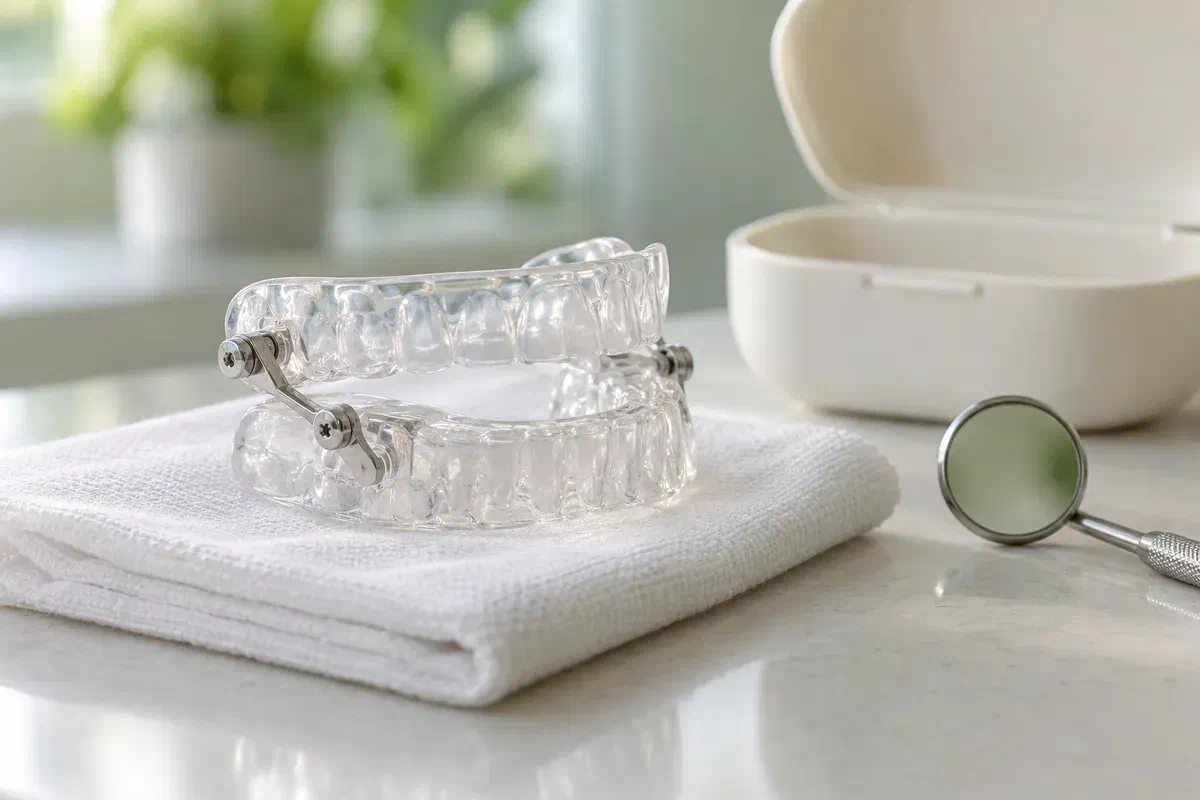
Illustrative intact sleep appliance beside a mirror and protective case before inspection
Faults worth reporting early

Clicks, cracks and creeping looseness

If a moving part has worked loose, an edge has turned sharp or the fit no longer feels secure, take the appliance out of nightly use and get in touch with your treating provider. Tightening, bending or simply carrying on can change the setting further.

Hairline cracks near a hinge or attachment

Stress tends to collect where moving parts meet the tray, so a fine line there deserves attention. Leave any separated material unbonded and keep it in the case. Say whether you noticed it after an accident or during ordinary use; its position on the device tells the clinician more than its length.

An adjuster, screw, pin or strap that has slipped

It’s tempting to tighten a screw with a jeweller’s driver or swap a stretched strap for an elastic band. Please don’t, and don’t turn an adjuster unless you’ve been instructed to. Tell us which part is loose or gone. A piece that may have been swallowed or inhaled is a medical question before it’s a dental one.

A fit that feels different on one side

Uneven looseness or pressure can come from a worn part, a distorted tray or a change in a tooth. Mention heat, recent fillings or crowns and any soreness. Don’t force the device to seat or reshape it with hot water; the clinician needs to see it as it is.

Choking or laboured breathing needs 911. When a small part can’t be found and might have been swallowed or breathed in, contact a doctor promptly and say exactly which piece is missing. Bring the rest of the device so the component can be matched.

Why mechanisms deserve a proper look

Tightening a screw is not the same as restoring the setting.

A mechanism can be snugged up and still hold your jaw at a different point from the one your physician prescribed. A thorough review looks at the appliance’s design, its materials and moving parts, the worn or damaged area, and how your teeth and gums are today. Before agreeing to any work, find out what it is meant to restore and how that will be measured.

Your treatment is on pause while the device is out of service, so tell the doctor managing your sleep care and ask how to cover the interval. Older guards, sports mouthpieces and products sold online don’t hold the jaw the way your prescribed appliance does.

Knowing which mechanism you have

Designs vary widely, and compatible parts usually come through the original provider, the manufacturer or their lab. Bring any paperwork. If the model is unknown, the task is to identify it, not to fit a screw or strap that looks about right.

Working out why it loosened

Mention earlier rattles, repeated adjustments, pressure points or recent dental work. Parts that keep working free may point to wear, a design limit or a change in your bite, and those causes need addressing alongside the part itself.

Clear expectations before work begins

Ask what the repair covers, how long the appliance may be away, an estimated fee and whether a lab needs it. A good estimate is plain about which answers are firm today and which wait on closer inspection or the supplier.

The assessment, in practice

Listen, inspect, choose, verify

Bring the device, any loose or removed parts and your paperwork. You won’t be asked to wear a faulty appliance to show us the rattle. Part of the visit is separating what can be settled here from what needs the maker.

  1. You describe the fault and its history

    Explain what you’ve heard or felt, when it began, whether a part is missing and whether you can still wear the device. Tell us who supplied it, who manages your sleep treatment, any recent dental work and any earlier repairs or adjustments.

  2. The clinician checks the mechanism and your mouth

    The moving parts, the trays and your teeth, gums and bite are examined together. That shows whether the fault is confined to one component or has affected the overall fit. Sometimes the supplier’s records or advice are needed before recommending anything.

  3. Together you settle on a route

    Options may include repair, a replacement assessment or referral back to the maker, with or without lab work. Ask what happens in what order, what it may cost and who will update you. If the device can’t be worn meanwhile, loop in your sleep physician.

  4. The returned device is tested before nightly use

    After the work is done, the clinician confirms the appliance seats and moves as designed. Check that the prescribed setting has been restored and whether your wear or adjustment instructions have changed. A sleep follow-up may also be advised, as a working mechanism doesn’t on its own prove therapy is effective.

Until it’s been seen

Leave the screwdriver in the drawer.

An accurate description of the fault is worth more than any tinkering. Keep the appliance as it is and take direction from the provider treating you about wearing it.

Keep parts together and secure

Close the appliance and any loose pieces in a hard case, out of reach of children and pets. Tiny screws are easy to lose in carpet or a pocket. Avoid repeated fitting, bending or trimming, and tell us outright if anything is missing.

Don’t tighten, adjust or substitute

Unless your provider has specifically shown you how, avoid turning adjusters or tightening screws. Household parts, glue and hot water can all change the setting or material. If you’ve already made a change, tell us exactly what, so it can be taken into account.

Ask your doctor how to manage the gap

The physician who prescribed your sleep treatment needs to know the appliance is out of use. They can advise on the coming nights. Leave CPAP settings and other therapies alone unless directed, and don’t assume a spare will do the job because it fits.

Patient information: NHLBI — keeping sleep-apnea treatment and provider follow-up connected

After the mechanism has been examined

Service it, replace it, or call the maker

For each option, understand what it should deliver and what is still unknown. Simply swapping a part isn’t sensible if the trays no longer fit well, the design can’t take the repair, or the reason it loosened will bring the fault straight back.

When compatible parts and a sound device are available

Servicing the existing appliance

If genuine or compatible components can be sourced, the right expertise is available and the trays are still in good condition, repair is worth weighing up. Find out whether the work is sent to a lab and how the appliance is checked when it returns. Periodic reviews still apply afterwards.

When the mechanism or trays can’t be restored

Considering a new device

A discontinued mechanism, worn or cracked trays, warping or meaningful changes in your teeth can make replacement the better path. The clinician should explain why repair would fall short and which records would need updating, so a new appliance reflects your current plan.

When design specifics or a therapy review are needed

Bringing in the original lab or your sleep team

Questions about part numbers, tolerances or how a particular mechanism is serviced are often best answered by whoever made it. Your physician may also want to revisit treatment during the gap. Agree who phones whom and how you’ll hear the plan.

Patient information: AADSM — device management and continued coordinated care

Questions about hinges, screws and adjusters

When the moving parts start misbehaving

Mechanisms differ a great deal between designs. Bring the appliance and tell us what you’ve noticed, rather than relying on a video online or a part meant for some other model.

(905) 876-4488
My sleep appliance has started clicking. Should I be worried?
A new click or rattle often means something has loosened or worn, even if the device looks fine. It’s worth stopping and asking your provider. Note when it started and whether it’s on one side, and have the mechanism assessed before it fails further.
Can I tighten a loose screw on my appliance myself?
Only if your provider has specifically shown you how and told you it’s appropriate. Otherwise, leave it. Tightening the wrong part, or tightening it too far, can change the jaw setting or damage the mechanism.
The adjuster won’t hold its setting anymore. What does that mean?
It may be worn, damaged or missing a small part. Don’t keep turning it to compensate. Stop wearing the device unless advised otherwise, and bring it in so the mechanism and the prescribed setting can be checked.
Do the straps or bands on a sleep appliance wear out?
Some components are designed to be replaced periodically, while others aren’t. Your appliance’s instructions or original provider can tell you which applies. Don’t substitute a household elastic; ask about the correct part at your assessment.
Could a loose mechanism affect how well my treatment works?
It could, because the mechanism helps hold your jaw in the prescribed position. Let your sleep physician know it’s out of use, and after any repair ask whether they want to review your treatment.
Can I combine a repair assessment with other appointments when coming from Puslinch?
Possibly. When you call, mention any other dental visits you’re due for and we can talk about what’s realistic. The repair itself may depend on lab timing or the original supplier, so we’ll be clear about that before you book.
Puslinch appliance assessments

Hear a rattle? Call before it turns into a break.

Ring Milton Dental Clinic with your appliance type, the fault you’ve noticed and whether you’re still wearing it. We’ll explain how the assessment works and whether anything should be requested from the original provider or lab beforehand.

Whether the mechanism can be repaired, and how long it takes and costs, can only be confirmed after examination and any lab or supplier input.

Visit Milton Dental Clinic
Unit 1, 342 Bronte St. S, Milton, ON L9T 5B7
Get directions Clinic hours
Monday–Thursday
11am–7pm
Friday–Sunday
By appointment only

Areas we serve

  • Milton
  • Oakville
  • Mississauga
  • Georgetown
  • Halton Hills
  • Acton
  • Campbellville
  • Brampton
  • Burlington
  • Puslinch
  • Rockwood
  • Erin
  • Caledon
  • Etobicoke
  • Old Milton
  • Bronte Meadows
  • Timberlea
  • Dorset Park
  • Dempsey
  • Clarke
  • Beaty
  • Coates
  • Harrison
  • Scott
  • Willmott
  • Ford
  • Bowes
  • Cobden
  • Walker
  • Mountain View
  • Milton Heights
  • Hawthorne Village
  • Valley View
  • Fallingbrook
  • Nassagaweya
  • Trafalgar
  • Esquesing
  • Nelson
  • Brookville
  • Moffat
  • Glen Williams
  • Norval
  • Limehouse
  • Stewarttown
  • Ashgrove
  • Hornby
  • Silver Creek
  • Speyside
  • Scotch Block
  • North Oakville
  • River Oaks
  • Glen Abbey
  • West Oak Trails
  • Palermo
  • Bronte Creek
  • College Park
  • Joshua Creek
  • Uptown Core
  • Preserve
  • Iroquois Ridge
  • Lisgar
  • Meadowvale
  • Meadowvale Village
  • Churchill Meadows
  • Erin Mills
  • Central Erin Mills
  • Streetsville
  • East Credit
  • Creditview
  • Heartland
  • Sheridan
  • Mount Pleasant
  • Credit Valley
  • Huttonville
  • Churchville
  • Springbrook
  • Northwest Brampton
  • Bram West
  • Fletcher's Meadow
  • Fletcher's Creek South
  • Alton Village
  • Orchard
  • Millcroft
  • Headon Forest
  • Tansley
  • Brant Hills
  • Tyandaga
  • Kilbride
  • Lowville
  • Aberfoyle
  • Morriston
  • Arkell
  • Hillsburgh
  • Freelton
  • Carlisle
  • Waterdown
  • Flamborough
  • Mountsberg

How can we help?

Milton Dental Clinic

Have a question about your smile? Choose the option that works best for you.

For urgent dental concerns, please call.
Messages are reviewed during clinic hours.