
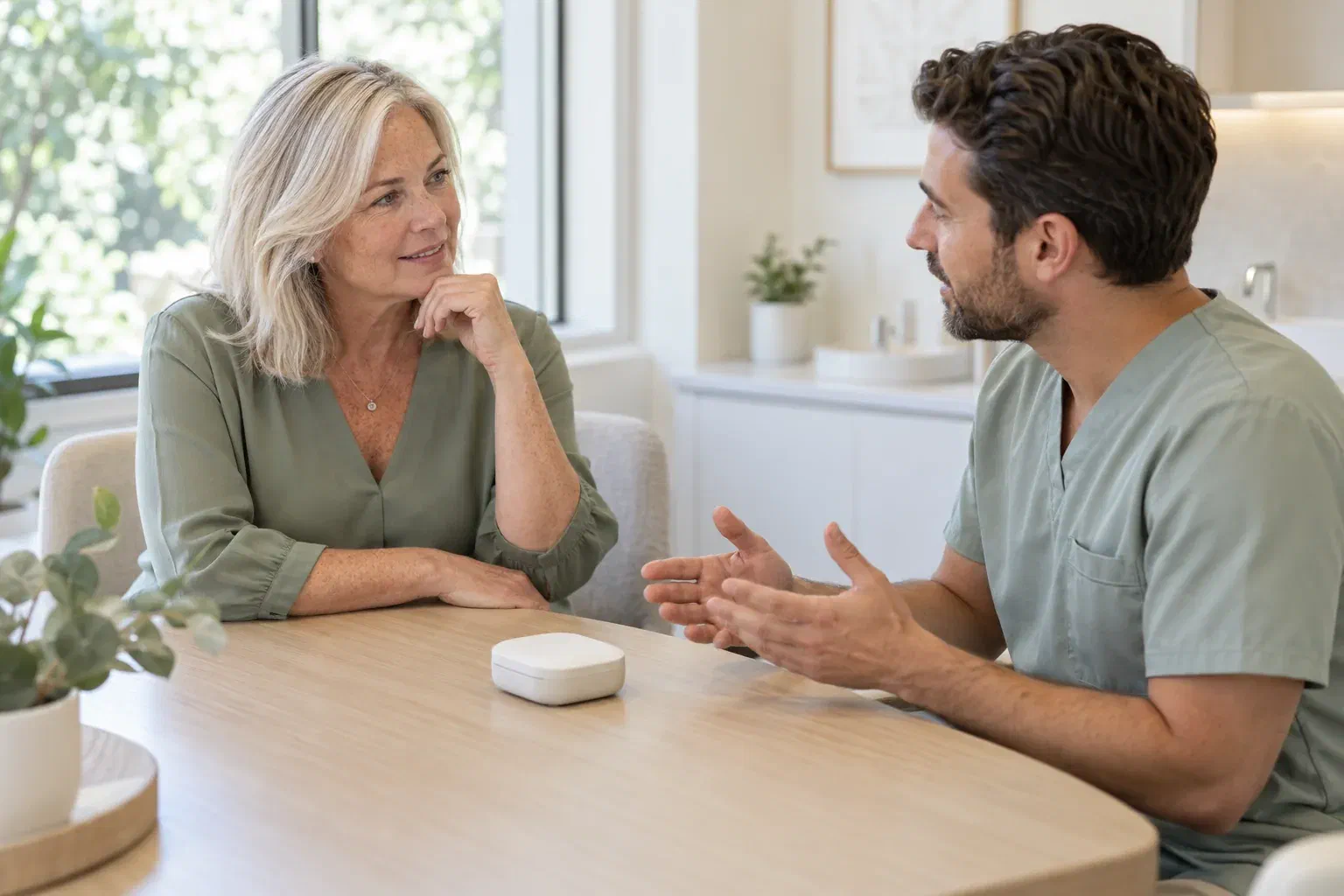
Illustrative consultation about replacing a custom oral sleep appliance
Specialized Care

Sleep Appliance Replacement in Milton

A cracked, lost or loose-fitting sleep appliance raises a practical question: fix it, or start again? Talk it through in Milton with a dentist who looks at your teeth as they are now and keeps your sleep physician in the loop.

When the device you rely on stops working

A split in the plastic is where the conversation starts, not where it ends.

Many people notice the problem at the bathroom sink: a hairline crack, a connector that wobbles, or a tray that suddenly will not seat. It is tempting to ask for the same thing again. Yet the appliance was built around the mouth you had years ago, and fillings, crowns, gum changes or a shifted bite can all alter what a new one needs to do.

So the first appointment is about understanding, not ordering. Bring the device in whatever state it is in, along with the case, and tell us how well it worked before it failed. Did you wake rested? Was your jaw sore in the morning? Those details help separate a hardware problem from a treatment problem.

Because Milton Dental Clinic did not necessarily make your original appliance, let us know who supplied it and which physician or sleep clinic oversees your condition. With that information, the dentist can suggest which assessments make sense and how to keep everyone informed. Reproducing an old setting without a fresh look does not confirm it still suits you.

Ask about a cracked or worn sleep appliance
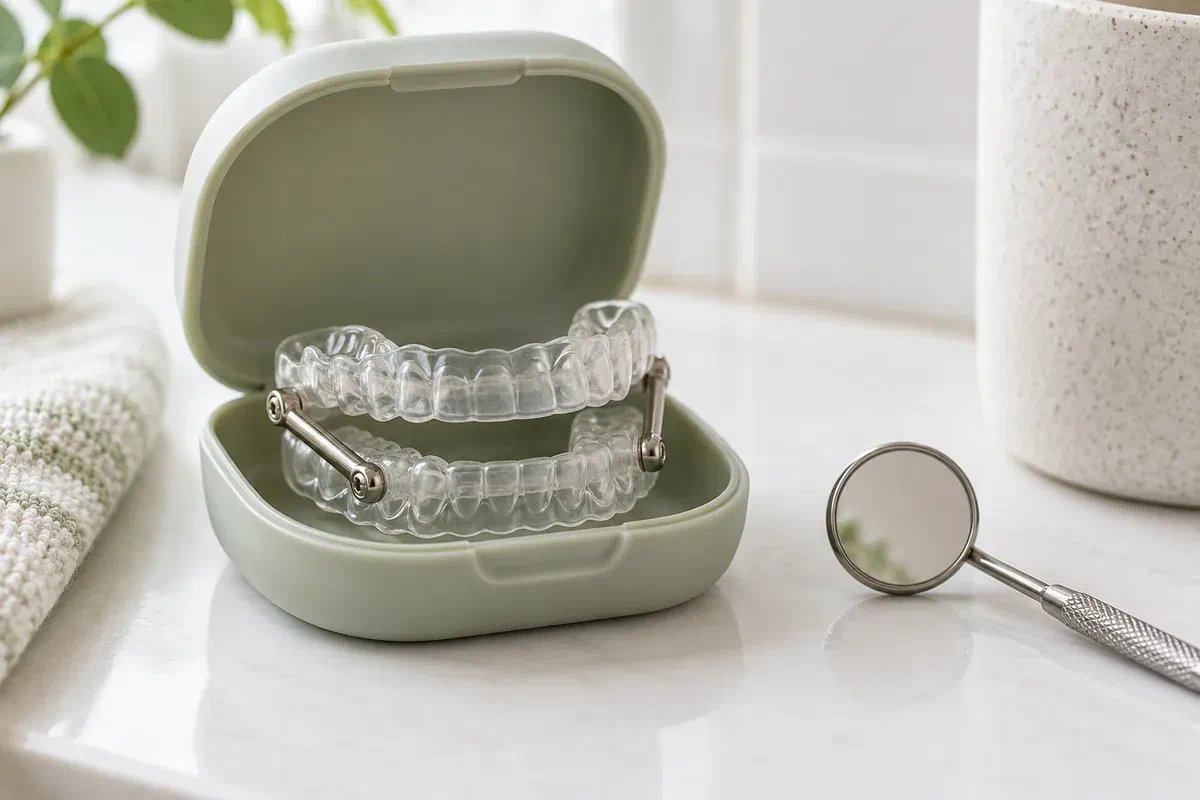
Illustrative connected oral sleep appliance inside an open protective case
What brought you in

Broken, missing or simply wrong — each one leads somewhere different.

Naming the actual problem helps the dentist decide what to examine first. A lost device, a damaged one, a changed mouth and a device that no longer seems to help each call for a slightly different set of questions.

You cannot find it, or it is gone for good

Note roughly when you last wore it and reach out to whoever made it to ask what records they kept. Those files may help, though they may also be out of date. Since the appliance is part of prescribed treatment, let your sleep physician know about the gap and ask what to do in the meantime.

It is cracked, warped or has a loose part

Bring it in rather than gluing or bending it at home. Some defects can be assessed for repair; others mean the device is no longer reliable. Age alone does not decide replacement, and a small-looking fault is not always a simple fix. Materials, design, parts and fit all play into the answer.

Your teeth or your results are different now

Tell us about recent dental work, a lost tooth, tender gums, bite changes or growing discomfort with the device. If snoring or daytime tiredness has crept back, mention that to your sleep-care provider too. A new appliance may help, but the underlying change still needs attention.

Please do not keep wearing an appliance that feels forced, cracked or has parts moving loosely. Call the provider who is treating you, and ask your sleep physician how to manage the nights until a decision is made.

Why a review is worth the visit

Your first appliance is a record of what worked and what did not.

Even if the device is lost, your memory of it is useful. Was it easy to put in? Did it leave your teeth feeling odd in the morning? Did a sleep study or physician review ever confirm it was helping? The dentist weighs that history against today’s examination rather than assuming the same design will behave the same way twice.

A replacement visit can also catch loose ends. Perhaps a filling is planned, or the sleep clinic has not seen you in a while. Sorting out what should happen first — and who arranges the fitting and later check-ups — lowers the chance of making a new device for a mouth that is about to change.

Patient information: AADSM — current assessment, appliance management, and coordinated follow-up

A current look at teeth, gums and jaw

The dentist examines the teeth, supporting tissues, restorations, bite and jaw movement that a new appliance would depend on. Ask whether anything should be treated before records are taken. Good results from the first device are encouraging, but they are not a substitute for checking the mouth today.

Sorting old records from ones that need redoing

Details of the original device, past dental records, adjustment notes and sleep-care letters all help tell the story. Ask which ones can be requested and which have to be refreshed. A stored scan or impression is not automatically usable just because a file still exists.

A plan for the gap and for later follow-up

Find out what to do while a replacement is being arranged, and who to call if that stretch runs longer than you hoped. Confirm how fitting and review of treatment response will be handled. Getting the new appliance is one stage of care, not the finish line.

How the replacement is worked out

Four stages from a broken device to a reviewed new one.

Arrive with the old appliance and any paperwork you have, or simply tell us what is missing. The aim is to understand why a replacement is on the table and what must be settled before a new device can be offered.

  1. Tell the story of the old appliance

    Explain what happened — lost, broken, uncomfortable, or something else — and how often you wore it beforehand. Share the name of the original provider and any recent sleep-clinic visit. Let the dentist know if you are going without treatment right now and whether a physician has advised you about that.

  2. Check the mouth as it is today

    The dentist looks at oral health and at the teeth and tissues that would hold an appliance. Recent or upcoming dental work can change the order of things. Ask which findings affect your choices and whether other dental treatment or a specialist opinion should come before new records.

  3. Talk through design, records and costs

    If a replacement looks appropriate, the dentist explains the suggested design, what records are needed, estimated costs and the expected stages. Ask why that option fits your past experience. Any timeline should come from the treating provider rather than being guessed from the assessment date.

  4. Fit the device and plan its review

    A new appliance needs its own fit check, handling guidance and prescribed starting position. Ask how dental follow-up and a medical check on effectiveness will be coordinated. Avoid copying old settings or changing parts yourself unless the instructions for that specific device say you may.

Between the old device and the new one

Nights without the appliance still need a plan.

What you should do depends on why the device is being replaced and whether the original is still safe to use. Ask for clear guidance covering the waiting period and the first weeks with the new appliance.

Keep your sleep physician informed

If you cannot wear the existing device, say so and ask what interim care is suitable. Do not drop other prescribed treatment or swap in a store-bought guard on your own. If you feel drowsy during the day, get medical advice and do not drive while sleepy.

Speak up about changes after records are taken

A new crown, a chipped or lost tooth, pain or a different-feeling bite can all affect how the replacement fits. Mention it when it happens or at the start of your next visit, not as you are leaving the fitting appointment.

Treat the new appliance as its own device

Practise putting it in and taking it out, and confirm cleaning, storage and any adjustments you are allowed to make. Looking like the old one does not mean it handles the same way. Keep the instructions somewhere handy and ask when to call if the first nights are hard.

Possible paths forward

Match the response to what actually went wrong.

Ask what each option would solve and what it would leave untouched. A brand-new appliance does not automatically fix discomfort, repeated breakage or returning symptoms if nobody has worked out why they happened.

When the assessment supports replacing it

A new custom appliance

Replacement may be reasonable once the relevant dental and medical information is reviewed. Ask which design and records are needed and how the fitting will work. The choice should reflect current findings and what you learned from the first device, with follow-up planned for the new one.

When the current device may still have life in it

Assessing whether a repair is suitable

Some faults can be assessed for repair instead. Whether that is sensible depends on the damage, the materials, the components and the fit. Ask what a repair would accomplish and how the device would be rechecked afterwards. Not every defect can be fixed, and repair is not always the economical route.

When your needs have shifted

A wider look at dental or sleep treatment

If your oral health, comfort or response to treatment has changed, a different assessment or care pathway may be needed. The dentist may contact the original provider or your sleep physician. Ask what must be solved first so a new device does not inherit the same unresolved problem.

Questions people ask us

Straight answers about repairing or replacing a sleep device.

Bring your questions about the old appliance, the fit, costs and what happens in between. Your records and examination make the answers specific to you.

(905) 876-4488
My appliance cracked last night. Can I still wear it until my appointment?
It is safest not to wear a device that is cracked, sharp or has loose parts, since pieces can break off and an altered shape may stress teeth. Call the clinic to describe the damage, and contact your sleep physician to ask how to manage in the meantime.
Is superglue or a home fix ever a good idea for a broken sleep device?
Home repairs are not recommended. Adhesives are not made for use in the mouth, and even a small change in shape can alter fit and position. Bring the appliance and any broken pieces in so the dentist can see whether a professional repair is worth assessing.
How does the dentist decide between repairing and replacing?
The decision rests on what failed, the device design and materials, whether parts are available, and how well it fits your current teeth. The dentist will explain the reasoning. Neither age nor the size of the defect decides it on its own.
Do I need to tell my sleep physician that my appliance broke?
Yes. The appliance is part of treatment your physician is managing, so a gap in use matters. They can advise you about the interim period and whether any review or testing should be arranged once the replacement is in use.
Will the new appliance be set exactly where my old one was?
Not necessarily. The starting position depends on the design, today’s findings, how you responded before and your prescribed plan. Settings do not always translate from one device to another, so follow the instructions given for the replacement rather than recreating the old one.
If my lost device turns up later, can I go back to using it?
Ask before you do. A device that has been missing may have been damaged, and your mouth or treatment plan may have changed since. The treating provider can tell you whether it has any role, such as a clinically agreed backup, or whether it should be retired.
Book in Milton

Bring the broken pieces and the backstory.

Call Milton Dental Clinic about a sleep appliance that is lost, damaged, worn or no longer comfortable. Let us know whether you still have it, who made it and whether you are currently without treatment, and we will talk through suitable assessment arrangements.

Whether to repair or replace depends on your current dental findings and the coordinated sleep-care plan.

Visit Milton Dental Clinic
Unit 1, 342 Bronte St. S, Milton, ON L9T 5B7
Get directions Clinic hours
Monday–Thursday
11am–7pm
Friday–Sunday
By appointment only

Areas we serve

  • Milton
  • Oakville
  • Mississauga
  • Georgetown
  • Halton Hills
  • Acton
  • Campbellville
  • Brampton
  • Burlington
  • Puslinch
  • Rockwood
  • Erin
  • Caledon
  • Etobicoke
  • Old Milton
  • Bronte Meadows
  • Timberlea
  • Dorset Park
  • Dempsey
  • Clarke
  • Beaty
  • Coates
  • Harrison
  • Scott
  • Willmott
  • Ford
  • Bowes
  • Cobden
  • Walker
  • Mountain View
  • Milton Heights
  • Hawthorne Village
  • Valley View
  • Fallingbrook
  • Nassagaweya
  • Trafalgar
  • Esquesing
  • Nelson
  • Brookville
  • Moffat
  • Glen Williams
  • Norval
  • Limehouse
  • Stewarttown
  • Ashgrove
  • Hornby
  • Silver Creek
  • Speyside
  • Scotch Block
  • North Oakville
  • River Oaks
  • Glen Abbey
  • West Oak Trails
  • Palermo
  • Bronte Creek
  • College Park
  • Joshua Creek
  • Uptown Core
  • Preserve
  • Iroquois Ridge
  • Lisgar
  • Meadowvale
  • Meadowvale Village
  • Churchill Meadows
  • Erin Mills
  • Central Erin Mills
  • Streetsville
  • East Credit
  • Creditview
  • Heartland
  • Sheridan
  • Mount Pleasant
  • Credit Valley
  • Huttonville
  • Churchville
  • Springbrook
  • Northwest Brampton
  • Bram West
  • Fletcher's Meadow
  • Fletcher's Creek South
  • Alton Village
  • Orchard
  • Millcroft
  • Headon Forest
  • Tansley
  • Brant Hills
  • Tyandaga
  • Kilbride
  • Lowville
  • Aberfoyle
  • Morriston
  • Arkell
  • Hillsburgh
  • Freelton
  • Carlisle
  • Waterdown
  • Flamborough
  • Mountsberg

How can we help?

Milton Dental Clinic

Have a question about your smile? Choose the option that works best for you.

For urgent dental concerns, please call.
Messages are reviewed during clinic hours.