
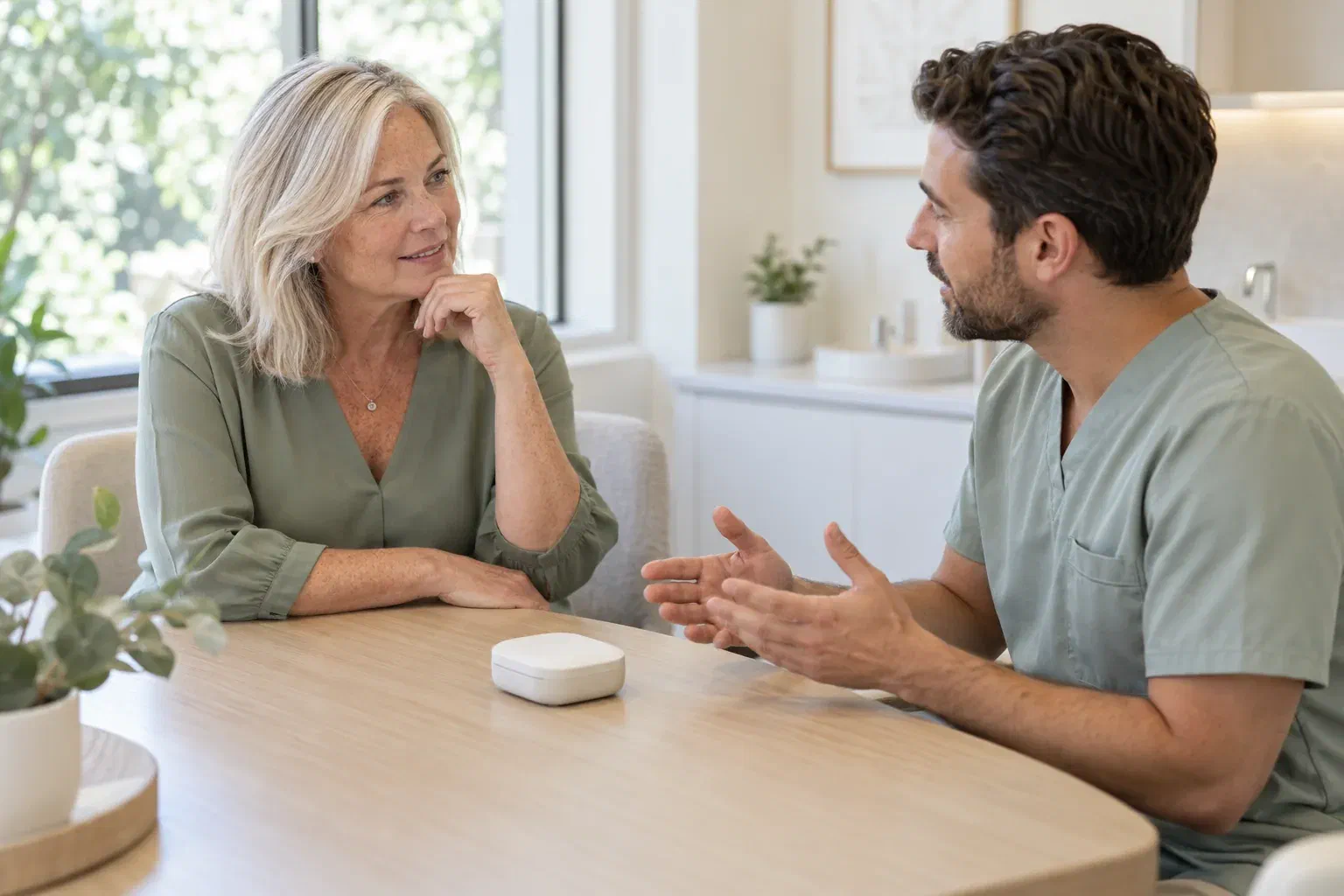
Illustrative consultation about replacing a custom oral sleep appliance
Specialized Care

Sleep Appliance Replacement in Oakville

Left your sleep appliance in a hotel room or packed it in a bag that never came home? From Oakville, you can arrange a review of your teeth and treatment plan so the next device is based on where things stand today.

Oakville · after a device goes missing

The case is empty. Here is what to do first.

A surprising number of oral sleep appliances disappear on the road — tucked under a hotel pillow, left on a cottage nightstand, or packed in luggage that went elsewhere. The instinct is to order an identical one quickly. Before that, it helps to check whether your teeth, dental work and sleep-care plan still match what the original was built for.

Write down what you remember while it is fresh: roughly how old the device was, how it felt, and whether it seemed to be doing its job. If you still have the case, the instructions or an earlier device, bring them along. Even without the appliance in hand, that history tells the dentist a great deal.

Share the name of the clinic that made the original and the physician or sleep clinic managing your condition. With that, Milton Dental Clinic can explain what assessment is appropriate and how information might be gathered. A replacement should suit the mouth you have now; reproducing an old design or setting without review would not confirm that.

Arrange a review after losing your appliance
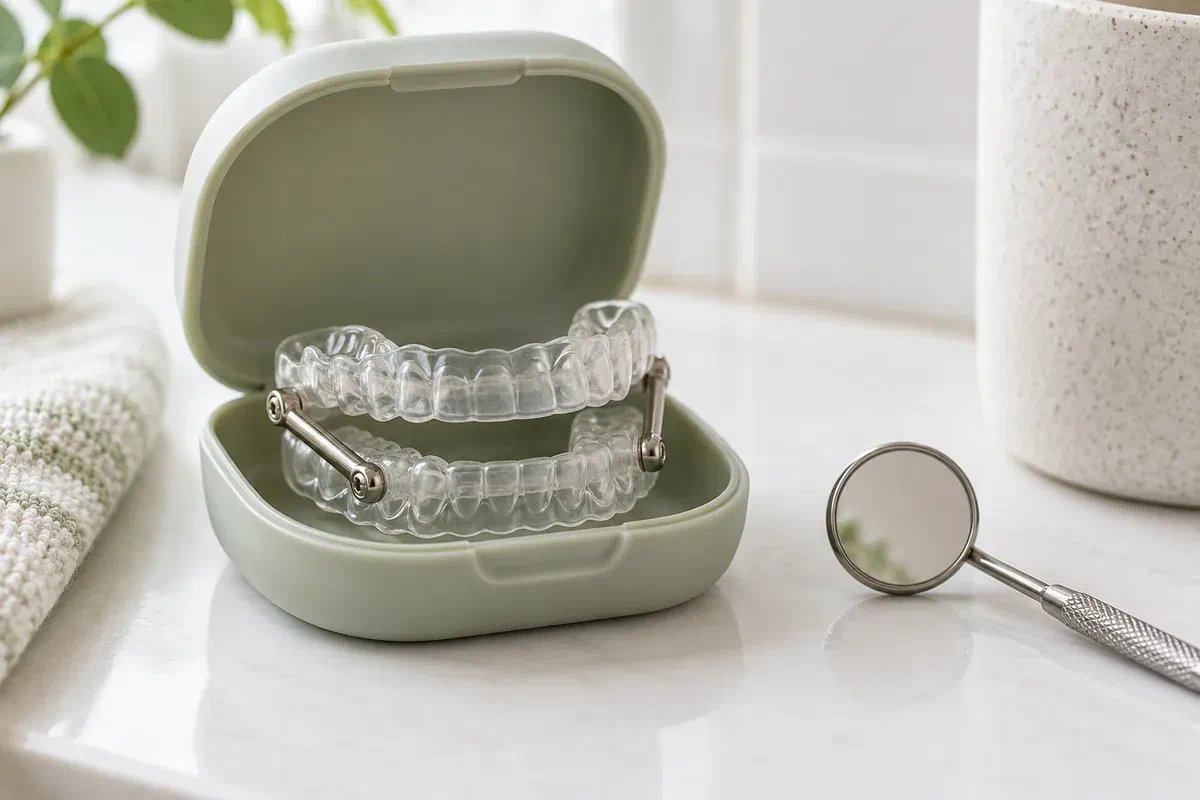
Illustrative connected oral sleep appliance inside an open protective case
Sorting out the reason

Missing, broken or no longer right?

Losing a device is a different situation from breaking one, and both differ from a mouth that has changed or a treatment that seems less effective. Saying clearly which applies helps shape the visit.

It was lost and is not coming back

Note the date you last wore it and ask the original provider what records exist. Some may be usable; others may need updating. Since the device is part of a prescribed treatment, contact the physician managing your sleep condition about an interim plan instead of simply waiting.

It came back damaged, or broke on its own

A device crushed in a suitcase or cracked over time should be brought in, pieces and all. A small fault is not automatically repairable, and an old appliance is not automatically finished. The specific damage, design, parts and present fit decide what is reasonable.

Something in your mouth or your sleep has changed

Mention new fillings or crowns, a lost tooth, gum soreness, a different bite or difficulty wearing the device. If snoring or tiredness has come back, tell your sleep-care provider. A new appliance alone may not address an oral problem or a treatment approach that is no longer working well.

If a recovered or damaged device feels tight, sharp or loose, please do not keep wearing it. Contact the treating provider, and ask your physician how to manage your sleep condition until the appliance question is settled.

What a replacement review offers

Turn a lost device into a useful check-in.

Without the appliance in front of them, the dentist relies on your memory and your records. Explain what felt comfortable, what did not, and whether a physician ever confirmed it was effective. That background sits alongside today’s examination, so the new plan is not built on the assumption that the old design will behave the same way.

The visit can also bring forgotten items to the surface. Is a filling or crown already on the schedule? Has it been a while since the sleep clinic saw you? Agreeing on an order — and on who handles fitting and later review — helps avoid making a device for a mouth that is about to change.

Patient information: AADSM — current assessment, appliance management, and coordinated follow-up

A look at the mouth that will wear it

Teeth, gums, restorations, bite and jaw movement all carry a new device, so each gets examined. If something needs treatment first, you will hear about it. A good experience with the lost appliance is helpful background, but it does not replace an examination of how things are today.

Working out which records can be reused

Paperwork on the lost device, earlier dental charts, any adjustment notes and letters from the sleep clinic can fill in the history. Ask what can be requested and what must be redone. A scan held in someone’s system is not necessarily suitable just because it still exists.

Clarity for the wait and the follow-up

Ask what to do in the meantime and who to call if the wait stretches out. Find out how fitting will happen and how your response to the new device will be reviewed. Collecting the replacement is part of the plan, not its final step.

What the appointments involve

Recall, examine, decide and fit.

Bring whatever you still have — case, instructions, an older device — or tell us what is gone. The appointment works out why a replacement is being considered and what must be in place before a suitable one can be made.

  1. Reconstruct what you know

    Explain where and when the device went missing or got damaged, and how often you used it beforehand. Give the original provider’s details and the date of any recent sleep review. Mention whether you are currently without treatment and whether your physician has already given advice about the gap.

  2. Assess the teeth and tissues now

    The dentist reviews oral health and the structures that would support and hold an appliance. Dental treatment completed since the original, or still planned, can affect the order. Ask which findings change your options and whether other care should happen before new records.

  3. Agree on a design and the records needed

    If replacement makes sense, the dentist outlines the proposed design, required records, estimated costs and the likely stages. Ask why that design is suggested given your past experience. Any timing should be confirmed by the treating provider rather than assumed from your first visit.

  4. Fit, instruct and plan a review

    On fitting day, the replacement is checked in your mouth, and you are shown how to handle it and where it should start. That starting point is prescribed for this device, so leave the old setting behind and change nothing yourself unless told you can. Ask who reviews the result: dentist, physician, or both.

Getting through the gap

No device for now does not mean no plan.

Advice for these weeks hinges on two things: the reason the appliance is being replaced, and whether anything you still own is safe to wear. Request clear guidance for the wait itself and for your first nights with the successor.

Tell the doctor managing your sleep care

A missing appliance is a pause in treatment, and your physician should hear about it. Ask what interim care suits you. Keep any other prescribed therapy going, and skip the sports or drugstore guard. Daytime drowsiness is a reason to seek medical advice and to stay off the road until it passes.

Report anything new in your mouth

A chipped tooth, a fresh filling, pain or a change in your bite after records are taken can affect fit. Tell the team promptly, rather than mentioning it as the fitting appointment is wrapping up.

Get to know the new appliance

Spend a few evenings practising insertion and removal before relying on it overnight. Confirm how to clean and store it and whether any adjustment is yours to make. Familiar looks can hide different handling. Tuck the instructions and the provider’s number into the travel case, and phone if early nights prove difficult.

Options after the review

Different problems, different answers.

For a lost device the answer may look obvious, but it is worth asking what any option fixes and what it leaves alone. Discomfort, repeated damage or returning symptoms will not vanish with a new appliance if no one knows why they began.

When the assessment points to a new device

A replacement custom appliance

Once the dental examination and your medical information have been considered, a new appliance may be the right call. You will want to know the proposed design, the records involved and how the fitting is booked. Today’s findings and your experience with the lost device should both shape that choice, and follow-up belongs in the plan.

When a damaged device has come back

Assessment for repair

If the appliance returned damaged, it may be assessed for repair. Suitcase damage varies, and so do materials, spare parts and how well the trays still seat. Find out what the repair is meant to achieve and how the device will be rechecked. Some defects cannot be corrected well, and a repair can cost more than it is worth.

When more than the device has changed

A broader review of dental or sleep care

Changes in oral health, comfort or how well treatment works can call for a different assessment or another route of care altogether. Information may be shared with the clinic that made the original or with your sleep physician. Settle which issue comes first, so the successor does not inherit an old difficulty.

Questions from Oakville

Lost-appliance questions, answered plainly.

Make a list of questions about the missing device, the fit, likely costs and the weeks before a replacement. Once your records and mouth have been examined, the answers can be specific.

(905) 876-4488
I lost my appliance while travelling. How soon should I call?
As soon as you are able. Calling early lets you start gathering records and speak with your sleep physician about the interim period. There is no need to wait until you are sure the device is gone for good.
Can the clinic that made my original simply send a copy?
Their records may help, but whoever provides the replacement needs to consider whether those records still match your mouth and whether the treatment plan is still suitable. New records may be needed. Mention any dental work or tooth changes since the original was made.
What should I bring if I no longer have the appliance?
Bring the case if you have it, any written instructions, the original provider’s name, and details of your sleep physician or clinic. A note of when you last wore it and how it felt is useful too.
Is a boil-and-bite mouthguard a reasonable stopgap?
A generic guard is not a substitute for a prescribed sleep appliance and may not be suitable for your teeth or condition. Ask your sleep physician about interim care rather than improvising.
How do I protect the next appliance when I travel?
Keep it in its hard case, pack it in carry-on rather than checked luggage, and make returning it to the case part of your morning routine. Avoid heat, such as a sunny car dashboard, which can distort some materials.
Will my sleep doctor need to check the new device once I start using it?
Follow the dental and medical review plan you are given. Feeling comfortable with the device does not by itself show it is controlling your sleep condition, so ask how and when its effect will be assessed.
Reaching us from Oakville

Tell us when and how the device went missing.

Get in touch with Milton Dental Clinic once you realise the device is gone, or if it came back broken, worn or ill-fitting. Say whether anything was recovered, which clinic made it and whether treatment has stopped, and we will talk through how the assessment can be arranged.

What gets made next rests on your present dental findings and on your physician’s sleep-care plan.

Visit Milton Dental Clinic
Unit 1, 342 Bronte St. S, Milton, ON L9T 5B7
Get directions Clinic hours
Monday–Thursday
11am–7pm
Friday–Sunday
By appointment only

Areas we serve

  • Milton
  • Oakville
  • Mississauga
  • Georgetown
  • Halton Hills
  • Acton
  • Campbellville
  • Brampton
  • Burlington
  • Puslinch
  • Rockwood
  • Erin
  • Caledon
  • Etobicoke
  • Old Milton
  • Bronte Meadows
  • Timberlea
  • Dorset Park
  • Dempsey
  • Clarke
  • Beaty
  • Coates
  • Harrison
  • Scott
  • Willmott
  • Ford
  • Bowes
  • Cobden
  • Walker
  • Mountain View
  • Milton Heights
  • Hawthorne Village
  • Valley View
  • Fallingbrook
  • Nassagaweya
  • Trafalgar
  • Esquesing
  • Nelson
  • Brookville
  • Moffat
  • Glen Williams
  • Norval
  • Limehouse
  • Stewarttown
  • Ashgrove
  • Hornby
  • Silver Creek
  • Speyside
  • Scotch Block
  • North Oakville
  • River Oaks
  • Glen Abbey
  • West Oak Trails
  • Palermo
  • Bronte Creek
  • College Park
  • Joshua Creek
  • Uptown Core
  • Preserve
  • Iroquois Ridge
  • Lisgar
  • Meadowvale
  • Meadowvale Village
  • Churchill Meadows
  • Erin Mills
  • Central Erin Mills
  • Streetsville
  • East Credit
  • Creditview
  • Heartland
  • Sheridan
  • Mount Pleasant
  • Credit Valley
  • Huttonville
  • Churchville
  • Springbrook
  • Northwest Brampton
  • Bram West
  • Fletcher's Meadow
  • Fletcher's Creek South
  • Alton Village
  • Orchard
  • Millcroft
  • Headon Forest
  • Tansley
  • Brant Hills
  • Tyandaga
  • Kilbride
  • Lowville
  • Aberfoyle
  • Morriston
  • Arkell
  • Hillsburgh
  • Freelton
  • Carlisle
  • Waterdown
  • Flamborough
  • Mountsberg

How can we help?

Milton Dental Clinic

Have a question about your smile? Choose the option that works best for you.

For urgent dental concerns, please call.
Messages are reviewed during clinic hours.