

Illustrative conversation about snoring and oral-appliance suitability
Specialized Care

Snoring Appliances in Acton

A snoring appliance relies on your teeth to hold it. For adults in Acton, we examine whether gums, fillings, gaps and jaw joints can support a device, after a doctor has looked at the snoring itself, and explain what may need care first.

The dental foundation

Teeth are the anchor.

Most custom snoring appliances grip the upper and lower teeth and use them to hold the lower jaw slightly forward overnight. That means the teeth, the gums and bone around them, and the jaw joints all take on a job they do not usually do. Whether they can manage it safely is the dental heart of the decision.

First, though, someone needs to understand the snoring. It can be harmless noise, or it can come with obstructive sleep apnea, a condition a physician must diagnose. A dentist cannot settle that by examining your mouth, and neither can a recording on your phone. Once the medical picture is clear, the question turns to your teeth.

For adults coming from Acton, we look closely at that foundation. Gum health, loose or missing teeth, older fillings and crowns, and how your jaw opens all matter. We explain what we find, what might need attention before a device, and whether a snoring appliance is realistic for you at this point.

Check whether your teeth can support a device
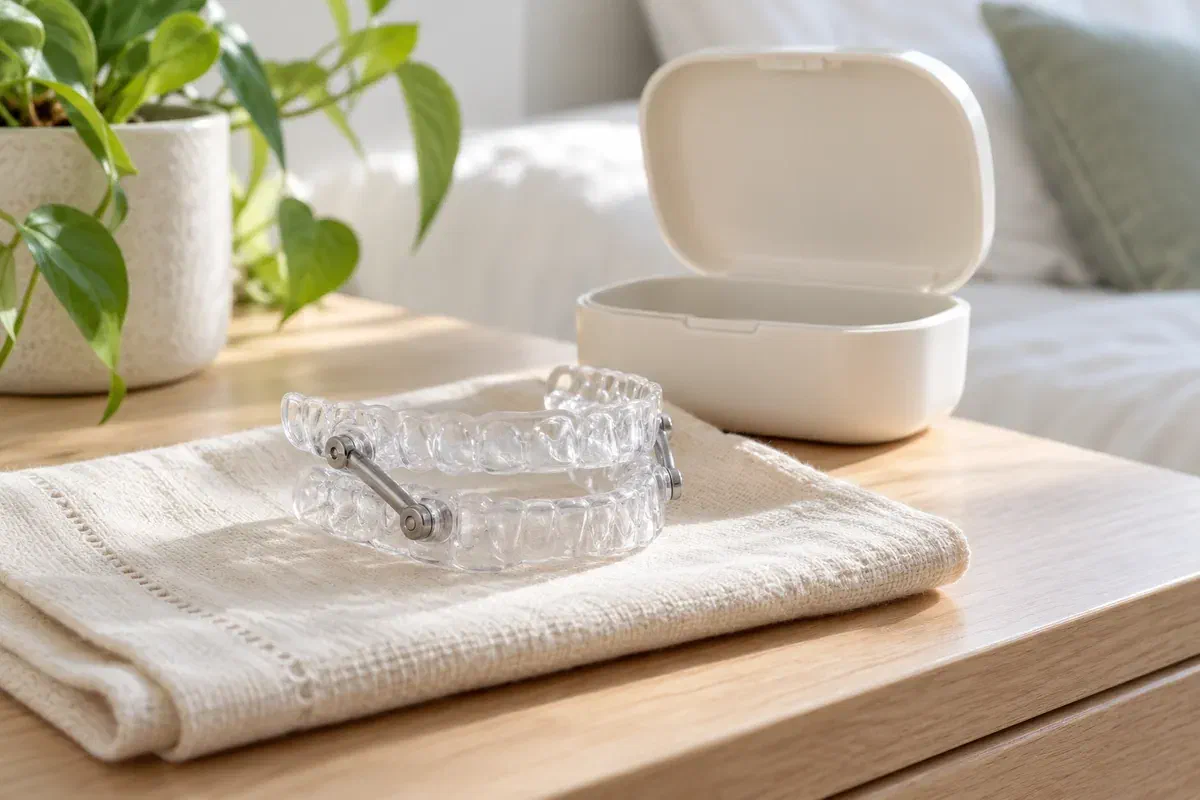
Illustrative custom mandibular advancement appliance beside its protective case
Before a device is planned

Three areas we look at, and why

Nobody expects you to arrive knowing which device you want. These points help us understand whether a physician should be involved first and whether your mouth is ready for an appliance now.

What a partner hears, and how you feel by day

Breathing that stops, gasping, or a struggle to stay awake during the day are reasons to see a doctor about a sleep evaluation. A mouthpiece is not a substitute for that. Tell your doctor whether the problem is getting worse and whether sleepiness has crept into driving.

Gums, gaps, and teeth that move

Bleeding or receding gums, teeth that feel loose, gaps from extractions, and recent fillings or crowns all affect how much grip a device can safely take. Jaw pain or clicking matters too. Some of these call for treatment first; others simply change the design.

Any earlier attempt at a mouthpiece

If you have tried one, bring it, and tell us how it came to you and why it ended up unused. Past experience is informative, but it does not doom every future device, nor does it guarantee a better outcome with a different design.

These assessments are for adults. A child who snores should be seen by a physician; an adult anti-snoring appliance is not a replacement for that evaluation.

Why the exam shapes the device

Good support first, then a design that respects it

When an appliance is appropriate, it should be designed around the teeth you actually have and the condition they are in. You should hear why a particular style suits your findings, what it is meant to achieve, and what it cannot do. Comfort, handling, possible side effects, and the review schedule should all be explained.

Mention what worries you in daily life. Weak grip, sensitive teeth, a partial denture you remove at night, or a habit of getting up often can all affect whether a device is practical. These considerations sit beside the diagnosis and dental findings during planning, not after the appliance has been made.

Patient information: AADSM — assessment, appliance management, and ongoing care

A defined job for the device

Check whether it is intended for diagnosed primary snoring or as part of a sleep-apnea plan. The distinction guides follow-up and who stays involved. A custom appliance can help some people, though it is not a remedy for every cause of snoring.

A fitting that protects the teeth it grips

At fitting, the clinician checks how the device engages each tooth and teaches you how to insert, remove, and clean it without straining weaker teeth. Ask what you may adjust. Your early routine should follow your own written plan.

Reviews focused on long-term health

Ask how gum health, tooth mobility, jaw comfort, and the way your teeth meet will be monitored, and how your physician will judge the response. Reviews remain important once the appliance feels normal, because teeth can change gradually.

How we work through it

Understand the snoring. Check the foundation. Then decide.

Any sleep reports, a medicine list, and a previous mouthpiece are useful. If you have none of those, a description of your sleep is enough. You do not need to have decided on an appliance.

  1. Talk through sleep and medical history

    We ask about the snoring, how you feel during the day, and any testing or advice from a doctor. If a medical evaluation has not taken place, we explain why it comes first. Our conversation can flag concerns but does not diagnose a sleep condition.

  2. Examine gums, teeth, and jaw joints

    The clinician checks gum and bone support, any loose or missing teeth, the state of existing restorations, how your teeth meet, and how your jaw moves. You will hear what each finding means and whether treatment or further assessment should come before a device.

  3. Weigh a device against the alternatives

    Discuss what an appliance could achieve, its limits, and other approaches suited to your diagnosis. Raise cost, the number of visits, and follow-up before choosing. If you go ahead, we explain the records needed and the stages; a finished device is not usually available at the first visit.

  4. Fit carefully and plan reviews

    The finished appliance is seated and checked against each tooth, and you go home with instructions on wearing and cleaning it. Ask how to reach us if a tooth or your jaw becomes sore. We agree how the response will be assessed and how your physician remains involved.

Looking after teeth and device

Watch for tenderness, and keep the gums healthy.

The early weeks should come with written instructions and an easy way to reach us. Discomfort deserves a call, and pushing the jaw further forward than prescribed is not likely to improve the result.

Handle it gently, as shown

Practise inserting and removing the appliance at fitting, and keep the guidance where you will see it. Make only the adjustments your plan permits. If handling is hard, especially around a weaker tooth, ask us instead of forcing it or bending a part.

Report sore teeth, gums, or a different bite

Tell us where you feel it and when. A tooth that starts to feel loose needs prompt attention. We can examine the appliance and your mouth together. Do not reshape the device at home, and stop wearing it if it cracks or no longer fits safely.

Keep both the mouth and the result under review

Tell us how your sleep and daytime alertness have changed and whether you are wearing the device regularly. Keep up your dental cleanings and medical follow-ups. A partner’s observations help, but they cannot replace evaluation of sleep-apnea treatment where indicated.

Options for Acton adults

If the teeth are not ready, there are still paths forward.

Ask what may be contributing to your snoring and which approaches suit your health and preferences. Advice should take account of your assessment, your dental condition, and any sleep disorder needing its own treatment.

When the diagnosis and dental support allow

A custom appliance once the mouth is ready

After any necessary dental care, a device may be designed for your remaining teeth and fitted with planned check-ins. Ask why that design suits your support and what signs mean an early visit. It should never be presented as a guarantee of quiet nights.

When health, nose, or habits may be involved

A physician’s review of other contributors

Your doctor can look at nasal issues, general health, medicines, and lifestyle and suggest suitable care. Keep any prescribed treatment going unless advised otherwise. If your teeth cannot support a device, this route may matter even more.

When a sleep disorder is confirmed

Physician-led care for sleep apnea

Depending on testing, treatment might involve PAP, an oral device where the teeth allow, or other medical care. We share the dental findings that affect those choices. Since healthy sleep is the goal, your physician continues to oversee the response.

Patient information: NHLBI — medical treatment options for sleep apnea

Questions from Acton about dental suitability

Can my mouth handle a snoring appliance?

Appliances that look alike can work in different ways. Ask about the specific device being considered and how it fits into your assessment and the wider plan.

(905) 876-4488
Can I get a snoring appliance if I have gum disease?
Active gum disease usually needs attention first, because a device places extra forces on the teeth and their support. Once the gums are stable, the clinician can reassess. Ask what your findings mean and what treatment might involve.
Do I need a certain number of teeth for an appliance to work?
There is no single number that applies to everyone. The position and support of your remaining teeth, existing restorations, and the design being considered all matter. Ask the clinician what your particular findings allow.
What happens to the appliance if I need a filling or crown later?
Changing the shape of a tooth may affect how the device seats. Tell your dentist about the appliance before any work and bring it along so the fit can be checked afterward.
Is a snoring appliance an option with a partial denture?
Sometimes. It depends on the natural teeth remaining and how they can anchor the device, since a removable denture is not usually relied on for that. Individual assessment is needed before any design is chosen.
Should a doctor see me before you look at my teeth?
The medical evaluation comes first to establish what the snoring represents, because it can be linked with obstructive sleep apnea. We can still examine your teeth, but an appliance is chosen only once the diagnosis is known.
If I snore less, can I stop the dental reviews?
Please continue them. Reviews track your gums, teeth, and bite, which can change gradually with appliance use. Less noise also does not confirm that sleep apnea is controlled; your physician may want testing to check.
Book from Acton

Let us check the foundation before anything is built on it.

Contact Milton Dental Clinic to arrange a dental assessment for a snoring appliance. Tell us about any sleep testing, current treatment, gum concerns, or a mouthpiece you have tried, so the first visit focuses on what matters.

Appliance treatment follows medical evaluation and a full dental examination.

Visit Milton Dental Clinic
Unit 1, 342 Bronte St. S, Milton, ON L9T 5B7
Get directions Clinic hours
Monday–Thursday
11am–7pm
Friday–Sunday
By appointment only

Areas we serve

  • Milton
  • Oakville
  • Mississauga
  • Georgetown
  • Halton Hills
  • Acton
  • Campbellville
  • Brampton
  • Burlington
  • Puslinch
  • Rockwood
  • Erin
  • Caledon
  • Etobicoke
  • Old Milton
  • Bronte Meadows
  • Timberlea
  • Dorset Park
  • Dempsey
  • Clarke
  • Beaty
  • Coates
  • Harrison
  • Scott
  • Willmott
  • Ford
  • Bowes
  • Cobden
  • Walker
  • Mountain View
  • Milton Heights
  • Hawthorne Village
  • Valley View
  • Fallingbrook
  • Nassagaweya
  • Trafalgar
  • Esquesing
  • Nelson
  • Brookville
  • Moffat
  • Glen Williams
  • Norval
  • Limehouse
  • Stewarttown
  • Ashgrove
  • Hornby
  • Silver Creek
  • Speyside
  • Scotch Block
  • North Oakville
  • River Oaks
  • Glen Abbey
  • West Oak Trails
  • Palermo
  • Bronte Creek
  • College Park
  • Joshua Creek
  • Uptown Core
  • Preserve
  • Iroquois Ridge
  • Lisgar
  • Meadowvale
  • Meadowvale Village
  • Churchill Meadows
  • Erin Mills
  • Central Erin Mills
  • Streetsville
  • East Credit
  • Creditview
  • Heartland
  • Sheridan
  • Mount Pleasant
  • Credit Valley
  • Huttonville
  • Churchville
  • Springbrook
  • Northwest Brampton
  • Bram West
  • Fletcher's Meadow
  • Fletcher's Creek South
  • Alton Village
  • Orchard
  • Millcroft
  • Headon Forest
  • Tansley
  • Brant Hills
  • Tyandaga
  • Kilbride
  • Lowville
  • Aberfoyle
  • Morriston
  • Arkell
  • Hillsburgh
  • Freelton
  • Carlisle
  • Waterdown
  • Flamborough
  • Mountsberg

How can we help?

Milton Dental Clinic

Have a question about your smile? Choose the option that works best for you.

For urgent dental concerns, please call.
Messages are reviewed during clinic hours.