

Illustrative conversation about snoring and oral-appliance suitability
Specialized Care

Snoring Appliances in Burlington

Your doctor or sleep clinic has suggested an oral appliance. Now what? For adults in Burlington, the dental part begins with an exam of teeth, gums and jaw, a clear explanation of the device, and a plan for how it will be reviewed.

After the sleep assessment

A referral in hand, and a dental exam to come

Some people arrive with the medical step already done. A sleep study or a physician’s review has clarified whether the snoring is simple or tied to obstructive sleep apnea, and an oral appliance has been mentioned as a possibility. That is a good starting point, and the records you bring help a great deal.

The dental question is different. Can your teeth, gums, and jaw joints support a device that holds the lower jaw a little forward each night? A snoring appliance of this kind works differently from a sports guard or a grinding guard, and it puts specific demands on the teeth it grips.

For Burlington adults who have been referred, we examine those details, explain what the findings mean, and discuss whether a custom device is sensible now, later, or not at all. Where no medical assessment has happened yet, we can explain why it should come first and how to ask for one.

See what the dental assessment involves
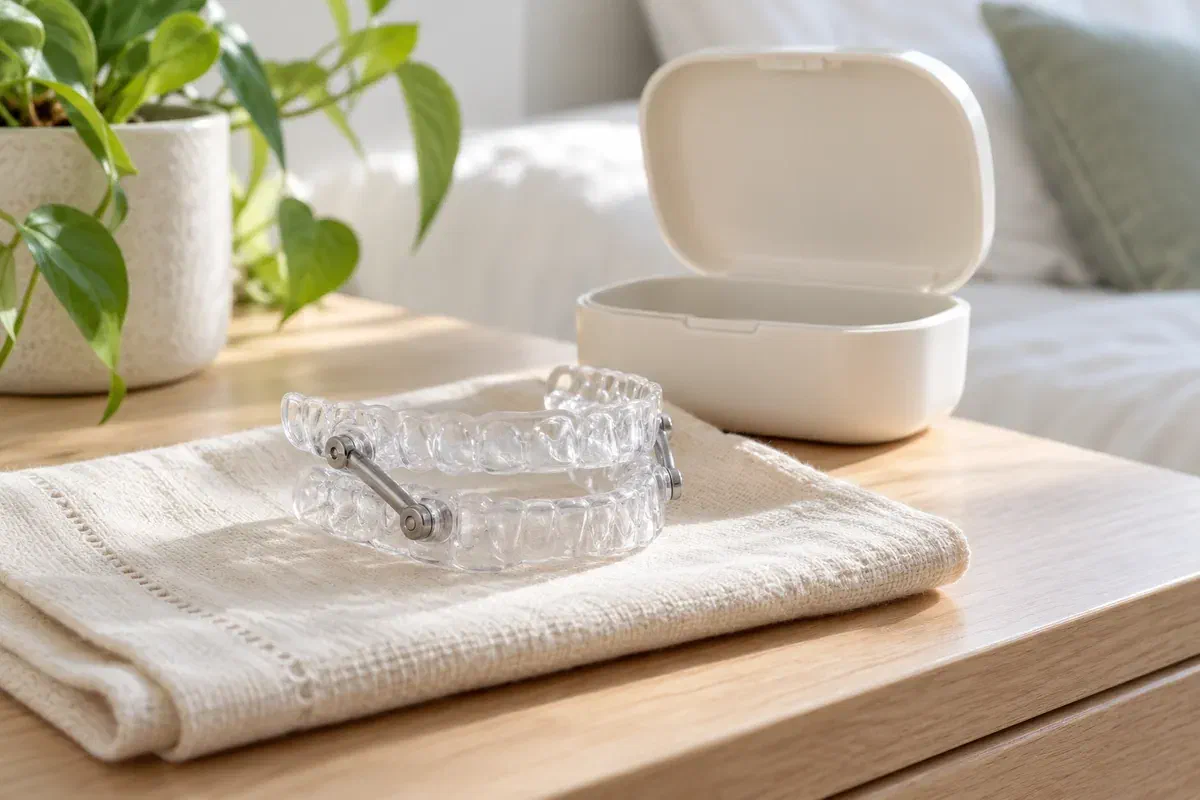
Illustrative custom mandibular advancement appliance beside its protective case
Details to share at the first visit

What you tell us shapes what we examine.

Bring whatever your physician or sleep clinic has given you, and tell us about anything new since then. Your answers help confirm that the dental plan lines up with the medical picture.

Symptoms that are new or worsening since testing

If pauses, gasping, or daytime drowsiness have appeared or increased, let your medical provider know as well as us. An appliance is not a reason to delay that update. Mention whether sleepiness has touched your driving or other moments when alertness is essential.

Teeth or jaw problems that could rule a device in or out

Loose teeth, tender gums, recent crowns or fillings, gaps, and a sore or clicking jaw can each affect what is possible. Some point to a different design; others mean treatment should come first. Being able to clip something over the teeth says little about whether it belongs there.

Any appliance you have worn before

Bring a previous device and tell us who made it, how you wore it, and what led you to stop. Useful as that is, one poor experience does not mean all appliances fail, nor that a fresh design will work. The clinician needs to see it in context.

We assess adults for these devices. A snoring child should be seen medically first, and an adult anti-snoring mouthpiece should not be used in place of that evaluation.

Turning a referral into a workable plan

A design chosen for your mouth, reviewed on a schedule

A referral says an appliance may help. The dental plan explains which kind, why it suits your teeth and bite, what effect is expected, and what it will not do. It should also be honest about comfort, handling, side effects such as tooth or jaw tenderness, and the reviews that follow.

Bring your own priorities into it. Maybe you sleep on your stomach, travel often, worry about cleaning, or want to be sure you can remove the device quickly. Those preferences matter. They are part of choosing a design, alongside the diagnosis and the exam, rather than issues to sort out once it arrives.

Patient information: AADSM — assessment, appliance management, and ongoing care

A device matched to your diagnosis

Your records should state whether the aim is primary snoring or treatment within a sleep-apnea plan. That affects testing, follow-up, and communication with your physician. A custom appliance can play a part, but it is never a catch-all cure for snoring.

Fitting that leaves you confident

When the appliance is ready, the clinician checks the fit in your mouth and shows you how to seat it, remove it, and keep it clean. Ask what you are allowed to change. Your starting routine belongs to your plan, not to an online schedule.

Reviews that cover more than the noise

Ask how tooth pressure, jaw comfort, and any bite change will be followed, and how your physician will judge the response. Reviews continue after the device feels normal. A comfortable fit and a quieter night still leave questions only follow-up can answer.

From referral to review

How a referred appliance usually comes together

Copies of your sleep report and referral are the most helpful things to bring. If you were not referred, come anyway; describing the problem is a perfectly good start.

  1. Review the referral and your sleep history

    We go over your symptoms, testing, and what your physician recommended. Where records are missing, we can explain which ones would help. Our questions add context, but diagnosis and testing stay with the sleep-care provider rather than the dental office.

  2. Examine your teeth, gums, and jaw function

    The clinician checks how many teeth can anchor a device, the health of their support, existing restorations, your bite, and how far and how comfortably your jaw moves. Some findings call for treatment or further assessment before an appliance is reasonable.

  3. Agree on whether to proceed

    Discuss the expected benefit, its limits, and how an appliance compares with other options for your diagnosis. Ask about costs, the number of visits, and reviews. If you decide to go ahead, we explain the records and stages involved; same-day delivery is not usual.

  4. Fit, report back, and follow up

    At fitting you learn how to handle and clean the appliance and receive your prescribed starting plan. Ask how to reach us with soreness or difficulty. We confirm how your physician will assess the response and how we will keep them informed where relevant.

Settling in with the device

Your plan, your pace, and a quick call when needed

Expect written instructions and a clear contact route for the early weeks. Soreness deserves a call rather than patience, and extra jaw advancement beyond your plan is not a way to speed things up.

Get comfortable with handling

Rehearse insertion and removal before leaving the fitting, and keep the guidance sheet close. Make only the changes your plan names. When it still feels clumsy, ask us rather than pressing it into place with your bite or bending a component.

Flag pain or a shifting bite early

Say which tooth or side is affected, when it begins, and whether it stops you wearing the device. We review the appliance and your mouth together. Avoid home modifications, and do not keep wearing a device that has broken or fits unsafely.

Keep both teams informed

Tell us whether snoring and any other symptoms have changed, and keep your appointments with your physician too. Let both know about nights you skipped. A partner’s impression is helpful, but sleep-apnea treatment still needs proper evaluation where indicated.

Options after a Burlington referral

Your diagnosis decides where the appliance fits.

Ask your physician and your dentist which approaches suit your situation. A good recommendation reflects the testing, what matters to you, and any sleep condition that calls for its own care.

Where testing and the dental exam support it

A custom appliance with reviews built in

An appliance may be made with an individual fitting and planned check-ins. Ask why the design suits your mouth and which problems should bring you in sooner. Expect a realistic explanation, not a promise of complete quiet or an assumption that everyone copes with the same device.

Where other factors or health conditions are involved

Continued medical review

Your physician can look at nasal, sleep, health, or lifestyle contributors and recommend care. Keep them up to date on medicines and treatments, and do not stop anything independently. The dental plan should be ready to step back if those findings suggest a different route.

Where a sleep disorder has been diagnosed

Combined treatment for sleep apnea

Depending on your results, care might involve PAP, an oral device, or other physician-led treatment. Ask how effectiveness will be confirmed and how dental findings affect your choices. Reducing noise is only one goal, so the medical provider remains involved.

Patient information: NHLBI — medical treatment options for sleep apnea

Burlington questions about referred appliances

Questions people ask once a device has been suggested

Appliances that look alike can work very differently. Ask about the exact device your physician and dentist are discussing, and how it fits into your care.

(905) 876-4488
Do you need my sleep study results before the dental exam?
They are very helpful. The report shows what was diagnosed and guides the dental plan. If you do not have a copy, ask your physician or sleep clinic, and we can explain which information is most useful.
Can you send updates to my sleep physician?
With your consent, we can share relevant dental findings and appliance information with the provider managing your sleep care. Coordinated communication helps both teams follow your response and make decisions together.
What if the dental exam shows I am not a good candidate?
We explain what we found and whether treatment could change that. Some findings are temporary, others are not. Your physician can then discuss other approaches, so the plan for your sleep continues even if an appliance is not suitable.
Do I need all my teeth to wear a snoring device?
Not always. The number of teeth, where they are, their support, and existing restorations all matter, and different designs need different anchorage. Ask what your findings mean rather than assuming the answer is yes or no.
Can a snoring appliance alter my bite over time?
Changes in how the teeth meet, or in tooth position, can happen with oral-appliance use, and jaw or tooth discomfort needs attention too. Discuss this before starting and keep reviews. Report lasting changes instead of trying to correct them yourself.
How is success measured if I have sleep apnea?
Not by the noise alone. Your physician decides how to assess treatment response, which may include follow-up testing. Dental reviews continue alongside that to check the appliance, your teeth, and your bite.
Arrange a visit from Burlington

Bring the referral. We will take it from there.

Contact Milton Dental Clinic to book a dental assessment for a snoring appliance. Bring sleep reports, details of any current treatment, and any device you have used, so your appointment begins with the information that counts.

Appliance suitability depends on medical evaluation and an individual dental examination.

Visit Milton Dental Clinic
Unit 1, 342 Bronte St. S, Milton, ON L9T 5B7
Get directions Clinic hours
Monday–Thursday
11am–7pm
Friday–Sunday
By appointment only

Areas we serve

  • Milton
  • Oakville
  • Mississauga
  • Georgetown
  • Halton Hills
  • Acton
  • Campbellville
  • Brampton
  • Burlington
  • Puslinch
  • Rockwood
  • Erin
  • Caledon
  • Etobicoke
  • Old Milton
  • Bronte Meadows
  • Timberlea
  • Dorset Park
  • Dempsey
  • Clarke
  • Beaty
  • Coates
  • Harrison
  • Scott
  • Willmott
  • Ford
  • Bowes
  • Cobden
  • Walker
  • Mountain View
  • Milton Heights
  • Hawthorne Village
  • Valley View
  • Fallingbrook
  • Nassagaweya
  • Trafalgar
  • Esquesing
  • Nelson
  • Brookville
  • Moffat
  • Glen Williams
  • Norval
  • Limehouse
  • Stewarttown
  • Ashgrove
  • Hornby
  • Silver Creek
  • Speyside
  • Scotch Block
  • North Oakville
  • River Oaks
  • Glen Abbey
  • West Oak Trails
  • Palermo
  • Bronte Creek
  • College Park
  • Joshua Creek
  • Uptown Core
  • Preserve
  • Iroquois Ridge
  • Lisgar
  • Meadowvale
  • Meadowvale Village
  • Churchill Meadows
  • Erin Mills
  • Central Erin Mills
  • Streetsville
  • East Credit
  • Creditview
  • Heartland
  • Sheridan
  • Mount Pleasant
  • Credit Valley
  • Huttonville
  • Churchville
  • Springbrook
  • Northwest Brampton
  • Bram West
  • Fletcher's Meadow
  • Fletcher's Creek South
  • Alton Village
  • Orchard
  • Millcroft
  • Headon Forest
  • Tansley
  • Brant Hills
  • Tyandaga
  • Kilbride
  • Lowville
  • Aberfoyle
  • Morriston
  • Arkell
  • Hillsburgh
  • Freelton
  • Carlisle
  • Waterdown
  • Flamborough
  • Mountsberg

How can we help?

Milton Dental Clinic

Have a question about your smile? Choose the option that works best for you.

For urgent dental concerns, please call.
Messages are reviewed during clinic hours.