

Illustrative conversation about snoring and oral-appliance suitability
Specialized Care

Snoring Appliances in Oakville

Is it only noise, or could it be sleep apnea? For Oakville adults weighing a dental snoring appliance, that question comes first, followed by an exam of the teeth and jaw and a frank talk about the options.

Sorting out the sound

Is it just snoring?

That is the question worth answering before anything goes in your mouth. Simple snoring is a nuisance. Obstructive sleep apnea is a medical condition in which breathing repeatedly narrows or stops during sleep, and it often comes with snoring. From the outside, the two can sound identical, which is why a doctor’s evaluation sets the direction.

Once the diagnosis is clear, a custom oral appliance may be one of the options for some adults. A common type positions the lower jaw slightly forward at night to help keep the airway more open. It is not a sports mouth guard, and it is not the same thing as a guard made to protect teeth from grinding.

Coming from Oakville, you can expect a straightforward first conversation. Describe the snoring, anything your partner has seen, and any testing you have had. We will explain which questions belong with a physician, what a dental exam can tell us, and how the decision about a device fits after both.

Find out where your snoring fits
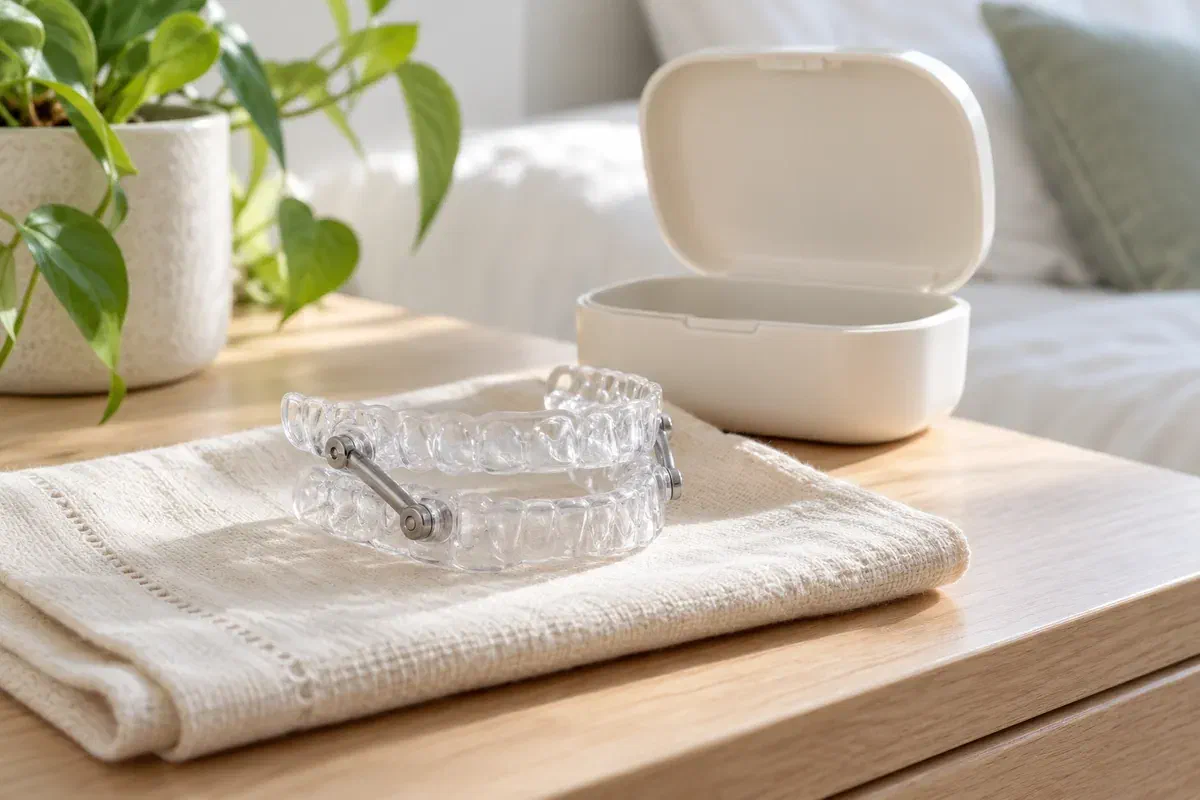
Illustrative custom mandibular advancement appliance beside its protective case
Clues that shape the next step

Three things that tell us which conversation to have

You do not need to label the problem yourself. Describing what happens at night, and how you feel during the day, helps show whether a medical sleep assessment should come before any appliance is discussed.

Breathing stops, gasps, or struggling to stay awake

These signs call for a conversation with a physician about sleep testing. A dental device should never be a way to skip that. Let them know whether things are getting worse and whether drowsiness has affected your driving or other activities where staying alert is important.

Dental issues that could make a device unsuitable

Tell us about teeth that move or ache, bleeding or receding gums, recent dental work, missing teeth, or jaw pain and clicking. Such findings may change the design, delay treatment, or suggest that other care is needed first. A device that fits over teeth is not automatically right for them.

Past attempts that did not work out

If you have tried an anti-snoring guard before, bring it and explain its source, how you used it, and why you gave up. That history helps, but it does not mean every appliance will disappoint or that a different one is sure to succeed. Context is what the clinician needs.

Our appliance assessments are for adults. Snoring in a child calls for a medical evaluation; a mouthpiece designed for adults is not an alternative to that.

What a tailored appliance plan offers

Built for one mouth, with a review schedule attached

Planning a snoring appliance means more than taking impressions. You should understand why a particular design suits your teeth and bite, what effect it is expected to have, and where it falls short. Comfort, ease of handling, possible side effects, and ongoing reviews all belong in that discussion from the start.

Think about your own routine as well. A tendency to clench, sensitive teeth, frequent business travel, or anxiety about removing the device in a hurry are all worth sharing. Those practical points make the plan workable, and they should sit beside the diagnosis and the oral findings rather than come up later.

Patient information: AADSM — assessment, appliance management, and ongoing care

A clear clinical purpose

Ask whether the appliance is for diagnosed primary snoring or forms part of a sleep-apnea treatment plan. That changes the follow-up and who is involved. A custom device may well have a role, yet no appliance should be offered as a universal answer to snoring.

A careful fitting and simple instructions

During the fitting appointment, the clinician confirms how the device sits and teaches you to insert, remove, and clean it. Ask which adjustments are yours and which are ours. Your starting routine should be written for you, not borrowed from someone else’s device.

Monitoring that continues

Find out how an achy jaw, pressure on individual teeth, or a shift in your bite would be picked up, and how the effect on your sleep will be measured. Ask when your physician needs to weigh in. Reviews remain important even when wearing the appliance becomes second nature.

The route from first visit to fitted device

Diagnosis guides it. The dental exam shapes it.

Sleep reports and any old mouthpiece are worth bringing along. Otherwise, simply come ready to describe your nights; nobody expects you to have chosen a device or decided that an appliance is right.

  1. Map out the snoring and the medical piece

    Share how frequent and loud the snoring is, what effect it has, and any related symptoms or past tests. The team explains how medical evaluation fits and which records may help. Screening can highlight concerns, but it cannot diagnose and is no substitute for testing by a sleep-care provider.

  2. Look closely at dental readiness

    The clinician checks your teeth, gums, restorations, bite, and how the jaw moves. Ask what the results mean for an appliance. Sometimes another treatment, more assessment, or coordination with a different provider makes sense before going further.

  3. Set the appliance beside the alternatives

    Talk through likely benefits, limitations, other options, and what nightly use requires, all against your diagnosis. Ask about costs, fitting, and reviews before you commit. If you choose a device, the records and stages are explained; it is not usually delivered at the first consultation.

  4. Fit the device and plan how it will be checked

    The appliance is checked in place and you receive guidance on handling, cleaning, and your prescribed start. Ask when to call about soreness or difficulty. Confirm how results will be assessed and how your sleep physician remains involved where that is part of your care.

Wearing your appliance well

Follow your plan, not a forum thread.

The first stretch of use should come with clear written guidance and an easy way to reach the team. Pain is not a sign that the device is working, and extra jaw advancement is not automatically better.

Put it in and take it out as taught

Practise handling the device at fitting and keep the instructions where you will see them. Make only the adjustments your plan explicitly allows. If it still feels awkward, call us instead of clamping down on it, bending a part, or changing a setting on a hunch.

Report ongoing aches or bite changes

Describe where you feel it, when it begins, and whether it stops you from wearing the appliance. We will look at the device and your mouth side by side. Do not grind or trim the appliance yourself, and set aside any device that is damaged.

Track the response together

Tell us whether the snoring has changed and whether other symptoms remain. Attend your dental and medical follow-ups, and be candid if you have missed nights. A bed partner’s view is valuable, but it cannot stand in for testing of sleep-apnea treatment when that is needed.

Approaches to consider from Oakville

Which approach fits depends on what is behind the snoring.

Ask what might be contributing and which treatments suit your circumstances. The recommendation should reflect your assessment, your own preferences, and any medical sleep condition that needs separate treatment.

If diagnosis and dental findings are in favour

A fitted oral appliance with planned follow-up

An appliance may be suggested with an individual fitting and a review plan. Ask why the design suits you and what should prompt an earlier visit. Its role should be described realistically, with no promise of total silence and no assumption that one design suits everybody.

If the cause or broader health needs exploring

Medical attention to underlying factors

A physician can assess nasal, sleep, health, or lifestyle contributors and discuss treatment. Share your medications and current therapies, and keep taking them unless told otherwise. A dental discussion should leave space for a different route when the findings point that way.

If snoring comes with a diagnosed sleep disorder

A joined-up sleep-apnea plan

Care may include PAP, a suitable oral appliance, or other physician-directed treatment, depending on the assessment. Ask how results will be confirmed and how your dental findings influence the choice. The aim is broader than quieter nights, so medical follow-up stays in place.

Patient information: NHLBI — medical treatment options for sleep apnea

Snoring-appliance FAQs

Before you decide, a few honest answers

Two devices can look similar and do quite different jobs. Ask about the one proposed for you and how it fits into your assessment and the wider plan for your snoring.

(905) 876-4488
How can I tell whether my snoring might be sleep apnea?
You cannot be sure on your own. Pauses, gasping, morning headaches, and heavy daytime sleepiness are reasons to see a physician, but some people have few obvious signs. Medical evaluation, often including a sleep study, is how the question is answered.
What does moving the lower jaw forward actually do?
A mandibular advancement appliance holds the jaw in a planned position to help keep the upper airway from narrowing during sleep. The right position depends on your assessment and device instructions. More forward is not necessarily better, so do not adjust beyond what was prescribed.
Can a dentist diagnose sleep apnea at a checkup?
No. A dentist may notice signs worth mentioning and can discuss them with you, but diagnosis comes from medical evaluation. A dental exam or an audio recording of your snoring cannot rule sleep apnea in or out.
Is it normal to drool or have a dry mouth with a new appliance?
Changes in saliva are commonly reported when people start wearing an oral appliance. Mention them at your review, along with any soreness. The clinician can check the fit and discuss what is expected for your particular device.
Can I keep my appliance if I start orthodontic treatment?
Tell both providers before anything begins. Moving teeth will change how the appliance fits, and the plan may need to be revisited. Do not try to wear the device over new orthodontic work without advice.
My partner says the snoring is gone. Do I still need testing?
Possibly. A quieter night is welcome, but it does not show that sleep apnea is properly controlled. Follow your physician’s advice about checking the response, which can include testing, and keep your dental reviews for your teeth and bite.
Book your Oakville snoring consult

Begin by finding out what the snoring means.

Reach out to Milton Dental Clinic to discuss your snoring and arrange a dental assessment. Share any previous sleep testing, current treatment, or mouthpieces you have tried, so the first conversation starts with the most useful details.

Any appliance recommendation follows medical evaluation and a personal dental assessment.

Visit Milton Dental Clinic
Unit 1, 342 Bronte St. S, Milton, ON L9T 5B7
Get directions Clinic hours
Monday–Thursday
11am–7pm
Friday–Sunday
By appointment only

Areas we serve

  • Milton
  • Oakville
  • Mississauga
  • Georgetown
  • Halton Hills
  • Acton
  • Campbellville
  • Brampton
  • Burlington
  • Puslinch
  • Rockwood
  • Erin
  • Caledon
  • Etobicoke
  • Old Milton
  • Bronte Meadows
  • Timberlea
  • Dorset Park
  • Dempsey
  • Clarke
  • Beaty
  • Coates
  • Harrison
  • Scott
  • Willmott
  • Ford
  • Bowes
  • Cobden
  • Walker
  • Mountain View
  • Milton Heights
  • Hawthorne Village
  • Valley View
  • Fallingbrook
  • Nassagaweya
  • Trafalgar
  • Esquesing
  • Nelson
  • Brookville
  • Moffat
  • Glen Williams
  • Norval
  • Limehouse
  • Stewarttown
  • Ashgrove
  • Hornby
  • Silver Creek
  • Speyside
  • Scotch Block
  • North Oakville
  • River Oaks
  • Glen Abbey
  • West Oak Trails
  • Palermo
  • Bronte Creek
  • College Park
  • Joshua Creek
  • Uptown Core
  • Preserve
  • Iroquois Ridge
  • Lisgar
  • Meadowvale
  • Meadowvale Village
  • Churchill Meadows
  • Erin Mills
  • Central Erin Mills
  • Streetsville
  • East Credit
  • Creditview
  • Heartland
  • Sheridan
  • Mount Pleasant
  • Credit Valley
  • Huttonville
  • Churchville
  • Springbrook
  • Northwest Brampton
  • Bram West
  • Fletcher's Meadow
  • Fletcher's Creek South
  • Alton Village
  • Orchard
  • Millcroft
  • Headon Forest
  • Tansley
  • Brant Hills
  • Tyandaga
  • Kilbride
  • Lowville
  • Aberfoyle
  • Morriston
  • Arkell
  • Hillsburgh
  • Freelton
  • Carlisle
  • Waterdown
  • Flamborough
  • Mountsberg

How can we help?

Milton Dental Clinic

Have a question about your smile? Choose the option that works best for you.

For urgent dental concerns, please call.
Messages are reviewed during clinic hours.