

Illustrative conversation about snoring and oral-appliance suitability
Specialized Care

Snoring Appliances in Rockwood

How will you know a snoring appliance is doing its job? For adults in Rockwood, the answer involves more than a quieter bedroom: a physician’s view of your sleep, dental reviews of teeth and jaw, and honest reporting from you.

Measuring what matters

Quieter is not the same as treated.

The first report on a new snoring appliance usually comes from the other side of the bed. It is a welcome one when the room goes quiet. Still, a partner’s ears are not a medical test, and the reason the device was made in the first place determines how its success should be judged.

That reason starts with a diagnosis. Snoring can be simple noise or a sign of obstructive sleep apnea, and a physician needs to tell which before a device is chosen. If an appliance is appropriate, it typically keeps the lower jaw a little forward overnight, which differs from what a grinding guard or sports guard is built to do.

For adults travelling from Rockwood, we explain at the outset how the result will be checked: by your physician where sleep apnea is involved, and by us for the teeth, gums, and jaw that carry the device. Knowing the plan for measuring progress makes it easier to decide whether to begin.

See how an appliance’s effect is checked
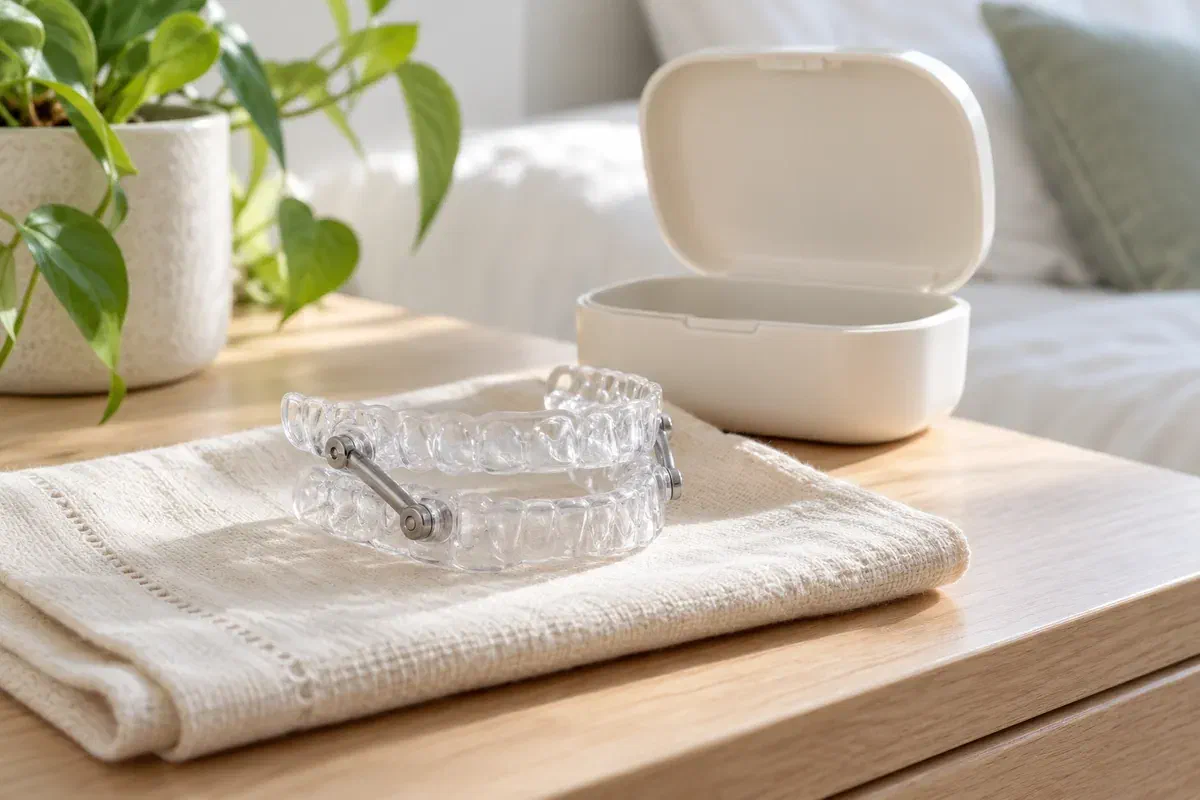
Illustrative custom mandibular advancement appliance beside its protective case
Starting points for the conversation

What we listen for before anything is measured

Diagnosing yourself is not your job. A few details about your nights and days help us see whether medical evaluation should come first, and what a good result would look like for you.

Signs that breathing is disrupted at night

Witnessed pauses, choking or gasping, and sleepiness during the day are reasons to speak with your doctor about a sleep evaluation. A mouthpiece should not be used instead. Share whether these signs are new or growing, and whether drowsiness has affected driving.

Teeth, gums, and jaw joints that would carry the device

Tell us about teeth that feel loose or sore, gum problems, missing teeth, recent dental work, and any jaw pain or clicking. These influence the design, may need care before an appliance, and become baselines that later reviews compare against.

Results from anything you have tried before

If an earlier mouthpiece seemed to help or made no difference, bring it and describe how you judged that. Previous impressions are useful but limited. They do not prove that every appliance will fail, or that a new one will succeed.

These assessments are for adults. A child who snores should be evaluated by a physician, and an anti-snoring device designed for adults does not replace that.

Why the plan includes measurement

Set the goal first. Then you can tell whether it has been met.

When an appliance is suitable, its plan should spell out the purpose, why the chosen design fits your teeth and bite, the expected effect, and the limits. It should also cover comfort, handling, side effects, and, importantly, how and when the response will be assessed by each provider involved.

Your own goals belong in that plan. Perhaps you want your partner back in the same room, or you want to feel less exhausted by mid-afternoon. Say so. These aims, together with the diagnosis and dental findings, help define what a good outcome looks like and what would prompt a change.

Patient information: AADSM — assessment, appliance management, and ongoing care

A purpose you can measure against

Confirm whether the device is meant for diagnosed primary snoring or forms part of treatment for sleep apnea. The answer affects whether testing is needed later. No appliance is a universal answer to snoring, and none should be promoted as one.

A fitting that sets a clear baseline

At fitting, the clinician checks the device in your mouth and makes a note of how your teeth meet without it, so later changes can be spotted. You will practise getting it in and out and learn how to keep it clean. Ask which adjustments, if any, are yours. Your starting plan is specific to your appliance.

Follow-up with defined checkpoints

Ask what will be checked at each dental review, from jaw comfort to the way your teeth come together, and when your physician will reassess your sleep. Reviews continue once the device feels routine, since comfort alone does not answer every question.

The sequence, including the check-ins

Assessment, choice, fitting, and the reviews that follow

Sleep reports, a medicine list, and any previous device help. Without them, a description of what happens at night is enough to start; you do not have to name the device you want.

  1. Establish the starting picture

    We ask how loud and how frequent the snoring is, whether you wake rested, how alert you stay through the afternoon, and what testing has been done so far. If a medical evaluation is still needed, we explain why it comes first. Our questions can identify concerns, though diagnosis stays with the physician or sleep-care provider.

  2. Record the dental baseline

    The clinician examines your teeth, gum support, restorations, the way your bite closes, and jaw movement, noting findings that later reviews will compare against. Ask what they mean. Treatment, more assessment, or input from another provider may be needed first.

  3. Agree on the plan and how success will be judged

    Discuss the benefit you can reasonably expect, the limits, and other options for your diagnosis. Raise costs and the number of visits. If you choose an appliance, we explain the records and stages, and agree with your physician how the response will be assessed.

  4. Fit the device and begin the review cycle

    The appliance is checked in place, and you receive instructions for handling, cleaning, and starting use. You know how to contact us about soreness. The first dental review is booked, and medical follow-up is arranged where your diagnosis calls for it.

Keeping track after fitting

Notice, note, and report.

Written instructions and a clear contact route should come with the device. Discomfort is a reason to call, and advancing the jaw beyond your plan will not make the results arrive sooner.

Get the handling right first

Practise inserting and removing the appliance during the fitting and keep the guidance nearby. Make only the adjustments your plan includes. If handling stays awkward, ask us instead of biting it into place or bending any part.

Keep a simple record of problems

Jot down where any soreness is, when it starts, and whether it stops you wearing the device. Bring those notes to your review, or call sooner if it is persistent. Do not adjust or repair the appliance yourself, and stop using one that is broken.

Share an honest account of use and results

Tell us how many nights a week you actually wear the device, how the snoring sounds now, and whether your energy during the day has shifted at all. Attend your dental and medical follow-ups. What a partner reports is welcome, but it is not a measure of how well sleep apnea is treated.

Options for Rockwood adults

Each option comes with its own way of measuring success.

Ask what may be driving your snoring and which treatments suit you. Any recommendation should rest on your assessment, the outcome you are hoping for, and any medical sleep condition needing treatment of its own.

When diagnosis and dental findings support it

A custom oral appliance with scheduled reviews

A device may be designed and fitted with checkpoints agreed in advance. Ask why the design suits your mouth and what should prompt an earlier visit. Its role should be described honestly, without promising silence or assuming everyone tolerates the same appliance.

When the cause may lie elsewhere

Medical review of contributing factors

A physician can look at nasal issues, general health, medicines, and habits around sleep, and suggest care. Do not stop prescribed treatment without advice. If the main cause is found here, an appliance may not be the right next step.

When a sleep disorder has been confirmed

Physician-led treatment for sleep apnea

Treatment may include PAP, an oral device, or other medical care, depending on testing. The physician decides how effectiveness is confirmed, sometimes with repeat testing. We report on your teeth and jaw so the plan stays workable.

Patient information: NHLBI — medical treatment options for sleep apnea

Rockwood questions about results

How to tell whether the appliance is working

Appliances that look alike can be made for very different purposes. Ask about the device being suggested for you and how its effect will be checked.

(905) 876-4488
What counts as success with a snoring appliance?
It depends on why the device was made. For diagnosed primary snoring, less noise and good comfort may be the main goals. Where sleep apnea is involved, your physician decides how the response is measured, which can include testing.
Can a phone app tell me whether my sleep apnea is controlled?
Apps that record snoring can be interesting, but they are not a medical test. Your physician decides what testing is appropriate. Share any recordings if you like, but do not rely on them to confirm treatment is working.
How soon is the first review after fitting?
The timing depends on your device and plan, and you will be told at fitting. Call sooner if you have persistent pain, a bite that feels wrong, or trouble wearing the appliance.
What will the dentist check at each review?
Typically the fit and condition of the appliance, your teeth and gums, jaw comfort, and how your bite closes compared with your baseline. You will also be asked how often you wear it and how you are sleeping.
Is my old grinding guard helping with my snoring?
Probably not in the way you hope. A grinding guard protects tooth surfaces, while a snoring appliance is designed around a planned jaw position. Bring the guard to your assessment and we can explain its purpose.
What happens if the appliance does not seem to help?
Tell us and your physician. The fit, how consistently it has been worn, and your diagnosis may all need review. Sometimes another approach is more suitable, and that is a valid outcome of the process.
Book from Rockwood

Know how progress will be judged before you start.

Get in touch with Milton Dental Clinic to arrange a first conversation about your snoring and what our examination would cover. Share details of earlier sleep tests, any treatment you use, and devices you have tried, and we will explain how results would be followed from the first night onward.

Suitability rests on medical evaluation together with a thorough dental examination.

Visit Milton Dental Clinic
Unit 1, 342 Bronte St. S, Milton, ON L9T 5B7
Get directions Clinic hours
Monday–Thursday
11am–7pm
Friday–Sunday
By appointment only

Areas we serve

  • Milton
  • Oakville
  • Mississauga
  • Georgetown
  • Halton Hills
  • Acton
  • Campbellville
  • Brampton
  • Burlington
  • Puslinch
  • Rockwood
  • Erin
  • Caledon
  • Etobicoke
  • Old Milton
  • Bronte Meadows
  • Timberlea
  • Dorset Park
  • Dempsey
  • Clarke
  • Beaty
  • Coates
  • Harrison
  • Scott
  • Willmott
  • Ford
  • Bowes
  • Cobden
  • Walker
  • Mountain View
  • Milton Heights
  • Hawthorne Village
  • Valley View
  • Fallingbrook
  • Nassagaweya
  • Trafalgar
  • Esquesing
  • Nelson
  • Brookville
  • Moffat
  • Glen Williams
  • Norval
  • Limehouse
  • Stewarttown
  • Ashgrove
  • Hornby
  • Silver Creek
  • Speyside
  • Scotch Block
  • North Oakville
  • River Oaks
  • Glen Abbey
  • West Oak Trails
  • Palermo
  • Bronte Creek
  • College Park
  • Joshua Creek
  • Uptown Core
  • Preserve
  • Iroquois Ridge
  • Lisgar
  • Meadowvale
  • Meadowvale Village
  • Churchill Meadows
  • Erin Mills
  • Central Erin Mills
  • Streetsville
  • East Credit
  • Creditview
  • Heartland
  • Sheridan
  • Mount Pleasant
  • Credit Valley
  • Huttonville
  • Churchville
  • Springbrook
  • Northwest Brampton
  • Bram West
  • Fletcher's Meadow
  • Fletcher's Creek South
  • Alton Village
  • Orchard
  • Millcroft
  • Headon Forest
  • Tansley
  • Brant Hills
  • Tyandaga
  • Kilbride
  • Lowville
  • Aberfoyle
  • Morriston
  • Arkell
  • Hillsburgh
  • Freelton
  • Carlisle
  • Waterdown
  • Flamborough
  • Mountsberg

How can we help?

Milton Dental Clinic

Have a question about your smile? Choose the option that works best for you.

For urgent dental concerns, please call.
Messages are reviewed during clinic hours.