

Illustrative discussion of a planned surgical tooth extraction
Specialized Care

Surgical Tooth Extractions in Caledon

Consent means understanding what could realistically go wrong, not just what is planned. From Bolton or elsewhere in Caledon, talk with us about the specific risks for your tooth, what your images show, why surgical removal is proposed and which alternatives deserve a look.

Reading the consent form properly

Nerves, sinuses, fractures: which of these is really about you?

A consent form can list a dozen possible complications, and reading it at home can be unsettling. The more useful question is which ones are likely for your tooth. Start with what the procedure involves. A surgical extraction is used when a tooth or root cannot sensibly be taken out with a straightforward technique, so access is created by easing back gum, removing some bone, or dividing the tooth into parts.

Risk only makes sense alongside benefit. Why is removal being recommended, and what would happen without it? Is there a reasonable way to keep the tooth? Ask the clinician to explain the findings that led to the recommendation and to compare the options in your own terms. The surgical method answers how. It cannot, on its own, answer why.

For households in Caledon, whether in Bolton or one of the smaller villages northeast of Milton, it helps to bring any images and records you have. We will review them, examine the tooth, explain a suitable pathway and refer you when the anatomy or your needs suit another provider. Tell us about your health, your medicines and past dental experiences, so the risks discussed are the ones that actually apply.

Discuss the risks for your extraction
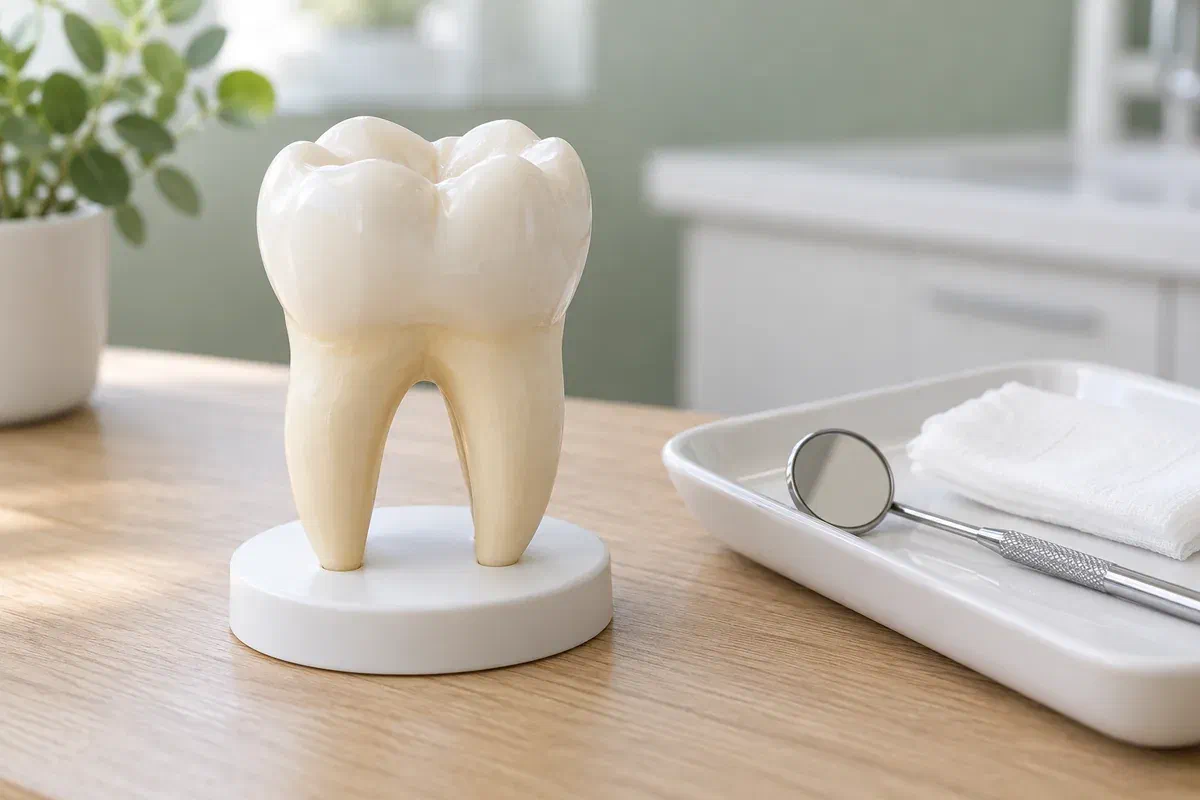
Illustrative two-root molar teaching model beside a dental mirror and gauze
Where the specific risks come from

Your tooth’s position, shape and neighbours tell the story.

The examination and suitable imaging are what turn a general list into a personal assessment. Ask the clinician to point out the relevant features on your images, since risks and sequence differ from tooth to tooth.

Depth and coverage

A tooth partly covered by gum or bone, or a root left after a fracture, usually needs more access, and more access can mean more swelling or discomfort. The clinician considers the position and the reason for removal together. Being hard to reach does not on its own justify extraction.

Brittleness and root form

Weakened teeth and roots that curve, spread or are very fine are more likely to break during removal, which is one reason sectioning is often planned. Ask what is expected, and what would happen if a root tip proved difficult to retrieve.

Closeness to the nerve, the sinus and other teeth

Lower back teeth may sit near the nerve that supplies feeling to the lip and chin; upper back teeth may sit near the sinus. Adjacent teeth and fillings can also be affected. Medical conditions and medicines add their own considerations, so share a full history.

Do not stop taking a blood thinner or any other prescribed medicine on your own ahead of surgery. The clinician treating you checks your history and agrees any change with the prescribing medical provider.

What a personalised risk discussion gives you

Perspective rather than alarm.

When risks are explained with your anatomy and health in view, you can see which matter and which are remote. Planning also settles the technique, the setting and the support before the day. Ask what the images showed and why this approach fits, and ask the clinician to distinguish between common, expected effects and rarer complications.

Weighing the decision also includes the space left behind. An extraction may form part of a larger restorative or orthodontic plan, or simply remove a tooth with no realistic future. Ask whether a replacement or monitoring would follow, and whether anything should be coordinated before the tooth is taken out.

Patient information: Liverpool University Dental Hospital — surgical removal of teeth or roots

Benefit and risk side by side

Ask what the extraction would solve and why other options are not suitable or are less appropriate. Hearing the expected benefit, along with what delay or refusal might mean, helps put the risks in proportion. A permanent decision should be informed by your real findings.

Comfort as part of the plan

Discuss local anaesthetic, anxiety and past experiences, and whether extra support would help. General anaesthesia is not an automatic feature of surgical extraction. If another approach or provider is advised, ask about its assessment, transport, escort and preparation requirements.

Knowing what recovery should look like

Ask about eating, work, exercise, medicines and who to contact afterwards. Recovery varies with the procedure and the person. A good plan describes the expected course and the warning signs, so you can tell normal soreness from something that needs review.

How consent and treatment unfold

Understand first, agree second, treat third, recover fourth.

Use the assessment to ask about risks in detail, and agree on a signal for pausing during treatment. Preparation advice must come from the provider carrying out the procedure and match the anaesthetic and your medical needs.

  1. Images, examination and an honest risk review

    The clinician examines the tooth, considers appropriate imaging, including more detailed scans where they would help, and reviews your health. Ask which risks are relevant, how likely they are and whether referral is advised. Confirm whether further treatment or records are needed first.

  2. Informed consent and comfort

    Before you agree, the provider explains the planned treatment, its main risks and reasonable alternatives. Local anaesthetic is discussed, with any additional arrangements assessed as suitable. Raise a hand the moment anything feels sharp; nobody expects you to grit your teeth through it.

  3. Careful access and removal

    Depending on the plan and findings, gum may be raised, bone removed or the tooth sectioned to limit force on surrounding structures. Pressure and vibration are common even when numb. The clinician manages the site afterwards and decides about sutures.

  4. Aftercare, warning signs and review

    You receive guidance on bleeding, cleaning, food, soreness and activity. Ask what changes in sensation, if any, should be reported and whether sutures or a review are needed. Confirm the contact route and what the next stage of dental care will be.

Recovery and what to watch

Most healing is quiet. Know the signs that are not.

Follow your own clinician’s instructions. The extent of the procedure, your medical history and any extra steps taken during surgery may change the advice, which a general leaflet cannot account for.

Protect the clot and the numb tissues

Avoid touching the socket with your tongue or fingers. Early instructions often include a day without rinsing or spitting, followed by gentle cleaning as advised. Let hot drinks cool, and be careful not to bite a numb lip or cheek.

Follow food, activity and medicine guidance

Choose comfortable foods and follow advice on exercise, smoking and site care. Pain relief should be whatever was suggested for you, at the labelled dose, and checked against your other prescriptions. Never substitute leftover antibiotics for advice or change prescriptions yourself.

Report changes promptly

Call about bleeding that persists, severe or worsening pain, swelling that grows, fever, numbness of the lip or chin that does not wear off, or symptoms that suggest a sinus problem. Describe when it began. Pain is not always infection, and worsening is not always expected.

Patient information: UCLH — protecting the site and following extraction aftercare

Weighing the alternatives

Every option carries its own trade-offs.

The right choice depends on your diagnosis and the tooth’s realistic outlook. Ask what each route involves, its limits and risks, and what leaving the problem untreated would mean.

When retention is a realistic possibility

Keeping the tooth

Rebuilding the tooth, treating its nerve canal or managing gum disease could be options, according to what caused the problem. Each carries its own risks and uncertainty. Ask about prognosis and what treatment would require, and why keeping your tooth is or is not reasonable.

When extraction is indicated and extra access is required

Surgical removal with a clear plan

The clinician explains the method, the preparation and the main risks. Ask which steps are anticipated and how recovery and later dental needs will be managed. Expect an honest estimate rather than a guaranteed appointment length or a recovery copied from someone else’s.

When the anatomy or your health shifts the balance of risk

Referral, monitoring or a revised plan

When a tooth sits very close to a nerve or the sinus, or health needs are complex, a specialist may be recommended. Ask what they will assess and whether interim care is needed. In selected cases, leaving part of a root or monitoring may be safer, which needs individual judgement.

Questions about risk and consent

Getting clear answers before you sign.

Take the consent form home if you need time, and bring questions back. The clinician can explain which risks apply to your tooth and which are remote.

(905) 876-4488
How likely is nerve damage after a surgical extraction?
It depends heavily on how close the tooth is to the nerve. For many teeth the risk is very low; for some lower back teeth it is higher. Most changes in sensation that do occur are temporary, but some can be lasting. Ask what your images show.
What happens if an upper tooth is close to the sinus?
Occasionally an opening between the socket and the sinus can occur during removal of an upper back tooth. The clinician will explain whether this is a consideration for you and what precautions or aftercare might apply.
Could a piece of root be left behind on purpose?
In selected cases, a small root tip close to a nerve or the sinus may be safer to leave than to chase. The clinician should discuss this possibility beforehand and explain any monitoring that would follow.
Can a neighbouring tooth or filling be damaged?
It is possible, particularly if the adjacent tooth has a large filling or crown. Ask whether your neighbouring teeth have restorations that could be affected and how that risk is managed.
Will I have time to think before signing consent?
Yes. Unless treatment is urgent, you can take time to consider the information and ask further questions. Consent can also be withdrawn before the procedure begins.
Is a dry socket a risk I should plan for?
Dry socket is a recognised complication in which the clot is lost or fails to form, causing increasing pain a few days after extraction. Following aftercare advice and avoiding smoking may help. Contact the provider if pain worsens rather than settles.
Plan with clarity from Caledon

Bring the consent form and your questions, and we will go through both.

Contact Milton Dental Clinic to arrange an assessment or to review a surgical extraction that has already been recommended. Any X-rays or scans you already have are useful, as is knowing your symptoms, your health and which risks weigh on you most.

Your examination decides the technique and who carries it out. Urgent symptoms should never wait for a routine booking, so call.

Visit Milton Dental Clinic
Unit 1, 342 Bronte St. S, Milton, ON L9T 5B7
Get directions Clinic hours
Monday–Thursday
11am–7pm
Friday–Sunday
By appointment only

Areas we serve

  • Milton
  • Oakville
  • Mississauga
  • Georgetown
  • Halton Hills
  • Acton
  • Campbellville
  • Brampton
  • Burlington
  • Puslinch
  • Rockwood
  • Erin
  • Caledon
  • Etobicoke
  • Old Milton
  • Bronte Meadows
  • Timberlea
  • Dorset Park
  • Dempsey
  • Clarke
  • Beaty
  • Coates
  • Harrison
  • Scott
  • Willmott
  • Ford
  • Bowes
  • Cobden
  • Walker
  • Mountain View
  • Milton Heights
  • Hawthorne Village
  • Valley View
  • Fallingbrook
  • Nassagaweya
  • Trafalgar
  • Esquesing
  • Nelson
  • Brookville
  • Moffat
  • Glen Williams
  • Norval
  • Limehouse
  • Stewarttown
  • Ashgrove
  • Hornby
  • Silver Creek
  • Speyside
  • Scotch Block
  • North Oakville
  • River Oaks
  • Glen Abbey
  • West Oak Trails
  • Palermo
  • Bronte Creek
  • College Park
  • Joshua Creek
  • Uptown Core
  • Preserve
  • Iroquois Ridge
  • Lisgar
  • Meadowvale
  • Meadowvale Village
  • Churchill Meadows
  • Erin Mills
  • Central Erin Mills
  • Streetsville
  • East Credit
  • Creditview
  • Heartland
  • Sheridan
  • Mount Pleasant
  • Credit Valley
  • Huttonville
  • Churchville
  • Springbrook
  • Northwest Brampton
  • Bram West
  • Fletcher's Meadow
  • Fletcher's Creek South
  • Alton Village
  • Orchard
  • Millcroft
  • Headon Forest
  • Tansley
  • Brant Hills
  • Tyandaga
  • Kilbride
  • Lowville
  • Aberfoyle
  • Morriston
  • Arkell
  • Hillsburgh
  • Freelton
  • Carlisle
  • Waterdown
  • Flamborough
  • Mountsberg

How can we help?

Milton Dental Clinic

Have a question about your smile? Choose the option that works best for you.

For urgent dental concerns, please call.
Messages are reviewed during clinic hours.