
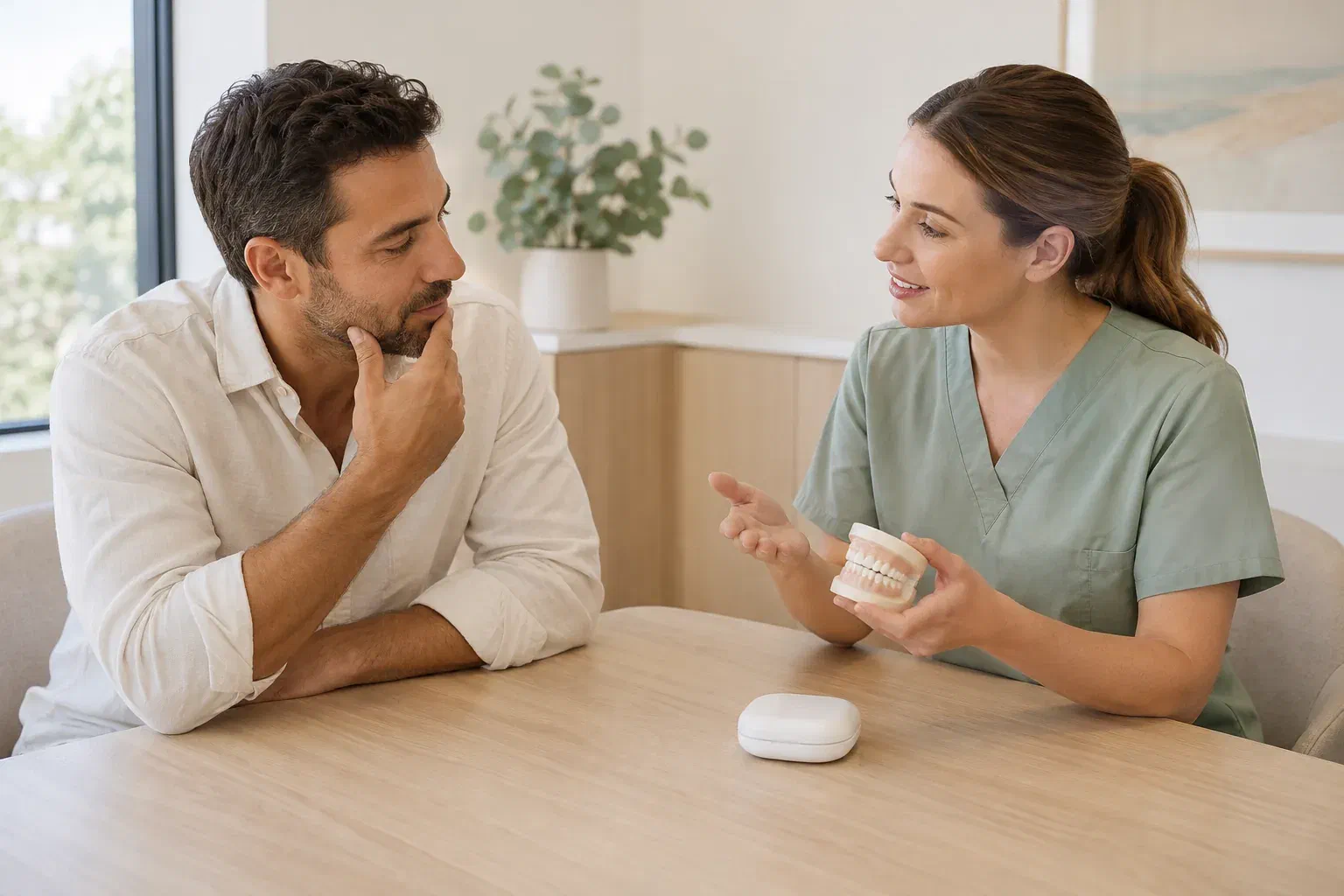
Illustrative consultation about teeth grinding and possible tooth wear
Specialized Care

Teeth-Grinding Treatment in Brampton

Often the first person to notice grinding is not the one doing it. When a spouse, sibling or roommate in Brampton mentions a grating sound at night, an examination can show what it means for your teeth and which kind of care, if any, makes sense.

Heard at home in Brampton

“You were grinding again last night.” Now what?

Hearing it from someone else can be unsettling, especially when you feel fine. Grinding during sleep is common, and so is clenching, either at night or in the day. Dentists call the two together bruxism. A report from the person beside you is a useful clue, though it is only one piece of what the dentist needs.

The teeth tell their own part of the story. Some wear comes from grinding and some from entirely different causes, and an edge that went flat long ago reveals little about what happens now. By pairing that report with your symptoms, your dental history and a careful examination, the dentist can suggest whether to watch, protect, repair or look into something further.

It helps to ask the person who noticed a few simple questions before you come: how often, how loud, and whether you also snore or seem to stop breathing. Bring any guard you already have. We will aim for a plan with a clear purpose rather than a promise that a mouthguard will make the noise disappear for good.

Find out what reported grinding means for you
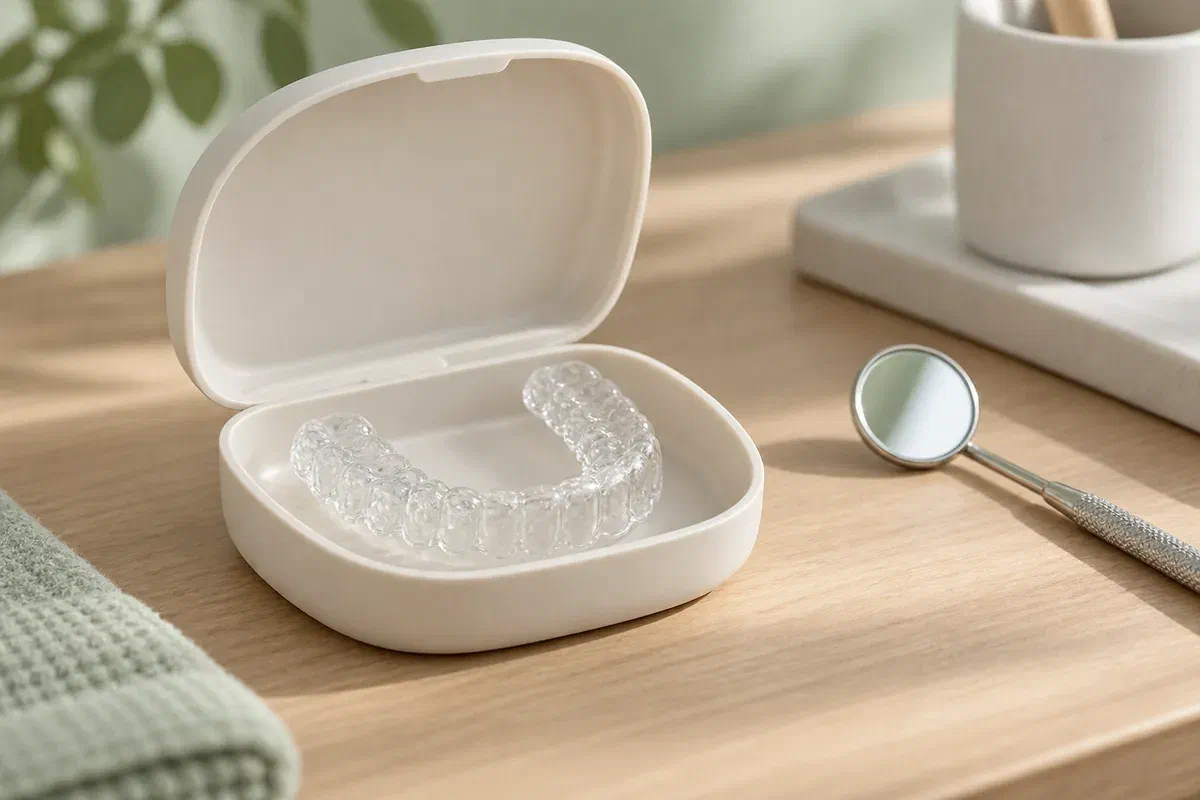
Illustrative single-arch clear dental nightguard in a protective case
Things others notice, things you notice

Three reasons people in Brampton book a grinding check

Tell us what you know and what others have told you. Gaps are normal; no one is expected to provide nightly evidence before an assessment begins.

A grating or clicking sound during sleep

Pass on what the other person described: frequency, loudness and whether it comes with snoring or breathing pauses. Their account shapes the history but cannot gauge tooth damage or explain why it happens. Breathing concerns and heavy daytime tiredness are worth raising so a doctor's input can be considered.

Teeth that look worn or feel tender in the morning

Note whether the change is recent, painful or affecting how you chew. The dentist weighs grinding alongside other causes of wear. A single tooth that is sensitive could have a separate problem, so it is safer to have it checked than to assume it is just the effect of grinding.

Dental work or a guard that does not hold up

If fillings keep chipping or an old guard has cracked, bring the guard and mention the repairs. Seeing the appliance and the teeth together is more informative than either alone. Damage of this kind is not, by itself, a reason for a heavier device or a larger restoration.

A broken tooth, severe pain, swelling or a jaw that suddenly will not move normally needs prompt attention. Call about those rather than saving them for a grinding consultation.

What the assessment adds

A report of noise becomes a plan with clear parts.

The sound someone heard does not decide the treatment. Instead, each finding gets its own response: protection where surfaces are at risk, repair where a tooth is damaged, and separate attention for a jaw that aches. Asking which finding sits behind each recommendation keeps the plan understandable.

Over time, the useful question is whether teeth and symptoms are holding steady. Comfort, how well you tolerate any appliance and what the dentist sees at review all count. That gives a fairer picture than whether the household heard grinding on a given night.

Patient information: NIDCR — bruxism assessment and management

Tell old wear from ongoing change

Records, X-rays or photos from earlier visits may help show whether the teeth are still changing. Other possible sources of wear are considered as well. Ask what will be tracked between appointments and what kind of change would make treatment the better choice.

Pick protection that fits your mouth and goal

If a guard is suggested, ask what it is for, how it should feel, when to wear it and what it cannot do. It should be fitted by a clinician and reviewed if it is uncomfortable. Sports mouthguards, retainers and sleep-apnea devices have separate jobs and are not stand-ins.

Consider sleep and health factors together

Sleep, stress, routines and medicines can all be relevant. Discussing them helps shape the plan without blaming you or assuming one cause. If the history raises a medical question, such as possible sleep-disordered breathing, we may suggest speaking with your physician.

What to expect

Bring the story, and we will examine the evidence.

If someone at home has noticed details, write them down so you remember them. Bring any appliance too. The first visit is about clarifying findings and choices, not applying the same answer to everyone who grinds.

  1. Share what you and others have noticed

    We cover the sounds reported, when any soreness appears and changes to teeth or restorations. Medicines, sleep and earlier treatment are part of the discussion. If nobody is sure how often the grinding happens, that is fine; the examination fills in more than any guess would.

  2. Check teeth, restorations and jaw comfort

    The dentist looks for wear, fractures and sensitivity, and examines the jaw muscles and joints. Particular teeth may need further tests, and older records can help gauge change. Ask what the findings support and what else could explain your symptoms.

  3. Talk through each reasonable route

    Choices may include practical advice and monitoring, a fitted guard, repair of a damaged tooth or a referral. Ask what each is meant to accomplish and its limitations. The most involved route is not automatically the most helpful one.

  4. Follow up and reassess

    We agree on a review date and the signs that should prompt an earlier call. Any appliance is checked along with your teeth. If problems continue, the dentist revisits the original questions instead of simply supplying another replacement guard.

At home

Keep it practical, and keep us posted.

Instructions follow from your findings and any appliance or treatment you receive. If the advice seems to differ from what another provider has said, let us know so we can clarify.

Handle a fitted guard with care

Rinse, clean and store it the way you were shown, and keep it in its case away from heat and pets. Bring it to every review. Do not bend, trim or reshape it yourself. A crack, a looser fit or new soreness is a reason to call, and a broken guard should come out of rotation until it is seen.

Watch for clenching during the day

The same people who hear you at night may spot you clenching while watching television or concentrating. A gentle reminder from them, or from yourself, to part the teeth and loosen the jaw can help. Avoid rubbing the teeth together to inspect worn spots, and say so if the habit change is not sticking.

Ask the person who noticed to keep noticing

With their agreement, an occasional note about whether the sound has changed can add useful context at review. Report new tooth symptoms, sleep changes or a possible link with a medicine. Do not stop a prescription without your prescriber's guidance.

Options to discuss

Not every grinding report leads to the same plan.

Ask what each option would involve, including observation. Treatment should respond to an identified need and should not promise that reshaping teeth will end the habit.

When the findings support starting conservatively

Monitoring with everyday advice

Hearing a sound at night is not, on its own, a reason to make a device or place a filling. If the teeth look stable, the dentist may suggest a few habits, a baseline record and a date to compare against. Ask which signs would make the next visit end differently.

When teeth or restorations need protection or repair

A fitted guard and care for affected teeth

Protection and repair often travel together but answer different problems. A guard can take the brunt of night-time contact; a cracked or worn-through tooth is treated in its own right. Neither step proves the grinding has settled, so the rest of the mouth stays on the review list.

When the history or response calls for more input

Further assessment when concerns remain

If the household describes gasping or long pauses in breathing, or if jaw pain, a stubborn toothache or a medicine question lingers, another dental or medical opinion may come next. Know what that opinion is meant to settle. Bulkier appliances and permanent bite changes can wait until it has.

Patient information: NHS — when to seek review for teeth grinding

Grinding questions from Brampton

When someone else hears it first

Bring the details that were shared with you, even if they are occasional. The answers here aim to separate realistic protection from claims that cannot be made.

(905) 876-4488
I do not feel anything. Should I still get the grinding checked?
It can be worth it. Some people have wear or early damage without discomfort. An examination shows whether there is anything to watch or protect, and if the findings are reassuring, that is useful to know too.
What should my partner tell the dentist about the noise?
How often it happens, how loud it is, roughly when during the night, and whether there is snoring or pauses in breathing. You can pass this on yourself; they do not need to attend.
Can grinding be heard every time it happens?
No. Clenching can be silent, and grinding may not always make a noise. That is one reason the dentist relies on the examination and your symptoms rather than on reports of sound alone.
Does a loud grinding noise mean my teeth are badly damaged?
Not necessarily. Loudness does not measure damage. Only an examination shows the condition of the teeth, and the plan follows from those findings rather than from how the noise sounded.
Could the person who heard me be noticing sleep apnea instead?
Grinding and sleep-disordered breathing are different things, though they can occur together. If snoring, gasping or breathing pauses were noticed, mention them, as a medical evaluation may be appropriate. A grinding guard does not treat sleep apnea.
If I get a guard, will the grinding sound stop?
It may or may not. A guard is meant mainly to protect the teeth, not to guarantee the habit ends, and some people still make noise while wearing one. Ask how its usefulness will be judged.
Arrange a visit from Brampton

Bring what you have heard, and we will look at the rest.

Reach out to Milton Dental Clinic about grinding someone has noticed, teeth that seem worn or a guard that is causing trouble. If you have pain or a recent break, mention it when you call so timing can be discussed.

Recommendations depend on the examination and may involve monitoring, protection, dental treatment or further assessment.

Visit Milton Dental Clinic
Unit 1, 342 Bronte St. S, Milton, ON L9T 5B7
Get directions Clinic hours
Monday–Thursday
11am–7pm
Friday–Sunday
By appointment only

Areas we serve

  • Milton
  • Oakville
  • Mississauga
  • Georgetown
  • Halton Hills
  • Acton
  • Campbellville
  • Brampton
  • Burlington
  • Puslinch
  • Rockwood
  • Erin
  • Caledon
  • Etobicoke
  • Old Milton
  • Bronte Meadows
  • Timberlea
  • Dorset Park
  • Dempsey
  • Clarke
  • Beaty
  • Coates
  • Harrison
  • Scott
  • Willmott
  • Ford
  • Bowes
  • Cobden
  • Walker
  • Mountain View
  • Milton Heights
  • Hawthorne Village
  • Valley View
  • Fallingbrook
  • Nassagaweya
  • Trafalgar
  • Esquesing
  • Nelson
  • Brookville
  • Moffat
  • Glen Williams
  • Norval
  • Limehouse
  • Stewarttown
  • Ashgrove
  • Hornby
  • Silver Creek
  • Speyside
  • Scotch Block
  • North Oakville
  • River Oaks
  • Glen Abbey
  • West Oak Trails
  • Palermo
  • Bronte Creek
  • College Park
  • Joshua Creek
  • Uptown Core
  • Preserve
  • Iroquois Ridge
  • Lisgar
  • Meadowvale
  • Meadowvale Village
  • Churchill Meadows
  • Erin Mills
  • Central Erin Mills
  • Streetsville
  • East Credit
  • Creditview
  • Heartland
  • Sheridan
  • Mount Pleasant
  • Credit Valley
  • Huttonville
  • Churchville
  • Springbrook
  • Northwest Brampton
  • Bram West
  • Fletcher's Meadow
  • Fletcher's Creek South
  • Alton Village
  • Orchard
  • Millcroft
  • Headon Forest
  • Tansley
  • Brant Hills
  • Tyandaga
  • Kilbride
  • Lowville
  • Aberfoyle
  • Morriston
  • Arkell
  • Hillsburgh
  • Freelton
  • Carlisle
  • Waterdown
  • Flamborough
  • Mountsberg

How can we help?

Milton Dental Clinic

Have a question about your smile? Choose the option that works best for you.

For urgent dental concerns, please call.
Messages are reviewed during clinic hours.