
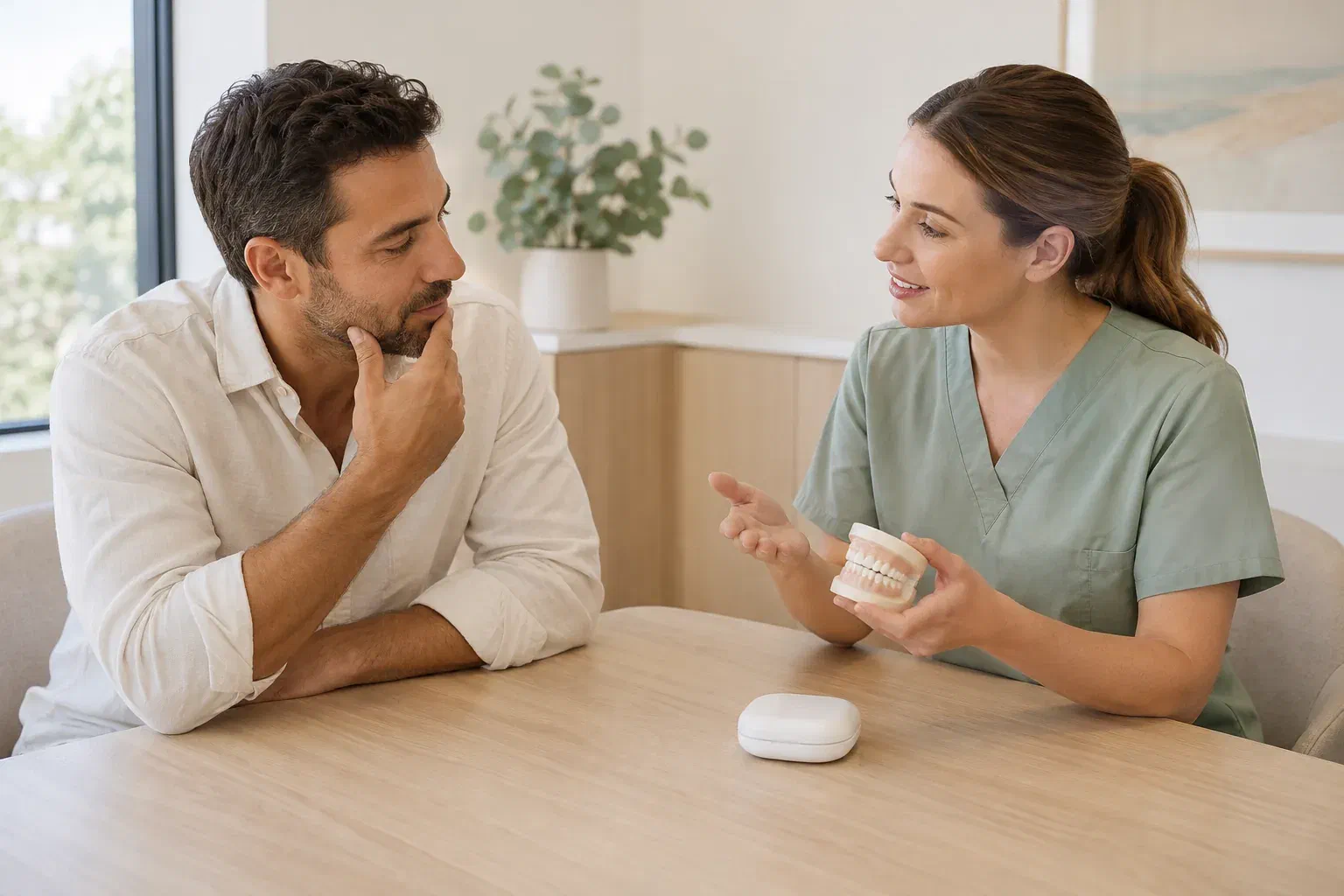
Illustrative consultation about teeth grinding and possible tooth wear
Specialized Care

Teeth-Grinding Treatment in Campbellville

Grinding, snoring and waking up unrested can arrive together, and it is hard to know which to tackle first. If you are coming from Campbellville, we look at the dental side carefully and help you see when a sleep question belongs with your doctor.

Sleep, snoring and grinding in Campbellville

Grinding and snoring are not the same problem, though they can share a bed.

A partner may report two things at once: a grating noise from your teeth and loud snoring, maybe with pauses that worry them. You might wake with a tight jaw and still feel tired by mid-morning. Grinding and clenching, known together as bruxism, can happen during sleep or in waking hours, and sometimes they turn up alongside a breathing-related sleep concern.

The two need to be thought about separately. Dentists can examine teeth, restorations, jaw muscles and joints, and judge whether wear is present and whether it is changing. Not all wear comes from grinding, and an old flat edge does not reveal current activity. Questions about breathing during sleep, however, usually need a physician's evaluation.

Tell us everything your partner has noticed, not only the grinding. Bring any guard you use. We will explain what the dental findings show, what a guard can and cannot do, and when it makes sense to speak with your doctor about sleep. A grinding guard is not a sleep-apnea treatment, and it should never be presented as one.

Talk about grinding and sleep concerns
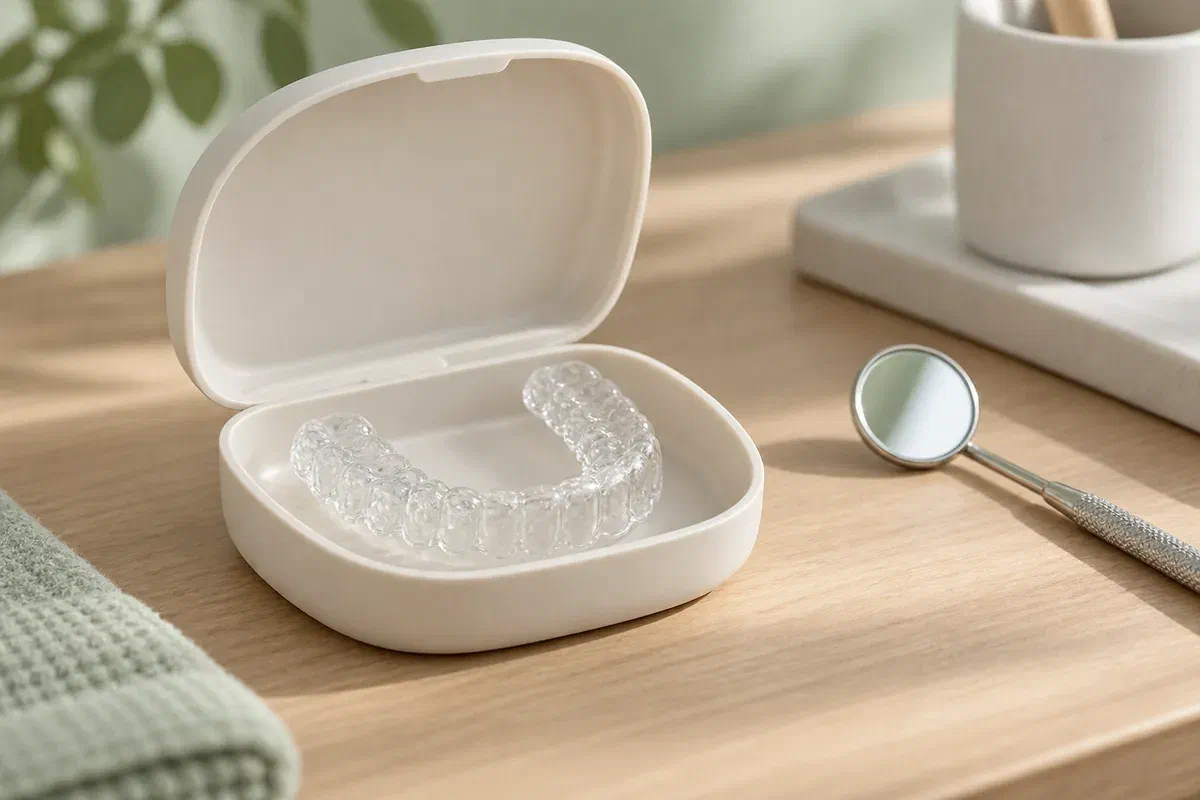
Illustrative single-arch clear dental nightguard in a protective case
What has been noticed?

Sounds, symptoms and surfaces

Partial details are fine. Write down what your partner describes if that is easier, and bring it along; nobody needs proof of every night.

Grinding, snoring or pauses heard at night

Share all of it. The grinding report adds to the dental history but cannot measure tooth damage on its own. Snoring, gasping, breathing pauses and a struggle to stay awake during the day are signs that should be raised with a doctor, and we will encourage that conversation when they come up.

Morning jaw ache or teeth that feel worn

Tell us whether it is new, how long it lasts and whether chewing is affected. The dentist considers several possible causes of wear and discomfort. If one tooth is sore on its own, it may need specific tests rather than being assumed to be part of the grinding pattern.

A guard or dental work that keeps failing

Bring a guard that has cracked or become uncomfortable, and mention fillings or crowns that have broken. The two are best assessed together. Wear or damage on either does not automatically mean a stronger guard or more dental work is the answer.

Two kinds of problem should not wait. For a tooth that has broken, pain that is hard to bear, swelling or a jaw that suddenly opens differently, call us promptly. If your partner describes frequent breathing pauses, or you are drowsy enough that driving feels unsafe, contact your doctor rather than waiting for a dental visit.

Getting the right help for each part

Dental protection here, sleep assessment where it belongs

Untangling the concerns allows each one to get the right attention. A fitted guard may protect teeth, a damaged tooth may need repair, a sore jaw may need its own approach and a breathing concern may need medical evaluation. Ask which finding each suggestion addresses.

Progress is easier to judge once the strands are separated. Your comfort, whether you can wear any appliance through the night, and whether your teeth hold steady between reviews are dental measures. How rested you feel, and what a sleep assessment shows, belong to the medical side. Keeping them apart stops a quiet night from being mistaken for a solved problem.

Patient information: NIDCR — bruxism assessment and management

Find out how much the teeth have been affected

Earlier records or photos can help the dentist judge whether wear is ongoing. Other causes of wear are kept in mind too. Ask what will be monitored and what would make treatment worthwhile, rather than assuming every worn tooth needs immediate repair.

Use the right appliance for the right purpose

Devices for grinding and devices for sleep apnea look similar on a shelf but are built for different goals. If a grinding guard suits you, ask about its purpose, how it should fit, when to wear it and its limits. Any sleep-apnea appliance would only follow a medical diagnosis, and a sports guard or retainer is not a substitute for either one.

Coordinate with your physician

Sleep, medicines, stress and routines may all be part of the picture, and discussing them is not about blame. When the history suggests a breathing concern during sleep, we may recommend seeing your doctor and can suggest what dental information would be useful to share.

The assessment

Here is what to expect at the first visit.

Bring notes from your partner, a list of medicines and any appliance. The first appointment sorts out the findings and options rather than assuming every grinder needs the same thing.

  1. Go through the sleep and dental history

    We discuss grinding reports, snoring, daytime tiredness, when jaw discomfort appears and changes to teeth or dental work. Medicines and earlier treatment matter too. If you do not know what happens at night, that is normal and simply becomes part of the picture.

  2. Examine teeth, jaw muscles and joints

    The dentist looks for wear, cracks, sensitivity and tenderness, and may test individual teeth that seem suspicious. Older records can help establish whether anything has changed. You should hear what the findings support, and whether something other than grinding, such as erosion or an uneven bite, could explain them.

  3. Separate dental steps from medical ones

    Dental options may include monitoring, a fitted guard or repair of damage. If sleep symptoms suggest a breathing concern, a referral to your physician may be recommended as well. Ask what each step should achieve and its limits.

  4. Follow up on both tracks

    We agree on a dental review and the changes that should bring you back sooner. If you see your doctor about sleep, let us know the outcome, since it may affect the dental plan. Persistent problems prompt a fresh look rather than repeated replacement guards.

Between appointments

Look after your teeth, and keep the sleep question moving.

Home care follows from what the examination showed and whatever appliance or treatment you were given. If what your doctor says and what we say ever seem to pull in different directions, ask us both, so the plan stays consistent and nothing falls between the two offices.

Care for a grinding guard properly

Clean and store it as directed and bring it to each review. Do not heat, bend or trim it. Call if it cracks, loosens or hurts, and stop wearing a damaged appliance rather than assuming discomfort is expected.

Watch for daytime clenching too

If you clench while awake, use the reminders we discussed and let your jaw relax with the teeth apart. Avoid grinding on purpose to check worn edges. Let us know if a habit is difficult to change so the advice can be adjusted.

Follow through with any sleep referral

If a sleep evaluation was suggested, arrange it with your doctor. Share any diagnosis or new appliance with us, and never use a grinding guard in place of prescribed sleep-apnea treatment. Do not stop any medicine on your own.

Campbellville care paths

Which route fits the findings?

Every option, including simply keeping an eye on things, should come with a plain explanation of what it involves and why it suits you. Be cautious of any suggestion that grinding can be ended by grinding down or building up the teeth themselves.

When dental findings are mild and stable

Monitoring with everyday advice

If the teeth show little change and symptoms are minor, practical habits and a scheduled review may be enough on the dental side. Ask what will be compared next time and what would change the plan.

When surfaces or restorations need protection or repair

A grinding guard and care for specific teeth

A fitted guard may help protect teeth, and a damaged tooth may need separate treatment. Ask what each step is for and how it will be reviewed. Protection and repair do not prove grinding has stopped or address a sleep-breathing concern.

When sleep symptoms or other concerns are present

Medical evaluation alongside dental care

Snoring with pauses, marked daytime sleepiness, persistent jaw pain or a medicine question may need input from your physician or another provider. Ask what that assessment should clarify before considering a stronger appliance or permanent bite changes.

Patient information: NHS — when to seek review for teeth grinding

Sleep and grinding questions

What to know when grinding and snoring overlap

Bring whatever has been noticed, even if it varies from night to night. These answers aim to separate realistic dental care from claims that cannot be made.

(905) 876-4488
Is grinding a sign of sleep apnea?
Not on its own. Grinding does not establish that diagnosis. If snoring, breathing pauses or significant daytime sleepiness are present, they should be raised with a doctor, who can decide whether a sleep assessment is needed.
Can a dentist diagnose a sleep-breathing problem?
A dentist may notice signs worth mentioning and recommend that you see your physician, but diagnosing a sleep-breathing disorder is a medical matter. We can help you describe the dental findings to your doctor.
Is a grinding guard the same as a sleep-apnea mouthpiece?
No. They are designed for different purposes. A grinding guard aims to protect teeth, while any sleep-apnea device would be used only after a medical diagnosis and as part of a prescribed plan.
My partner says I grind and snore. Which should I deal with first?
Mention both. Breathing concerns during sleep should be discussed with your doctor without delay, while the dental assessment can look at your teeth and jaw. The two can proceed side by side.
Can I still have grinding assessed if I sleep alone?
Yes. Morning jaw discomfort, patterns of wear, tenderness in the chewing muscles and changes in dental work all provide clues. The examination does not depend on anyone having heard grinding, and many people who clench make little or no noise at all.
If I live outside the town centre, can I combine my grinding visit with a cleaning?
Ask when booking. Depending on what is needed and appointment availability, it may be possible to group visits, which can be helpful for rural households planning around other commitments.
Book from Campbellville

Tell us about the nights, the mornings and your teeth.

Contact Milton Dental Clinic to have grinding, morning jaw discomfort or a troublesome guard assessed. If you have pain or a recent break, mention it so we can advise how soon to come in.

Dental recommendations depend on the examination; any sleep concern will be directed to your physician.

Visit Milton Dental Clinic
Unit 1, 342 Bronte St. S, Milton, ON L9T 5B7
Get directions Clinic hours
Monday–Thursday
11am–7pm
Friday–Sunday
By appointment only

Areas we serve

  • Milton
  • Oakville
  • Mississauga
  • Georgetown
  • Halton Hills
  • Acton
  • Campbellville
  • Brampton
  • Burlington
  • Puslinch
  • Rockwood
  • Erin
  • Caledon
  • Etobicoke
  • Old Milton
  • Bronte Meadows
  • Timberlea
  • Dorset Park
  • Dempsey
  • Clarke
  • Beaty
  • Coates
  • Harrison
  • Scott
  • Willmott
  • Ford
  • Bowes
  • Cobden
  • Walker
  • Mountain View
  • Milton Heights
  • Hawthorne Village
  • Valley View
  • Fallingbrook
  • Nassagaweya
  • Trafalgar
  • Esquesing
  • Nelson
  • Brookville
  • Moffat
  • Glen Williams
  • Norval
  • Limehouse
  • Stewarttown
  • Ashgrove
  • Hornby
  • Silver Creek
  • Speyside
  • Scotch Block
  • North Oakville
  • River Oaks
  • Glen Abbey
  • West Oak Trails
  • Palermo
  • Bronte Creek
  • College Park
  • Joshua Creek
  • Uptown Core
  • Preserve
  • Iroquois Ridge
  • Lisgar
  • Meadowvale
  • Meadowvale Village
  • Churchill Meadows
  • Erin Mills
  • Central Erin Mills
  • Streetsville
  • East Credit
  • Creditview
  • Heartland
  • Sheridan
  • Mount Pleasant
  • Credit Valley
  • Huttonville
  • Churchville
  • Springbrook
  • Northwest Brampton
  • Bram West
  • Fletcher's Meadow
  • Fletcher's Creek South
  • Alton Village
  • Orchard
  • Millcroft
  • Headon Forest
  • Tansley
  • Brant Hills
  • Tyandaga
  • Kilbride
  • Lowville
  • Aberfoyle
  • Morriston
  • Arkell
  • Hillsburgh
  • Freelton
  • Carlisle
  • Waterdown
  • Flamborough
  • Mountsberg

How can we help?

Milton Dental Clinic

Have a question about your smile? Choose the option that works best for you.

For urgent dental concerns, please call.
Messages are reviewed during clinic hours.