
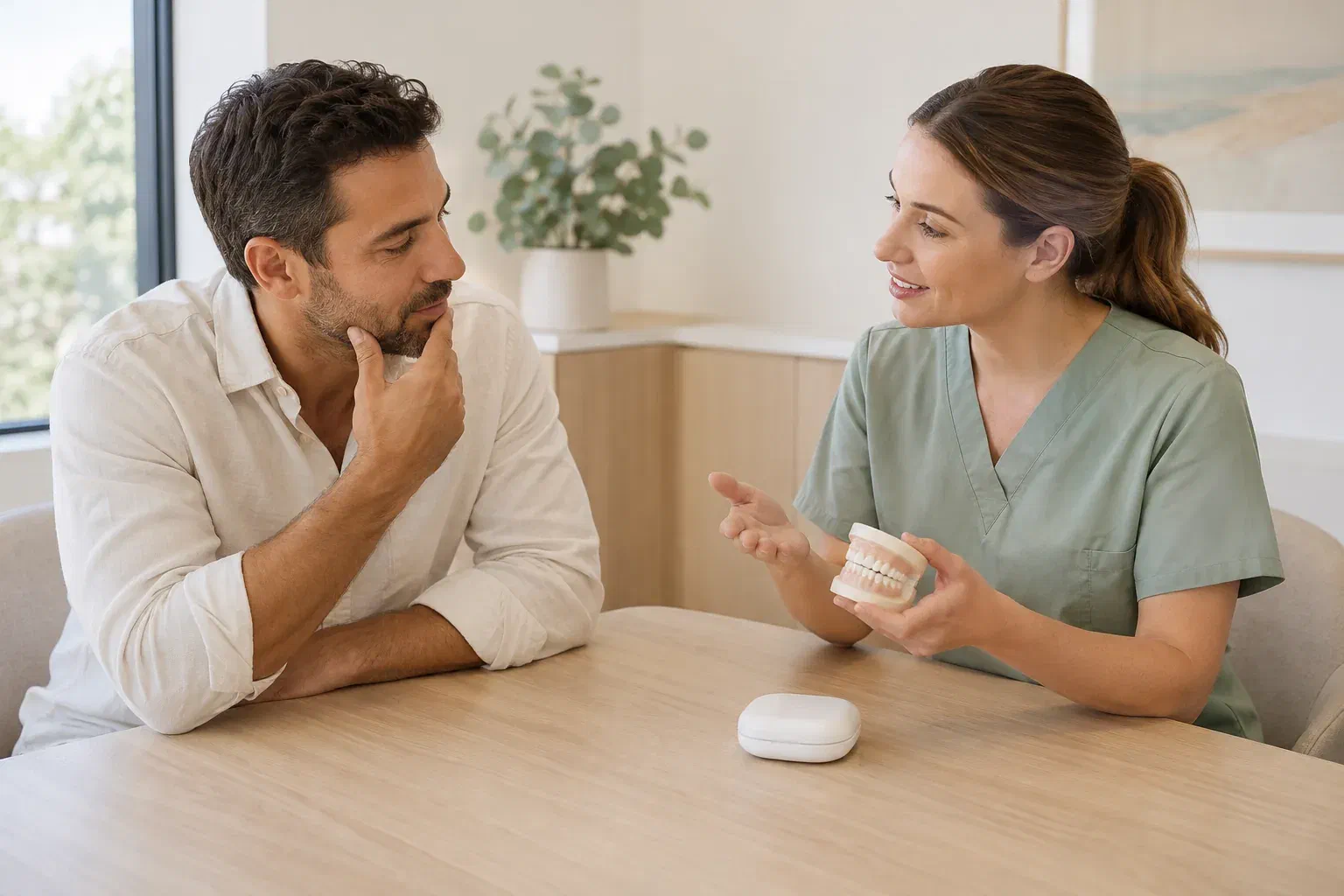
Illustrative consultation about teeth grinding and possible tooth wear
Specialized Care

Teeth-Grinding Treatment in Milton

A tired jaw on waking, a flattened edge, or a filling that keeps failing can all lead to the same question about grinding. Talk it through close to home in Milton and look at assessment and protection shaped by what the examination actually finds.

Grinding, close to home in Milton

Is a guard always the first step?

Many people arrive with that question already half answered. A friend wears a nightguard, an online article recommends one, and the morning jaw ache seems to fit. Grinding, which dentists group with clenching under the word bruxism, can happen during sleep or during the day, and it shows up differently from one mouth to the next.

Before any device is chosen, the dentist looks at what is really there. Worn surfaces can come from more than one source, and an edge that flattened years ago says little about how active the habit is this month. Your history, the symptoms you feel now and the examination together decide whether watching, protecting, repairing or investigating further makes most sense.

When you book at our Bronte Street practice, tell us what first made you wonder about grinding and whether anyone has given you advice or an appliance before. Bring that appliance along. The aim is a plan with a clear job, such as shielding vulnerable teeth or looking into a stubborn symptom, rather than a promise that plastic will end the habit for good.

Ask about grinding and your morning jaw
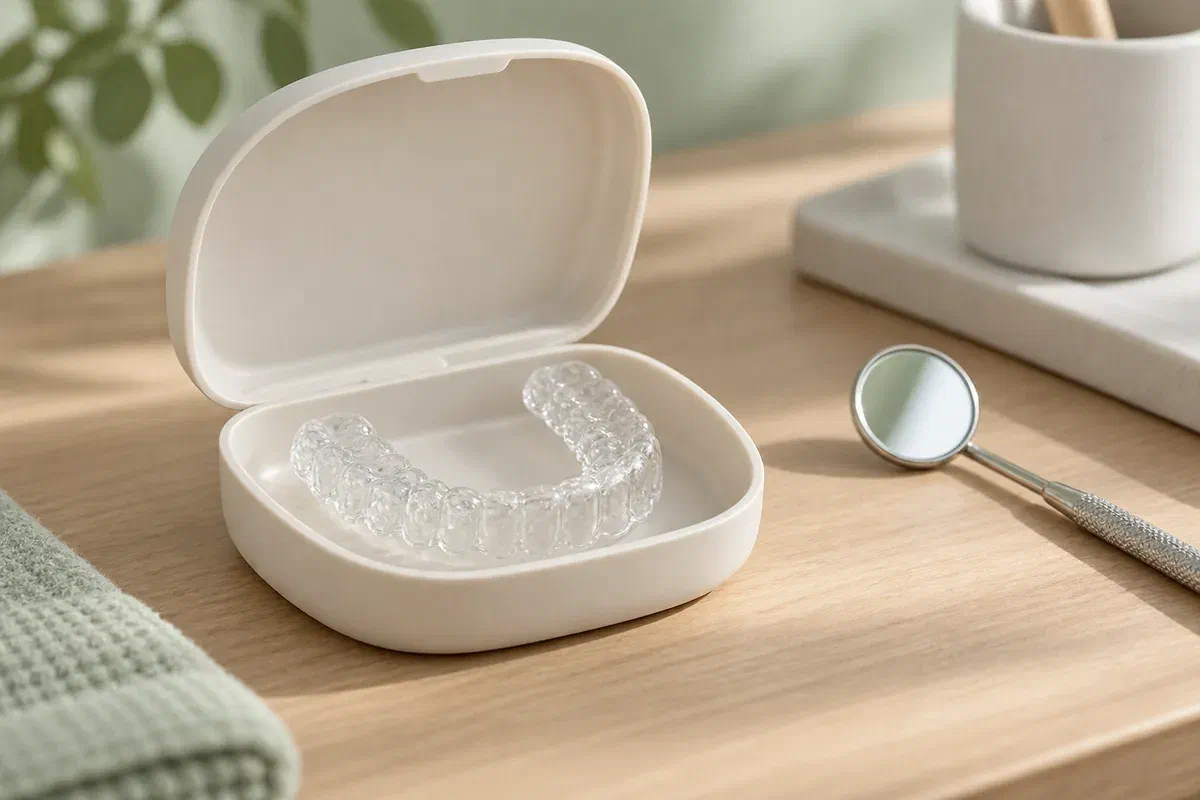
Illustrative single-arch clear dental nightguard in a protective case
Signs worth mentioning

Small clues add up, and you only need a few of them.

Tell us what has been noticed and roughly when. Nobody expects a sleep diary or a recording; a handful of honest observations is a perfectly good place to begin the conversation.

Noise at night that someone else has heard

Share what a partner or family member described, and add any other sleep worries. Their report helps the history, yet it cannot measure damage or point to every cause. Snoring, pauses in breathing or heavy daytime tiredness are worth raising so a medical opinion can be suggested if it seems warranted.

Edges that chip, ache or look different

Say whether the change is recent, sore, or getting in the way of chewing. The dentist weighs the state of that tooth and other possible reasons for wear. A tooth that hurts on its own may need its own investigation, so it is safer not to write the sensitivity off as ordinary grinding soreness.

An appliance or filling that keeps letting you down

Bring along a guard that has cracked, thinned or become uncomfortable, and describe any crowns or fillings that keep breaking. The device and your teeth are best reviewed side by side. A broken guard does not automatically call for a thicker one or another restoration; the findings steer what happens next.

Call promptly for a broken tooth, severe pain, swelling or a sudden change in how your jaw opens. A longstanding grinding question should never hold up care for something new.

Why a careful plan helps

Each recommendation should answer one specific finding.

Grinding care often has several parts that do different jobs. A guard may be offered to protect enamel, a cracked tooth may need repair, and a sore jaw may need separate attention. Asking which finding each suggestion answers makes it easier to see why the plan has more than one step.

A good plan also builds in a way to check how things are going. Comfort, whether you can actually wear an appliance, and changes in the teeth all matter here. Tracking findings across visits tends to tell more than whether a partner heard noise on a given night or a guard shows a scuff.

Patient information: NIDCR — bruxism assessment and management

Learn whether the wear is moving and why

Older photos, X-rays or exam notes may help the dentist read today's surfaces. Mention other parts of your history too, instead of blaming every flat edge on grinding. Ask what will be watched and what change would prompt treatment, rather than expecting each worn tooth to need a crown right away.

Choose protection for your mouth and its purpose

If a guard suits you, ask what it is meant to do, how it should fit, when to wear it and what it cannot do. It needs a clinical fitting and a review if it feels wrong. Sports mouthguards, retainers and sleep-apnea devices each do a separate job and are not swaps for one another.

Look at contributing factors without blame

Sleep, medicines, routines and stress can all be part of the conversation when they apply. Talking about them helps shape care without implying one neat cause or that you did something wrong. When the history raises a question outside dentistry, the dentist may suggest bringing another provider in.

What the visit involves

Listen, look closely, then decide together.

Bring any appliance you already own and tell us what has helped and what has not. The first appointment is about understanding the findings and choices, not about handing every grinder the same solution.

  1. Talk through what you have noticed

    Describe the sounds people have reported, when discomfort tends to appear, and any change to teeth or dental work. Mention medicines, sleep concerns and earlier treatment. Not knowing whether you grind at night is a fine answer; that uncertainty is weighed with the exam rather than replaced with a guess.

  2. Check teeth, dental work and sore spots

    The dentist looks for wear, cracks, sensitivity and signs in the jaw muscles and joints. One tooth may need extra tests, and earlier records can show whether things have changed. Ask what the findings support and which symptoms might have another cause before agreeing to a device or a restoration.

  3. Weigh watching, protecting and repairing

    Discuss whether anything needs to be done now and what each option is meant to achieve. The plan might be practical advice, a fitted guard, repair of a damaged tooth, or a referral for another opinion. Ask about likely benefit and limits; the biggest option is not automatically the most effective one.

  4. Follow up and adjust when needed

    Agree on when to come back and which changes should bring you in sooner. If you receive an appliance, its fit and wear are checked along with your teeth. Ongoing symptoms or repeated breakage call for a fresh look, not an endless chain of replacement guards without revisiting the original questions.

Between appointments

Keep the routine simple and speak up when something changes.

What you are asked to do depends on the findings and on any appliance or treatment provided. If advice seems to clash with an earlier guard or another provider's instructions, ask us to explain.

Look after a fitted guard as instructed

Clean and store it the way you were shown, and bring it to each review. Avoid heating, bending, trimming or adjusting it at home. Call if the fit changes, a crack appears or it causes pain, and stop wearing a broken or painful appliance instead of assuming the discomfort is expected.

Catch daytime clenching gently

If grinding or clenching happens while you are awake, use the reminders you agreed on and let your jaw rest in a relaxed position. Try not to keep sliding your teeth together to feel the worn spots. If a new habit is hard to keep up, say so and the advice can be adjusted.

Keep your dental and medical care talking

Let us know about new tooth symptoms, changes in sleep, or a possible link with a new medicine. Never stop a prescription on your own. If another clinician is involved, ask what should be passed along so the dental side and your wider health are not handled in separate silos.

Possible paths in Milton

Watch, protect, repair or refer: the exam points the way.

Ask what each reasonable option would involve, including simply keeping an eye on things. Care should answer a real need, not promise that reshaping teeth will make grinding disappear.

When the findings favour a conservative start

Observation with everyday strategies

A reported grinding night does not always call for a device or a filling. The dentist may suggest helpful habits and a review schedule while watching for change in symptoms or wear. Ask what is being tracked and which development would shift the recommendation.

When teeth or dental work need protecting or repairing

A fitted guard plus care for specific teeth

A properly assessed guard can help shield surfaces, while a damaged tooth may need treatment of its own. Talk through the purpose, limits and follow-up for each step. Repairing a worn tooth does not show that grinding has stopped, or that neighbouring teeth can stop being watched.

When the history or response suggests looking further

More assessment when questions remain

Lasting jaw pain, a tooth that keeps hurting, sleep symptoms or a question about medication may need more dental or medical input. Ask what the next step is meant to clarify. A tougher appliance or a permanent change to the bite should not be assumed to be the fix before those questions have answers.

Patient information: NHS — when to seek review for teeth grinding

Milton grinding questions

Straight answers about wear, guards and what comes next.

Bring whatever made you concerned, even if it only happens now and then. The aim is to tell a useful protective step apart from a promise nobody can keep.

(905) 876-4488
Why does my jaw feel tired when I wake up?
Grinding or clenching during sleep is one possible reason, but it is not the only one. The dentist asks about timing, other symptoms and your teeth, then examines the jaw muscles and joints. If the picture points elsewhere, further dental or medical assessment may be suggested.
Will the dentist automatically suggest a nightguard once I mention grinding?
Not necessarily. Some people are best served by monitoring and practical advice, others by protection, and some by repair of a particular tooth. The recommendation should follow from what the examination shows rather than from the fact that grinding was mentioned.
Can I buy a mouthguard at the pharmacy instead?
Over-the-counter guards exist, but they are not fitted or reviewed by a clinician, and a poorly fitting device may cause its own problems. Ask the dentist whether protection is needed at all and, if so, what kind suits your teeth and the purpose.
Do flat edges mean I am grinding more than I used to?
Not by themselves. Wear shows what has happened to the surfaces over time and does not reveal how active grinding is today. Comparing findings with older records or later visits can help show whether things are actually changing.
Will wearing a guard stop me from grinding?
A guard is meant to protect surfaces, not to guarantee that the habit ends. Some people still grind while wearing one. Ask what the appliance is expected to do for you and how its usefulness will be judged at review.
Can I book an evening visit to talk about grinding?
Weekday hours run from Monday to Thursday, 11am to 7pm, with Friday to Sunday by appointment only. Call (905) 876-4488 to find a time, and mention pain or a broken tooth so the urgency can be judged.
Book a grinding review in Milton

Come in with your questions, and your guard if you have one.

Reach Milton Dental Clinic to talk about night-time noises, wearing edges, or a guard or restoration that worries you. Mention pain or a recent break when you call so we can judge how soon you should be seen.

The plan rests on the examination and may mean monitoring, protection, dental treatment or a further opinion.

Visit Milton Dental Clinic
Unit 1, 342 Bronte St. S, Milton, ON L9T 5B7
Get directions Clinic hours
Monday–Thursday
11am–7pm
Friday–Sunday
By appointment only

Areas we serve

  • Milton
  • Oakville
  • Mississauga
  • Georgetown
  • Halton Hills
  • Acton
  • Campbellville
  • Brampton
  • Burlington
  • Puslinch
  • Rockwood
  • Erin
  • Caledon
  • Etobicoke
  • Old Milton
  • Bronte Meadows
  • Timberlea
  • Dorset Park
  • Dempsey
  • Clarke
  • Beaty
  • Coates
  • Harrison
  • Scott
  • Willmott
  • Ford
  • Bowes
  • Cobden
  • Walker
  • Mountain View
  • Milton Heights
  • Hawthorne Village
  • Valley View
  • Fallingbrook
  • Nassagaweya
  • Trafalgar
  • Esquesing
  • Nelson
  • Brookville
  • Moffat
  • Glen Williams
  • Norval
  • Limehouse
  • Stewarttown
  • Ashgrove
  • Hornby
  • Silver Creek
  • Speyside
  • Scotch Block
  • North Oakville
  • River Oaks
  • Glen Abbey
  • West Oak Trails
  • Palermo
  • Bronte Creek
  • College Park
  • Joshua Creek
  • Uptown Core
  • Preserve
  • Iroquois Ridge
  • Lisgar
  • Meadowvale
  • Meadowvale Village
  • Churchill Meadows
  • Erin Mills
  • Central Erin Mills
  • Streetsville
  • East Credit
  • Creditview
  • Heartland
  • Sheridan
  • Mount Pleasant
  • Credit Valley
  • Huttonville
  • Churchville
  • Springbrook
  • Northwest Brampton
  • Bram West
  • Fletcher's Meadow
  • Fletcher's Creek South
  • Alton Village
  • Orchard
  • Millcroft
  • Headon Forest
  • Tansley
  • Brant Hills
  • Tyandaga
  • Kilbride
  • Lowville
  • Aberfoyle
  • Morriston
  • Arkell
  • Hillsburgh
  • Freelton
  • Carlisle
  • Waterdown
  • Flamborough
  • Mountsberg

How can we help?

Milton Dental Clinic

Have a question about your smile? Choose the option that works best for you.

For urgent dental concerns, please call.
Messages are reviewed during clinic hours.