
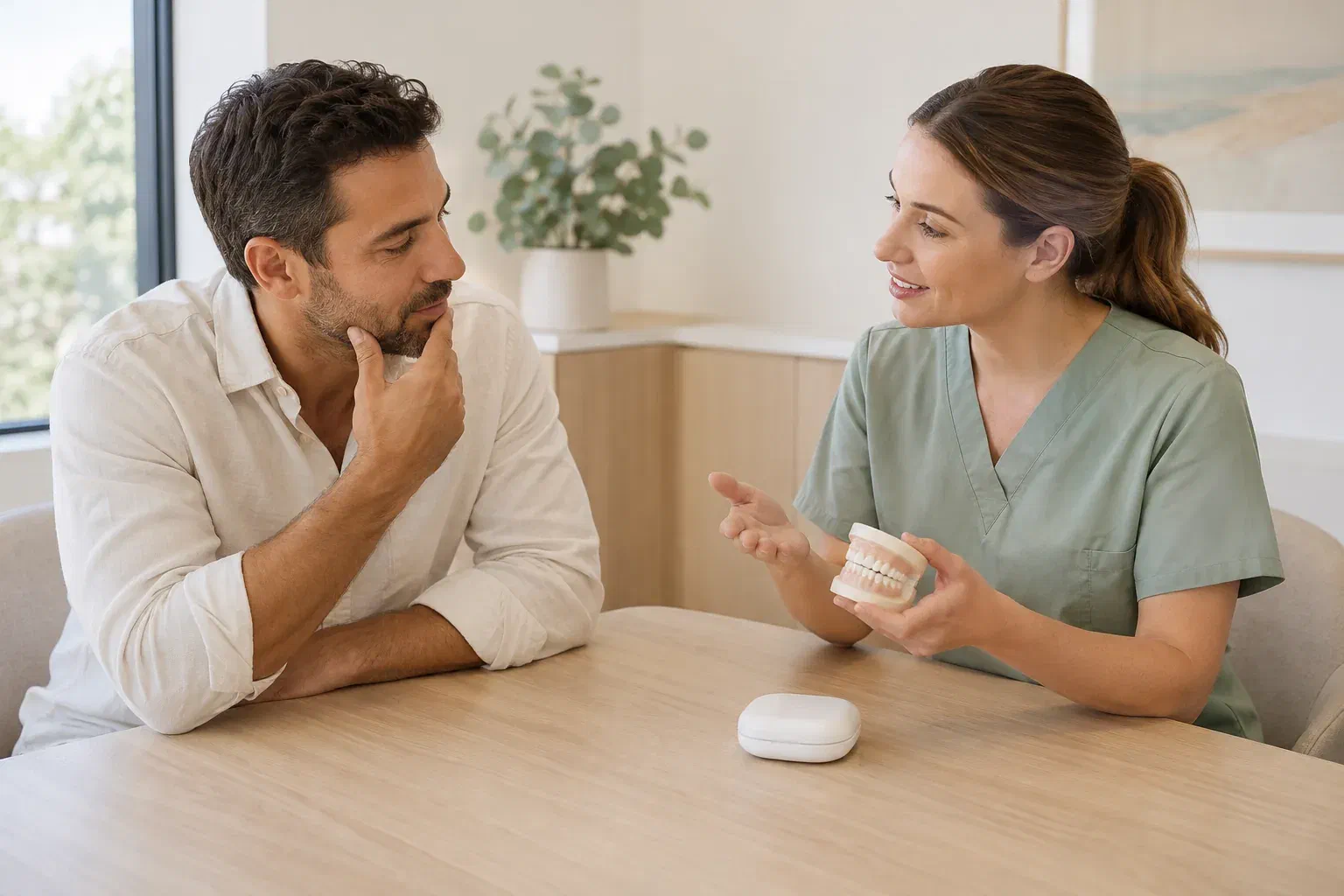
Illustrative consultation about teeth grinding and possible tooth wear
Specialized Care

Teeth-Grinding Treatment in Mississauga

Grinding is not only a night-time problem. A jaw that tightens through the workday, teeth pressed together over a keyboard, or an ache by late afternoon can be part of the same pattern. From Mississauga, you can have it assessed and plan care that fits both day and night.

Daytime grinding, from Mississauga

Busy day, clenched jaw.

Most talk about grinding centres on sleep, yet plenty of people catch themselves doing it at a desk, in traffic or during a tense phone call. Bruxism is the dental term that covers both grinding and clenching, awake or asleep. Some people have one pattern, some both, and many are not sure which applies to them.

Working that out is part of the assessment. Wear on the teeth has more than one possible source, and an edge that flattened long ago does not reveal what your jaw is doing this week. The dentist listens to when symptoms appear, examines your teeth and jaw, and only then talks about watching, protecting, repairing or seeking another view.

Come prepared to describe a typical day as well as a typical night. If you already use a guard, bring it, and mention any advice you have had before. A good plan is specific about its aim, perhaps reducing daytime pressure through habits or protecting teeth during sleep, and it does not pretend that an appliance can switch grinding off for good.

Talk about daytime and night-time grinding
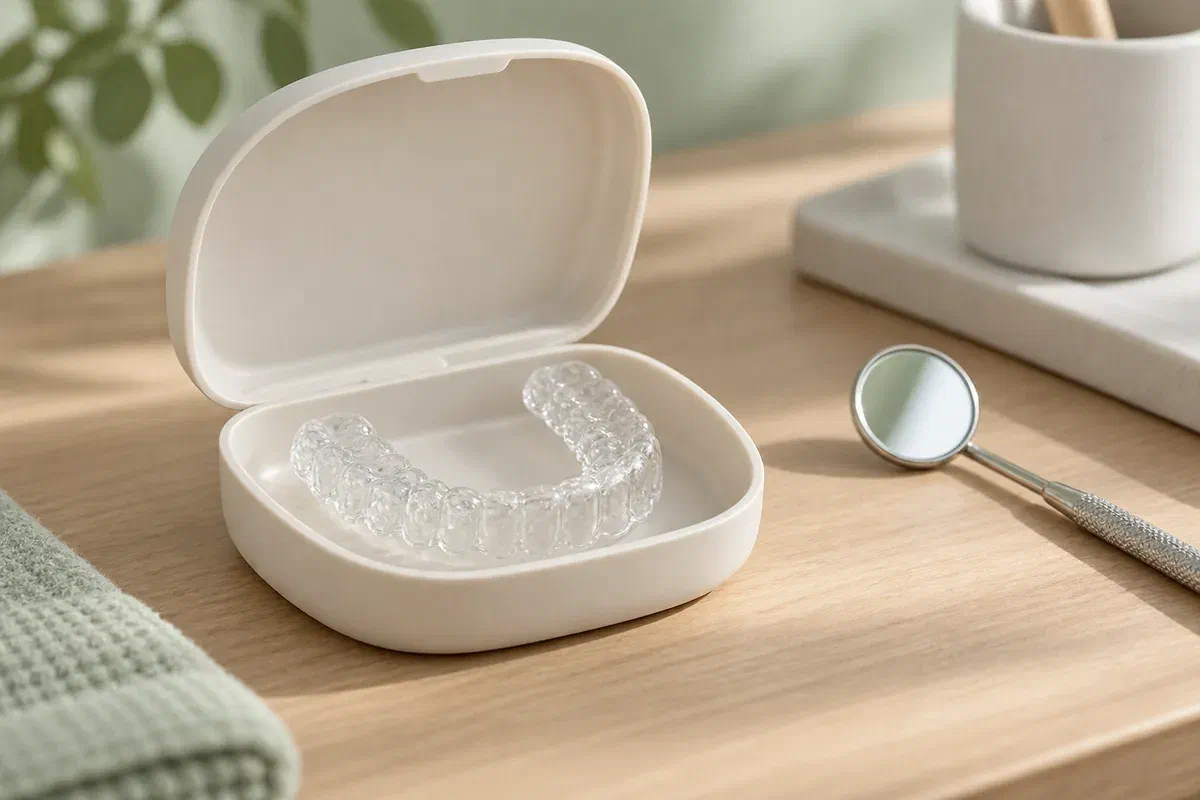
Illustrative single-arch clear dental nightguard in a protective case
When it is time to ask

Notice the pattern? That is enough to begin.

You do not need to log every clench or record your sleep. A rough sense of when things feel worse, and what others have mentioned, is a perfectly useful starting point.

A partner hears grinding after lights out

Share what has been described and anything else you have noticed about your sleep. That account matters, but it cannot show how much wear has occurred or settle the cause. If snoring, interrupted breathing or daytime drowsiness are present, say so, as a medical evaluation may be worth discussing.

Sore teeth or worn edges after long workdays

Tell us whether the discomfort is new, comes and goes, or affects chewing. Wear and sensitivity can have causes other than grinding, and the dentist considers them. One tooth that stays sore deserves its own check rather than being assumed to be part of a clenching habit.

Restorations or appliances that keep failing

Fillings that keep chipping or a guard that wore through quickly are useful clues. Bring the guard so it can be looked at with your teeth. A short lifespan does not automatically mean you need a tougher device or a bigger repair, and the examination helps decide.

If a tooth breaks, pain becomes severe, swelling develops or your jaw suddenly locks or shifts, call promptly rather than waiting to discuss grinding. New problems come first.

Why the details pay off

Daytime habits and night-time protection are different tools.

Clenching at a desk and grinding in sleep may call for different responses. Awareness strategies can help during the day, a fitted guard may protect teeth overnight, and a damaged tooth or aching jaw may need treatment of its own. Understanding which finding each suggestion targets makes the overall plan easier to follow.

It also helps to agree how progress will be judged. Fewer afternoon aches, a guard you can actually tolerate and teeth that hold steady between visits are better signs than a single quiet night. Those comparisons across appointments guide whether the plan should stay as it is or change.

Patient information: NIDCR — bruxism assessment and management

Understand when and why the wear happens

Previous X-rays, photos or exam notes can help show whether surfaces are changing. Day-to-day factors are considered alongside sleep, and not every worn area is blamed on grinding. Ask what the dentist plans to track and what would justify moving to treatment.

Use a guard for what it does well

If a night appliance is advised, ask about its purpose, the fit to expect, how often to wear it and what it cannot fix. It should be fitted clinically and adjusted if it bothers you. A sports guard, a retainer and a sleep-apnea device each serve other purposes and cannot be swapped in.

Look at work, sleep and medicines without blame

Workload, stress, sleep, caffeine and medication may all come up. Talking about them helps tailor advice without suggesting there is a single cause or that the habit is your fault. If something calls for input beyond dentistry, we may recommend involving your doctor.

Inside the appointment

From your daily routine to a plan you can follow

If you have a guard, bring it, along with a sense of when symptoms peak. The first visit should clarify what is happening rather than prescribe the same fix to everyone who grinds.

  1. Map out your days and nights

    We ask when your jaw feels tight, what others have heard at night, and how your teeth or dental work have changed. Medicines, sleep quality and earlier treatment matter too. Not knowing whether you grind while asleep is common and simply becomes part of what the examination considers.

  2. Examine teeth, muscles and joints

    The dentist looks for wear facets, cracks and sensitive teeth, and checks the jaw muscles and joints for tenderness. Some teeth may need more testing. Ask what the findings suggest and whether anything else could explain your symptoms before agreeing to an appliance or repair.

  3. Choose the lightest effective step

    That might be daytime awareness strategies, a fitted night guard, repair of a damaged tooth, or referral for another opinion. For each, ask what it is meant to achieve and where its limits lie. The most elaborate option does not automatically work best.

  4. Recheck and fine-tune

    A follow-up looks at your teeth, your symptoms and the condition of any appliance. Get in touch sooner if something breaks or new pain appears. If problems persist, the dentist re-examines the original questions rather than replacing the guard repeatedly.

Through the workweek

Relaxed jaw by day, protected teeth by night

Your instructions depend on the findings and on any treatment or device provided. If something you were told before seems to contradict the new plan, ask us to explain the difference.

Look after your night guard properly

Clean it and store it in its case as shown, and bring it to each review. Avoid putting it in hot water, bending it or trimming it. Call if it cracks, fits differently or causes pain, and do not keep wearing a damaged appliance in the hope that discomfort will pass.

Build small daytime check-ins

A reminder on your screen or phone can prompt you to notice whether your teeth are touching. Lips closed, teeth apart and a relaxed tongue is a comfortable rest position for many people. Try not to grind on purpose to feel worn edges, and tell us if a habit is not sticking.

Share relevant health changes

Let us know about new tooth pain, poorer sleep or a medication change that seems to line up with symptoms. Never stop a medicine on your own. If your physician or another clinician is involved, we can discuss what information should pass between us.

Paths for Mississauga adults

Habit work, protection, repair or referral

Ask what each sensible choice involves, including monitoring. Care should match a finding and should never promise that reshaping teeth will end grinding.

When symptoms are mild and wear is stable

Daytime strategies and monitoring

For many people, awareness habits and a scheduled review are the right first step. A device or filling is not automatic. Ask what the dentist will look for at follow-up and what change would lead to a different recommendation.

When teeth or restorations need shielding or fixing

Night protection and targeted repair

A fitted night guard may protect surfaces during sleep, while a damaged tooth may need separate treatment. Discuss the purpose and follow-up of each. Fixing one worn tooth does not prove the grinding has eased or that other teeth no longer need watching.

When symptoms continue or the history raises questions

Another opinion for persistent problems

Ongoing jaw pain, a persistently painful tooth, sleep symptoms or a medication concern may warrant further dental or medical assessment. Ask what that step should answer. A heavier appliance or permanent bite alteration should not be assumed to be the fix in the meantime.

Patient information: NHS — when to seek review for teeth grinding

Questions about daytime and sleep grinding

What is happening, and what helps?

Bring whatever you have noticed, even if it is patchy. These answers aim to help you tell realistic protection from promises nobody can keep.

(905) 876-4488
Is clenching during the day the same as grinding at night?
They are related and both fall under bruxism, but they can behave differently and may call for different approaches. Daytime clenching often responds to awareness strategies, while sleep grinding is more often discussed in terms of protection.
Can I wear my night guard at my desk?
Ask before doing so. Most night guards are designed for sleep, and wearing one during the day may not be the best answer to daytime clenching. The dentist can suggest strategies that suit waking hours.
Could stress at work be making me grind?
Stress is one factor often discussed with grinding, but it is rarely the whole story. The dentist may talk about routines and sleep without assuming a single cause or suggesting you are to blame.
Why do my teeth ache by late afternoon?
Clenching through the day is one possibility, but a particular tooth can also become sensitive for other reasons. If one tooth hurts consistently, it needs its own examination rather than being put down to tension.
Does grinding mean I have a sleep disorder?
Not necessarily. Grinding does not establish a sleep diagnosis. If you snore, stop breathing at night or feel very tired during the day, mention it, as a medical assessment may be appropriate. A guard does not treat a sleep disorder.
Should a crowned or rebuilt tooth fix my clenching?
No. Restorations treat the tooth, not the habit. Ask why any restoration is suggested, what the alternatives are and how protection and review will continue.
Book from Mississauga

Tell us about your days, not just your nights.

Contact Milton Dental Clinic to talk about jaw tightness at work, reported grinding during sleep or a guard that is not helping. Mention pain or a broken tooth so we can decide how soon you need to be seen.

Care depends on the examination and may involve daytime strategies, monitoring, protection, dental treatment or referral.

Visit Milton Dental Clinic
Unit 1, 342 Bronte St. S, Milton, ON L9T 5B7
Get directions Clinic hours
Monday–Thursday
11am–7pm
Friday–Sunday
By appointment only

Areas we serve

  • Milton
  • Oakville
  • Mississauga
  • Georgetown
  • Halton Hills
  • Acton
  • Campbellville
  • Brampton
  • Burlington
  • Puslinch
  • Rockwood
  • Erin
  • Caledon
  • Etobicoke
  • Old Milton
  • Bronte Meadows
  • Timberlea
  • Dorset Park
  • Dempsey
  • Clarke
  • Beaty
  • Coates
  • Harrison
  • Scott
  • Willmott
  • Ford
  • Bowes
  • Cobden
  • Walker
  • Mountain View
  • Milton Heights
  • Hawthorne Village
  • Valley View
  • Fallingbrook
  • Nassagaweya
  • Trafalgar
  • Esquesing
  • Nelson
  • Brookville
  • Moffat
  • Glen Williams
  • Norval
  • Limehouse
  • Stewarttown
  • Ashgrove
  • Hornby
  • Silver Creek
  • Speyside
  • Scotch Block
  • North Oakville
  • River Oaks
  • Glen Abbey
  • West Oak Trails
  • Palermo
  • Bronte Creek
  • College Park
  • Joshua Creek
  • Uptown Core
  • Preserve
  • Iroquois Ridge
  • Lisgar
  • Meadowvale
  • Meadowvale Village
  • Churchill Meadows
  • Erin Mills
  • Central Erin Mills
  • Streetsville
  • East Credit
  • Creditview
  • Heartland
  • Sheridan
  • Mount Pleasant
  • Credit Valley
  • Huttonville
  • Churchville
  • Springbrook
  • Northwest Brampton
  • Bram West
  • Fletcher's Meadow
  • Fletcher's Creek South
  • Alton Village
  • Orchard
  • Millcroft
  • Headon Forest
  • Tansley
  • Brant Hills
  • Tyandaga
  • Kilbride
  • Lowville
  • Aberfoyle
  • Morriston
  • Arkell
  • Hillsburgh
  • Freelton
  • Carlisle
  • Waterdown
  • Flamborough
  • Mountsberg

How can we help?

Milton Dental Clinic

Have a question about your smile? Choose the option that works best for you.

For urgent dental concerns, please call.
Messages are reviewed during clinic hours.