

Illustrative consultation about jaw-joint movement and discomfort
Specialized Care

TMJ Assessment in Campbellville

Jaw trouble that flares for a week and then disappears is easy to put off, especially when a trip into town has to fit around everything else. For households in Campbellville, a TMJ assessment can be booked on a calm day and still be useful. We go through your pattern, check jaw movement and the teeth, and explain the options.

Flare-ups that come and go

You don't have to be in pain on the day for the visit to count.

A common worry goes something like this: the jaw was terrible last week, it's fine now, so is there any point going in? There is. Symptoms that wax and wane are typical of many jaw problems, and the pattern itself tells the clinician a lot. A good day at the appointment simply means the history does more of the work.

Your temporomandibular joints sit in front of each ear and work with the chewing muscles whenever you eat, talk or yawn. An assessment considers them alongside your teeth and general health, and it unfolds as a conversation plus an examination rather than one test with a yes-or-no answer. A painless click, a jaw that locked briefly during a flare and an ache that might start in a tooth are each weighed on their own terms.

Living out in Campbellville, you may prefer to make one trip cover a lot, and perhaps line it up with other family appointments. Jot down what the flares are like, what seems to trigger them, and what you've tried. Bring any old reports or a guard. We'll plan the examination around that and be clear about when a dental, medical or specialist colleague should be involved.

Book a jaw assessment between flare-ups
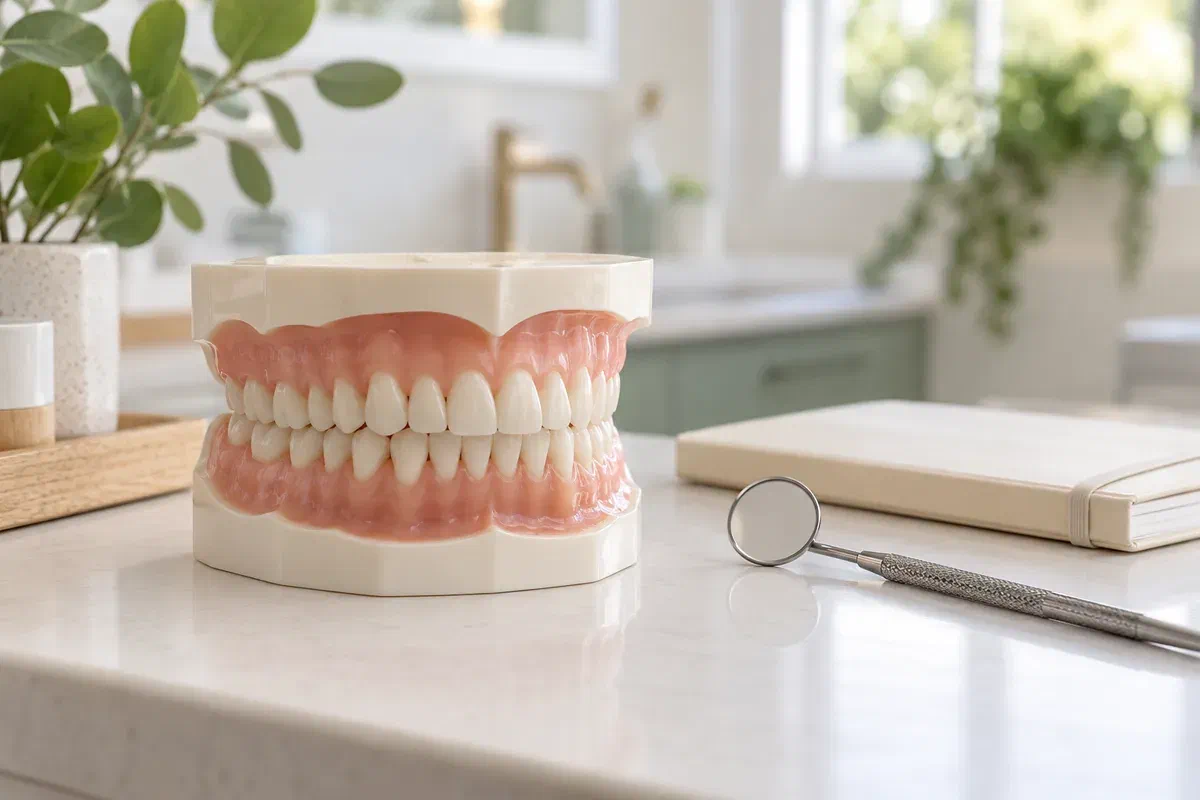
Illustrative supported dental teaching cast beside a mirror and closed notebook
Describing an on-and-off problem

Paint a picture of a typical flare.

How often do flares happen, how long do they last and what do they feel like at their worst? Is there a background ache between them? Working out the cause is our part, and you shouldn't try to bring on a flare before the visit.

What a flare feels like and where

Show us the area and describe whether a flare brings aching with meals, soreness on waking or a constant dull pain. Mention any tooth that gets tender during flares and other facial discomfort. This helps keep several explanations in view instead of blaming the joint for all of it.

Catching or restriction during bad spells

Does the jaw stick, open less or feel like the teeth meet strangely during a flare? Did any of this follow an injury? Don't try to recreate it for us. If the jaw ever gets stuck and won't open or close, call promptly rather than waiting for it to pass.

Sounds that appear or vanish with flares

Some people find a click gets louder, quieter or more painful as symptoms come and go. Tell us about that. A noise on its own isn't a reason for treatment, and volume doesn't measure damage, so it's considered alongside movement and history.

Phone promptly about a recent injury, real swelling, fever or a jaw that suddenly won't move. If you can't eat or drink or have other serious symptoms, seek urgent medical care; in a rural area, don't wait until the next trip into town.

Why it's worth going on a quiet day

Patterns over time are often more telling than one bad moment.

An assessment helps sort out whether flares seem to stem from the teeth, the muscles or joint, or from something another provider should look at. You should hear the reasoning plainly. Often the next step is a practical plan for managing flares with a review; sometimes more information is needed before anything specific is suggested.

It also sets a baseline for the in-between times. Knowing how your jaw behaves on a good day, as well as how flares unfold, makes later comparisons meaningful. One visit isn't meant to give you a lifelong label. It's meant to leave you with a plan for the next flare and a simple way to judge whether things are getting better.

Patient information: NIDCR — history, examination, and diagnostic considerations for TMD

How flares disrupt your routine

Explain what you avoid during a bad spell, whether that's crunchy food, long conversations or certain tasks around the house or farm. Those details shape the questions asked and the goals of any care more than a pain score would.

An exam that uses your history to fill the gaps

Even without a flare on the day, the clinician can check jaw movement, joints, muscles and teeth. Mention anything that feels like a milder version of your usual symptoms. The examination stays comfortable, with pauses whenever you want.

A reasoned plan, including for the next flare

Should a scan or outside opinion come up, it's fair to ask what it would add. Ask, too, what to do when the next flare arrives, and which signs during a flare would justify calling rather than waiting it out.

On the day

History, a gentle exam, then a plan you can take home

Let us know when booking if a long visit is hard, or if your opening is limited even between flares. If you'd like to coordinate with other family appointments, ask. Bring any old reports, but don't delay over paperwork.

  1. Walk us through the pattern

    We'll ask when it began, how often flares happen, what seems to bring them on, any injuries, dental and medical history, and what you've tried. If you've kept notes or photos of swelling, bring them. A calm day is fine; just describe the bad ones.

  2. Check the jaw as it is today

    Opening, closing and side-to-side glides are observed, and the joint area, cheek and temple muscles and teeth are examined where your history points. Gentle pressure may bring on a faint echo of your usual ache, which is useful to mention. Speak up if it's uncomfortable; nothing needs to be forced.

  3. Make sense of the findings and the history

    Ask what stands out, what else was considered and how clear the picture is from one visit. Some questions need more investigation or a review during a flare. Quiet findings on the day don't mean your symptoms are imagined.

  4. Agree a plan for now and for the next flare

    That might be monitoring, conservative guidance, a test or a referral, along with what to do when symptoms return. Ask who arranges each part and how you'll get results. Know which flare signs mean you should call straight away.

Between appointments

Have a plan ready before the next bad spell.

Most people go home with some flare-management advice, and some also leave with a recheck booked or a referral in hand. If it's unclear what's optional, what comes next or who books it, ask the team before you head home.

Use the advice meant for your pattern

Try any recommended comfort measures or changes during flares, within the limits discussed. Avoid forceful exercises or online jaw-repositioning techniques. If something seems to make flares worse, stop it and check with the provider.

Keep a flare diary, not a constant check

When a flare happens, jot down the date, how long it lasted, what it affected and anything that might have set it off. Between flares, there's no need to keep testing the jaw. A simple diary makes the review far more useful.

Line up follow-up efficiently

Where a scan or another appointment is planned, find out who books it and who will explain the results, and whether it can be grouped with other trips. Let us know if travel or timing is difficult.

Possible directions

A plan built around how your symptoms behave

An assessment doesn't automatically mean you need treatment. Ask why an approach suits your pattern and what change in flares would lead to a different plan.

When flares are mild and manageable

Explanation and keeping track

Occasional, short-lived flares or a painless click may simply be explained and tracked, with no device or procedure. Ask what change would matter. Monitoring is a choice, and flares that worsen should bring you back.

When symptom management is a reasonable first step

A conservative flare plan

Practical measures to use during flares may be suggested, with a review of how they help. Know what to do when symptoms start and when to check in. If flares continue or the first explanation stops fitting, the plan is revisited.

When the pattern raises an unanswered question

Further investigation or another provider

Now and then a flare pattern leaves a question the chair-side exam can't settle. A specific scan, your family doctor or a specialist may then be the better next stop. Before agreeing, find out what you'd learn and who will go through it with you. No picture replaces the story of your flares.

Campbellville flare questions

When symptoms won't stay put

It's fine to ask what an exam can show on a quiet day, and why a step is suggested, before deciding on treatment.

(905) 876-4488
Should I wait for a flare before booking a jaw assessment?
No. A clear description of your flares is usually enough, and it’s better not to provoke symptoms. If a flare happens around your appointment, that’s fine too; just let the team know how you’re feeling.
Is it useful to take photos when my face looks swollen?
It can be. If you notice visible swelling, a dated photo may help the clinician understand what happens during a flare. Significant swelling, especially with fever, needs prompt attention.
Can weather or season seem to affect my jaw?
Some people notice patterns linked to routines, stress or activities. Mention anything you’ve noticed, and the clinician can consider it without assuming one cause.
Can several family members be seen on the same trip?
Ask when booking. The team can discuss whether appointments can be arranged close together, while making sure the jaw assessment has enough time.
What should I do during a flare if I can't get in quickly?
Follow any advice you’ve been given, eat softer foods if that’s more comfortable and avoid forcing your jaw. Call for advice, and seek urgent care for serious symptoms or inability to eat or drink.
Do flares mean my jaw is getting worse over time?
Not necessarily. Many jaw symptoms fluctuate. A diary of how often flares happen and how long they last helps tell whether the overall trend is improving, steady or worsening.
From Campbellville

Book on a good day. Bring the story of the bad ones.

Reach out to Milton Dental Clinic about on-and-off jaw pain, stiffness, clicking or teeth that don't seem to meet the way they used to. A jaw that has just locked, or a recent fall or blow, changes the timing, so mention either one on the phone and we'll help you weigh it.

Next steps may include monitoring, a flare plan, further investigation or a referral.

Visit Milton Dental Clinic
Unit 1, 342 Bronte St. S, Milton, ON L9T 5B7
Get directions Clinic hours
Monday–Thursday
11am–7pm
Friday–Sunday
By appointment only

Areas we serve

  • Milton
  • Oakville
  • Mississauga
  • Georgetown
  • Halton Hills
  • Acton
  • Campbellville
  • Brampton
  • Burlington
  • Puslinch
  • Rockwood
  • Erin
  • Caledon
  • Etobicoke
  • Old Milton
  • Bronte Meadows
  • Timberlea
  • Dorset Park
  • Dempsey
  • Clarke
  • Beaty
  • Coates
  • Harrison
  • Scott
  • Willmott
  • Ford
  • Bowes
  • Cobden
  • Walker
  • Mountain View
  • Milton Heights
  • Hawthorne Village
  • Valley View
  • Fallingbrook
  • Nassagaweya
  • Trafalgar
  • Esquesing
  • Nelson
  • Brookville
  • Moffat
  • Glen Williams
  • Norval
  • Limehouse
  • Stewarttown
  • Ashgrove
  • Hornby
  • Silver Creek
  • Speyside
  • Scotch Block
  • North Oakville
  • River Oaks
  • Glen Abbey
  • West Oak Trails
  • Palermo
  • Bronte Creek
  • College Park
  • Joshua Creek
  • Uptown Core
  • Preserve
  • Iroquois Ridge
  • Lisgar
  • Meadowvale
  • Meadowvale Village
  • Churchill Meadows
  • Erin Mills
  • Central Erin Mills
  • Streetsville
  • East Credit
  • Creditview
  • Heartland
  • Sheridan
  • Mount Pleasant
  • Credit Valley
  • Huttonville
  • Churchville
  • Springbrook
  • Northwest Brampton
  • Bram West
  • Fletcher's Meadow
  • Fletcher's Creek South
  • Alton Village
  • Orchard
  • Millcroft
  • Headon Forest
  • Tansley
  • Brant Hills
  • Tyandaga
  • Kilbride
  • Lowville
  • Aberfoyle
  • Morriston
  • Arkell
  • Hillsburgh
  • Freelton
  • Carlisle
  • Waterdown
  • Flamborough
  • Mountsberg

How can we help?

Milton Dental Clinic

Have a question about your smile? Choose the option that works best for you.

For urgent dental concerns, please call.
Messages are reviewed during clinic hours.