

Illustrative consultation about jaw-joint movement and discomfort
Specialized Care

TMJ Assessment in Halton Hills

Is a clicking jaw worth an appointment, or something to live with? For households across Halton Hills, a TMJ assessment can answer that honestly. We listen to how the problem affects your day, look at jaw movement and the teeth, and explain whether watching, simple care, imaging or another assessment is the right call.

Worth booking, or worth watching?

A practical way to decide what your jaw needs

Plenty of jaws click. Many never cause trouble. That is why people hesitate to book: it feels like a small thing to bother a dentist with. A useful rule of thumb is to look at what the jaw is doing to your life. Pain, catching, trouble opening, or a bite that suddenly feels strange are all good reasons to be seen. A painless sound you've had for years may just need a word of reassurance.

The temporomandibular joints, on each side just ahead of the ears, team up with the chewing muscles for every bite and every word. An assessment treats them as part of the whole mouth and body rather than a standalone part. It is not one test. The clinician asks questions, then examines what your answers point toward, and keeps in mind that pain near the joint might have another source entirely.

From Georgetown, Acton, Glen Williams or a smaller hamlet in Halton Hills, the first step is simply to tell us what nudged you to call and what has become harder. If you have old reports, a guard or advice from someone else, bring it along. We can then decide on a sensible examination and say plainly when another dental, medical or specialist opinion would help.

Find out if your jaw needs a closer look
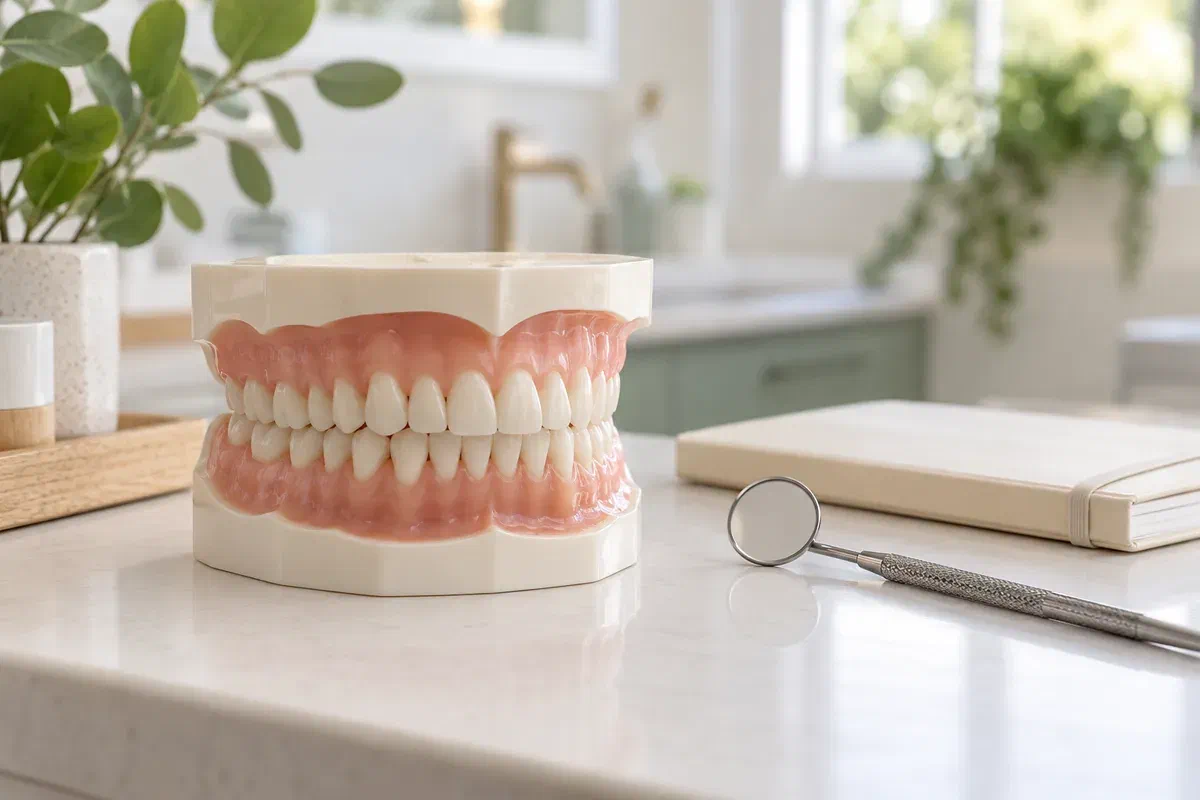
Illustrative supported dental teaching cast beside a mirror and closed notebook
Signs that tip the balance toward booking

Pain, restriction and change matter more than noise.

Tell us how long it's been going on, whether it's getting worse, and whether it's constant or on and off. You don't need a name for the problem, and nobody will ask you to keep repeating something that hurts.

Discomfort that keeps returning

Where does it ache, and when? After meals, on waking, at the end of a busy day, or for no clear reason? Mention a tooth that's tender or pain elsewhere in your face. Those details help the clinician weigh a range of causes rather than putting everything down to the joint.

A jaw that catches, sticks or closes differently

Restriction or a changed bite, particularly if new or following a knock, is a stronger reason to be seen than a sound on its own. Don't try to force the movement. If your jaw suddenly can't open or close as normal, phone for advice that same day rather than waiting.

Sounds, and whether they come with anything else

A click with no pain or locking may simply be noted. One that has started to hurt, or that comes with catching, deserves more attention. Volume on its own isn't a sign of damage, so the clinician reads it in context with movement and symptoms.

Don't wait to book if you've had a recent injury, notice real swelling or a fever, or the jaw suddenly won't move properly. Being unable to eat or drink, or having other serious symptoms, is a reason to seek urgent medical help rather than a routine visit.

What you get from asking

Either peace of mind or a plan, and often both

One helpful result of an assessment is knowing which category you're in. The findings may suggest a dental cause, something in the muscles or joint, or a symptom that should be looked at by a physician or specialist. You should hear the reasoning in plain language. Sometimes the answer really is to watch it. Sometimes more information is needed first.

Even when nothing needs doing, the visit gives you a baseline. If your jaw changes later, there is a record to compare against, which makes the next conversation more useful. The aim isn't to tag you with a lifelong condition; it's to leave you with a clear understanding and a simple point to check in again.

Patient information: NIDCR — history, examination, and diagnostic considerations for TMD

A conversation about what actually bothers you

Tell us whether the issue is pain, eating, talking, sleep or simply worry. A noise that embarrasses you at dinner is a valid concern too. Your priorities shape which questions are asked and what, if anything, care should aim for.

An exam proportionate to the concern

A quick, painless click may need only a brief look at movement. Pain or restriction may call for checking the joints, chewing muscles and teeth more closely. Point out anything that brings on familiar symptoms, and ask for breaks whenever you like.

Honest advice about whether anything else is needed

If a test or referral is mentioned, ask what it would answer and how it could alter your care. If nothing further is suggested, ask what would make you come back. Watching is a valid outcome, as long as you know what to watch for.

What the appointment involves

Simple, conversational and paced to you

If you can't open far or a long appointment would be tough, let us know when you call. Earlier imaging reports are welcome, but a new symptom shouldn't wait while you look for paperwork.

  1. A chat about the history

    When did it start? Has it changed? Any injuries, recent dental work, health conditions or medications? Have you tried a guard, heat, stretches or anything else? Tell us what helped and what didn't. If the jaw is quiet today, describe a typical troublesome day.

  2. A look at how the jaw moves

    The clinician watches you open, close and move side to side, and checks the joints, muscles and teeth as your history suggests. You'll be asked whether anything feels tender or familiar. Speak up if it's uncomfortable; you don't have to push through for your concern to count.

  3. An explanation you can follow

    You'll hear which findings stand out, which possibilities were considered and how confident anyone can be at this stage. Some questions need further investigation. A finding that looks normal doesn't mean the pain isn't real.

  4. A decision on what comes next

    That might be nothing more than reassurance, or it could be practical care, a test or a referral. Ask who arranges what and how you'll hear about results. Agree which changes should prompt a call before any planned review.

Once you're home

Live normally, and keep half an eye on changes.

You might leave with reassurance, a few things to try, a follow-up or a referral. If it isn't clear which is which, or who is booking the next step, ask us to go over it.

Use only the advice meant for you

If you were given comfort measures or activity changes, stick to them within the agreed limits. Don't add forceful exercises or jaw-repositioning tricks from the internet. If something makes the jaw worse, stop and ask the provider.

Notice changes without fixating

It's enough to notice whether eating and opening feel better or worse and whether anything new appears. Avoid testing the click over and over. A short, honest summary is more useful at review than daily experiments.

Follow up if you were asked to

If imaging or another appointment is part of the plan, find out who books it and who explains the results. Let us know if scheduling or getting there is difficult. A recommendation should lead to a clear next action.

Likely outcomes

Reassure, manage or investigate

An assessment doesn't mean you'll need treatment. Ask why an approach fits your situation and what kind of change would lead to a different plan.

When nothing needs active treatment

Reassurance and keeping an eye on it

Many painless clicks and stable findings need only an explanation. There's no device or procedure involved. Ask what would count as a meaningful change. Monitoring is still a plan, and new pain or lost movement is a reason to return.

When easing symptoms is a sensible first step

Practical, conservative care

You may be offered simple measures and a check-in to see how they affect eating and comfort. Know what to try and when to come back. If symptoms continue or the first explanation stops fitting, the plan should be looked at again.

When a question remains unanswered

Imaging or another opinion

A targeted image, or a medical or specialist assessment, can sometimes answer a question that a dental exam can't. Ask what the outcome could change and who will talk you through it. Any image is considered alongside your symptoms and exam.

Halton Hills questions

Should I book? Common hesitations answered

You can ask what a test can and can't show and why a recommendation is made before deciding on treatment. The goal is clarity.

(905) 876-4488
My jaw clicks but doesn't hurt. Do I need to do anything?
Often not. A painless, stable click may simply be noted. It becomes more important to have it checked if it starts to hurt, catches or limits your opening. Mention it at your next checkup if you’re unsure.
Can I just mention my jaw at my regular checkup?
Yes, that’s a reasonable start for mild concerns. The dentist can decide whether a separate, longer assessment would be helpful. If symptoms are significant or getting worse, book a dedicated visit.
Could my child's jaw clicking be a concern?
Mention it at their dental visit, along with any pain or difficulty eating. The dentist can examine and advise whether anything further is needed, keeping in mind that children’s jaws are still developing.
How do I know if jaw pain is urgent?
Sudden inability to open or close, a recent injury, significant swelling, fever, or being unable to eat or drink need prompt attention. Ongoing ache without these features can usually be booked as a regular assessment.
Is jaw pain ever related to other health conditions?
It can be. Some medical conditions affect joints or cause pain felt near the jaw. Tell the clinician about your health history so they can consider whether a medical review would help.
Will I feel silly booking for something minor?
There’s no need to. Asking about a symptom that worries you is a sensible thing to do, and sometimes the most useful outcome is learning that it can safely be watched.
From across Halton Hills

Not sure if it's worth it? Ask.

Contact Milton Dental Clinic about a clicking, aching or stiff jaw, or a bite that feels off. If your jaw has suddenly locked or you've had a recent injury, mention it when you call so we can talk about how soon to be seen.

The outcome may be reassurance, practical advice, further investigation or a referral.

Visit Milton Dental Clinic
Unit 1, 342 Bronte St. S, Milton, ON L9T 5B7
Get directions Clinic hours
Monday–Thursday
11am–7pm
Friday–Sunday
By appointment only

Areas we serve

  • Milton
  • Oakville
  • Mississauga
  • Georgetown
  • Halton Hills
  • Acton
  • Campbellville
  • Brampton
  • Burlington
  • Puslinch
  • Rockwood
  • Erin
  • Caledon
  • Etobicoke
  • Old Milton
  • Bronte Meadows
  • Timberlea
  • Dorset Park
  • Dempsey
  • Clarke
  • Beaty
  • Coates
  • Harrison
  • Scott
  • Willmott
  • Ford
  • Bowes
  • Cobden
  • Walker
  • Mountain View
  • Milton Heights
  • Hawthorne Village
  • Valley View
  • Fallingbrook
  • Nassagaweya
  • Trafalgar
  • Esquesing
  • Nelson
  • Brookville
  • Moffat
  • Glen Williams
  • Norval
  • Limehouse
  • Stewarttown
  • Ashgrove
  • Hornby
  • Silver Creek
  • Speyside
  • Scotch Block
  • North Oakville
  • River Oaks
  • Glen Abbey
  • West Oak Trails
  • Palermo
  • Bronte Creek
  • College Park
  • Joshua Creek
  • Uptown Core
  • Preserve
  • Iroquois Ridge
  • Lisgar
  • Meadowvale
  • Meadowvale Village
  • Churchill Meadows
  • Erin Mills
  • Central Erin Mills
  • Streetsville
  • East Credit
  • Creditview
  • Heartland
  • Sheridan
  • Mount Pleasant
  • Credit Valley
  • Huttonville
  • Churchville
  • Springbrook
  • Northwest Brampton
  • Bram West
  • Fletcher's Meadow
  • Fletcher's Creek South
  • Alton Village
  • Orchard
  • Millcroft
  • Headon Forest
  • Tansley
  • Brant Hills
  • Tyandaga
  • Kilbride
  • Lowville
  • Aberfoyle
  • Morriston
  • Arkell
  • Hillsburgh
  • Freelton
  • Carlisle
  • Waterdown
  • Flamborough
  • Mountsberg

How can we help?

Milton Dental Clinic

Have a question about your smile? Choose the option that works best for you.

For urgent dental concerns, please call.
Messages are reviewed during clinic hours.