

Illustrative consultation about jaw-joint movement and discomfort
Specialized Care

TMJ Assessment in Old Milton

Some jaws have clicked quietly for decades. Others start catching for the first time. For people in Old Milton, a TMJ assessment at our Bronte Street practice compares what has changed with what has always been there, then talks through monitoring, simple care, imaging or another opinion.

An old click, a new question

When a familiar jaw sound starts behaving differently

Plenty of adults have lived with a jaw noise for years without a second thought. What usually brings someone in is change: the click now comes with soreness, the jaw sticks for a moment before opening, or chewing tires the face sooner than it used to. A TMJ assessment is built around that kind of change. It looks at the two joints in front of your ears, the muscles that move them, and your teeth and health as one connected system.

No one test sorts out every facial ache. The clinician listens, asks follow-up questions and examines what your account suggests. Long-standing painless sounds are often handled very differently from a recent loss of opening, and discomfort close to the joint is not automatically coming from the joint.

Old Milton has many long-time households, and some people arrive with years of dental history behind them. If you have older reports, an earlier splint or notes from a previous dentist, bring what you can and tell us what you were advised. We can then plan a suitable exam and say plainly when a dental, medical or specialist colleague might answer something we cannot.

Talk to us about a changing jaw
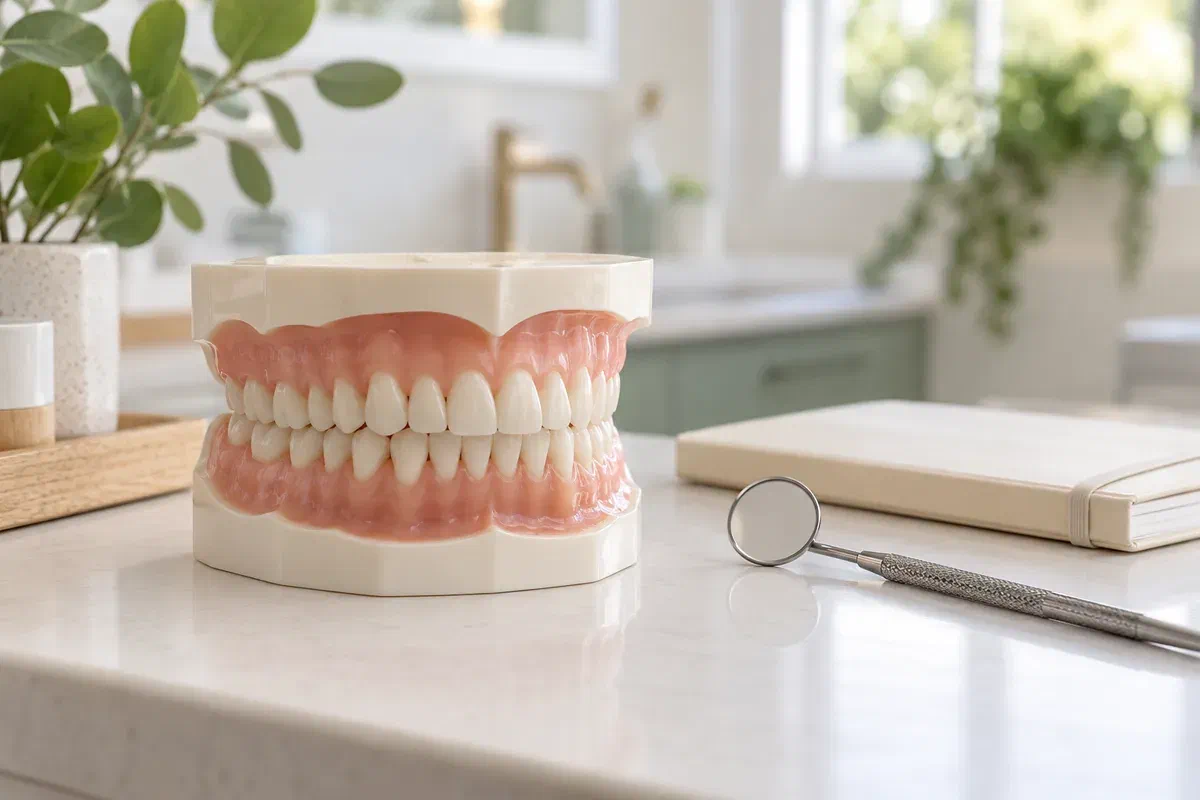
Illustrative supported dental teaching cast beside a mirror and closed notebook
Before we examine anything

Tell us what is old, what is new, and what worries you.

Separating the long-standing parts of your jaw history from the recent ones is one of the most helpful things you can do. A diagnosis is not your job, and you will not need to keep reproducing a painful motion.

Where the discomfort sits and when it appears

Point to the area and describe whether it shows up during meals, on waking, after a long conversation or without a clear trigger. Mention any tooth that feels sore or ache elsewhere in the face. This keeps other explanations in view, so not every pain near the ear gets put down to the joint.

A jaw that catches, stiffens or meets differently

Note whether opening feels blocked, closing feels uneven or your teeth seem to come together in a new way, and whether this followed a fall or blow. Don't try to force the movement for us. If the jaw suddenly will not open or close properly, phone straight away instead of waiting for a regular booking.

How long the noise has been there

A click you have heard for twenty years and one that arrived last month raise different questions. Tell us whether the sound hurts or comes with locking. On its own, a noise does not mean treatment is needed, and a louder one is not necessarily a worse one.

Call without delay after a recent injury, or if you have notable swelling, a fever or sudden trouble moving the jaw. Serious associated symptoms or being unable to eat or drink need urgent medical attention rather than a routine jaw visit.

Why a baseline helps

Today's findings give future visits something to compare against.

Part of the value of an assessment is sorting out what seems tooth-related, what points to muscles or the joint, and what may need another provider. You should hear the reasoning in plain language. In some cases watching and simple measures are enough; in others, more information is needed before anyone recommends something specific.

Just as useful is the record it creates. When your current pattern and limitations are written down, a review months later can show whether things are settling or shifting. One appointment should not hand you a lifelong label. It should give you a plan you can follow and a sensible point to look again.

Patient information: NIDCR — history, examination, and diagnostic considerations for TMD

What the problem is getting in the way of

Tell us which ordinary tasks have become uncomfortable and which you most want back. Trouble finishing a crusty sandwich or sitting through a long dental appointment says a great deal. Your priorities help set the direction of the questions and any care that comes later.

Examination that follows your history

Movement, both joints, the chewing muscles, teeth and neighbouring areas may be checked, depending on what you describe. Tell the clinician when pressure or movement brings on your usual ache and when it feels unfamiliar. You can ask to pause, and the exam can be adjusted as needed.

A clear reason for any test, review or referral

When further imaging or an outside opinion is mentioned, ask what question it would answer and whether the result could change the plan. Different concerns call for different investigations. If monitoring is the choice, find out what to watch for and what should prompt an earlier visit.

The appointment, step by step

From the history to an agreed next move

Mention ahead of time if your opening is limited or a longer visit would be difficult. Earlier imaging reports are welcome, though a new symptom deserves attention now, even if older records are still in a drawer somewhere.

  1. Go over your jaw history, recent and long-standing

    We ask when each symptom began, what has changed, any injuries, previous dental work, your medical background and any appliances or exercises you have used. Note what has helped and what has not. If things vary from week to week, describe the usual pattern rather than only how today feels.

  2. Observe movement and check related areas

    Guided by your history, the clinician looks at how your jaw opens and moves and checks the joints, muscles and teeth as relevant. You may be asked about tenderness or whether a motion feels familiar. Say if anything is uncomfortable; pushing past that point is not needed.

  3. Discuss the findings honestly, including the gaps

    Ask what stands out, which other causes were considered, and whether a working diagnosis is reasonable yet. Some questions can only be answered with more information. A normal-looking result does not dismiss your symptoms or end the discussion.

  4. Decide what happens next and when to recheck

    Options include monitoring, conservative advice, a further test or a referral. Ask who will arrange each part and how results will reach you. Agree on which new symptoms mean you should call sooner, so you are not left waiting without a plan.

In the weeks that follow

Keep the plan simple and speak up about real changes.

You may leave with suggestions to try, a review booked or a recommendation to see someone else. If you are unsure which step is next, which is optional or who is arranging it, ask us to spell it out.

Use the advice that was meant for you

Apply any comfort measures or changes to activity within the limits you agreed on. Steer clear of vigorous jaw exercises or self-repositioning techniques found online. If something you try makes the jaw feel worse, stop and ask the provider what to do instead.

Keep a light record instead of constant checking

A few notes on eating, opening and general comfort, plus anything new, are enough. Try not to keep clicking the jaw or measuring your opening to see how it is doing. A short practical summary tends to be more helpful at review than daily self-tests.

See any referral or review through

Find out how imaging or another appointment will be booked and who will explain the results. Tell us if scheduling or getting to an appointment is difficult. A referral should come with a clear next action, not leave you guessing whether the issue has been dealt with.

What the findings may point to

Monitor, manage, or look further?

An assessment is not a commitment to treatment. Ask why a given approach suits you and what would make it worth changing when you are reviewed.

When active treatment is not needed

Explanation with periodic review

A long-standing painless click or a stable finding may be explained and recorded without any appliance or procedure. Ask what change would matter and whether a recheck is useful. Monitoring is a planned decision, not a reason to overlook new pain or reduced movement.

When the findings support easing symptoms first

Practical conservative care

You may be given everyday measures to try, along with a review of how they affect eating and comfort. Ask what to do and when to come back. The plan should be clear enough to follow and open to revision if symptoms carry on or the first explanation no longer fits.

When more information would change the decision

Targeted imaging or an outside opinion

Each investigation answers a particular question, and a medical or specialist referral can be more useful than further dental work. Ask what a result would change and how it will be explained. An image is interpreted together with your symptoms and examination, not as a verdict on its own.

Old Milton jaw questions

Answers for people who have lived with a jaw sound for years

You are free to ask about what testing can and cannot show, and why a particular step is suggested, before you agree to any treatment.

(905) 876-4488
My jaw has clicked since my teens. Why would I get it checked now?
A painless click that has stayed the same may simply be noted. An assessment becomes more useful when something changes, such as new pain, catching or reduced opening. Describe the history so the clinician can compare the old pattern with the new one.
Can getting older change how my jaw joints feel?
Jaw symptoms can change over time for many reasons, and age alone does not explain them. Mention other joint conditions, new medications and dental changes such as missing teeth or new dentures, so the clinician can consider them alongside the examination.
Do dentures or missing back teeth matter in a jaw assessment?
They can be relevant to how you chew and how the teeth or dentures meet. Bring dentures you wear and say how they feel. The clinician can consider these factors without assuming they are the whole explanation for your symptoms.
Should I bring a night guard I stopped wearing years ago?
Yes, if you still have it. Explain why you stopped, whether it helped and any trouble it caused. The clinician can look at it with your current findings, without assuming the old recommendation should simply be picked up again.
Is an ache in front of my ear always the jaw joint?
Not always. Several sources can produce pain in that area. Tell the clinician about hearing changes, ear fullness or other symptoms, because some of these need medical evaluation in addition to a dental review.
If I'm referred elsewhere, does that mean something serious was found?
Not necessarily. A referral often means another provider is better placed to answer a particular question. Ask what the referral is meant to clarify and how the findings will be shared with you, so you understand why the step is being suggested.
Near Old Milton

Book a time to talk through what has changed.

Contact Milton Dental Clinic about a jaw that has started to hurt, catch or feel different, or about advice you received in the past. Tell us when you call if the jaw has suddenly stiffened or you have had a recent injury, so the urgency can be weighed.

Next steps can include monitoring, conservative advice, further investigation or a referral.

Visit Milton Dental Clinic
Unit 1, 342 Bronte St. S, Milton, ON L9T 5B7
Get directions Clinic hours
Monday–Thursday
11am–7pm
Friday–Sunday
By appointment only

Areas we serve

  • Milton
  • Oakville
  • Mississauga
  • Georgetown
  • Halton Hills
  • Acton
  • Campbellville
  • Brampton
  • Burlington
  • Puslinch
  • Rockwood
  • Erin
  • Caledon
  • Etobicoke
  • Old Milton
  • Bronte Meadows
  • Timberlea
  • Dorset Park
  • Dempsey
  • Clarke
  • Beaty
  • Coates
  • Harrison
  • Scott
  • Willmott
  • Ford
  • Bowes
  • Cobden
  • Walker
  • Mountain View
  • Milton Heights
  • Hawthorne Village
  • Valley View
  • Fallingbrook
  • Nassagaweya
  • Trafalgar
  • Esquesing
  • Nelson
  • Brookville
  • Moffat
  • Glen Williams
  • Norval
  • Limehouse
  • Stewarttown
  • Ashgrove
  • Hornby
  • Silver Creek
  • Speyside
  • Scotch Block
  • North Oakville
  • River Oaks
  • Glen Abbey
  • West Oak Trails
  • Palermo
  • Bronte Creek
  • College Park
  • Joshua Creek
  • Uptown Core
  • Preserve
  • Iroquois Ridge
  • Lisgar
  • Meadowvale
  • Meadowvale Village
  • Churchill Meadows
  • Erin Mills
  • Central Erin Mills
  • Streetsville
  • East Credit
  • Creditview
  • Heartland
  • Sheridan
  • Mount Pleasant
  • Credit Valley
  • Huttonville
  • Churchville
  • Springbrook
  • Northwest Brampton
  • Bram West
  • Fletcher's Meadow
  • Fletcher's Creek South
  • Alton Village
  • Orchard
  • Millcroft
  • Headon Forest
  • Tansley
  • Brant Hills
  • Tyandaga
  • Kilbride
  • Lowville
  • Aberfoyle
  • Morriston
  • Arkell
  • Hillsburgh
  • Freelton
  • Carlisle
  • Waterdown
  • Flamborough
  • Mountsberg

How can we help?

Milton Dental Clinic

Have a question about your smile? Choose the option that works best for you.

For urgent dental concerns, please call.
Messages are reviewed during clinic hours.